Category Archives: Uncategorized

Bailey Edwards Nelson: Catching a Glimpse

Like so many others, I watched last night as the stars of Hollywood paraded down a red carpet to be honored at the Academy Awards. Great praise–and critique–was given to every garment and piece of jewelry chosen for the special occasion. Men and women preened and pranced like peacocks, displaying their beautiful feathers for the world to see. I, of course, offered my own expert opinions on their appearance and demeanor from the safety of my couch.

Once inside, the show spent over three hours celebrating the work of these outstanding individuals, golden statues serving as the mark of excellence. My interest peaked as I listened to acceptance speeches that honored mothers and thanked spouses, listing coworkers and mentors in an attempt to sum up a lifetime of gratitude.

In the midst of all this glitz and glamour I periodically checked in on the Facebook buzz. Among the fashion critique and polls on who would win which award, something caught my eye. It was a picture put out by a popular Christian publishing house calling for the return of God to the Oscars. It claimed that God had only been publicly thanked in acceptance speeches a handful of times over the last ten years, which in the opinion of this group, needed to be rectified. It then prophesied an increase in “faith-based films” as a solution which they would be pursuing.

After seeing this post I began to pay more attention to the acceptance speeches that followed and noted that three of the actors in the last few hours of the show did, indeed, thank God. They publicly called on the name of the Almighty in gratitude for their talent and the opportunities they had been given. I assume this pleased the individuals who published the well-circulated meme, but who knows. Either way, their faith was made public.

As we approach Ash Wednesday we read the words of Matthew 6, “Beware practicing your piety before others in order to be seen by them.” Hmmm…

It seems that making your faith public is risky business. Jesus warns against loudly and proudly giving alms and praying so that everyone will sit up and take notice. Rather than flaunting your rumbling stomach as a righteous sacrifice, slap your cheeks and perk up when you fast. Why? Because it doesn’t matter what everyone else sees, hears or thinks. There should be no YouTube replays of your prayers or Joan Rivers there to give her “Fasting Police” report. All the Facebook shares and reTweets may leave you feeling like that treasure chest is overflowing, but is that where your heart belongs?

As I sorted through the day-after social media ranting of last night’s broadcast, I came across another interesting Facebook proclamation. “I relish the chance to publicly wear my faith.” (Referencing the imposition of ashes) The writer went on to say that she planned to receive her ashes early in the morning so that she might wear them throughout her day to work, restaurants, the gym etc. I gathered, based on the lengthy comment section, that she believed that by publicly wearing a sign of her faith she would cause others to be reminded of their own faith, to draw nonbelievers to the faith, or at least bring discomfort to those who opposed her faith. It was her marketing strategy, in a sense, and she looked forward to seeing its fruits.

In my experience, there are always a good number of parishioners who would rather die than go out in public with a black cross smudged on their forehead. Baby wipes are freely passed around post-service and that mark of faith is gone before they hit the parking lot. Others may choose to let the ashes remain, but become uncomfortable when they enter the drug store and cashier offers a curious glance, or even God forbid, a question about their “new look”. All that to say, her anxious excitement over the upcoming opportunity to wear these ashes as a badge of honor and piety got me thinking.

ash_wednesday

We may not have our Ash Wednesday planned out in terms of how many hot spots we can hit with our newly branded selves, but are we innocent of viewing this yearly ritual as just another step in the dance of piety? If having ashes placed on our foreheads is about “wearing our faith,” about “making God public,” then the question remains, who are we wearing them for?

If you are like me, then you have moments in your day when you catch a glimpse of yourself in the mirror and are genuinely surprised, even jolted, by what you see. You didn’t realize your hair looked like Alfalfa or that you had been walking around all day with leftovers from lunch on your shirt. Unless you live in front of the mirror, you can forget from time to time the sight of your own self.

When I catch that glimpse of myself after Wednesday’s service and I see the smudge of black and perhaps even the drip of oil down my nose I see something more than faith or piety or ritual: I see me. I see the mark of my humanity, of a fragile and fleeting life haunted by hurt, prejudice, hatred and sin. I see death, my death. I see the end of everything that I thought mattered most and the desperate longing for something more. It is not pride that wells up in me, but humility. From dust I was born and to dust I shall return. God, help me.

So, who are we wearing these ashes for?

If that cashier at the drugstore asked about our marked up foreheads, I doubt many of us would have the courage to speak to the fragility of our own lives–to admit that what we are wearing is not our faith, but our humanity. In a world that often demands perfection, and promotes a version of Christianity that demands the same, Ash Wednesday gives us the opportunity to wear our imperfections and root around in the soot of our sin.

The gift of Ash Wednesday is the glimpse we catch of ourselves in the mirror of honesty and it calls us to change what we see. Not what the world sees, but what we see. For what we see is exactly what God sees, the nakedness of someone in need of redemption.

Bailey Headshot

Rev. Bailey Edwards Nelson has served on the pastoral staff of congregations throughout the southeast, most recently as Senior Pastor of a congregation in North Carolina. She is a graduate of McAfee School of Theology and Furman University. Bailey holds a deep love for preaching and the creative arts.

Kerrie Clayton Jordan: Once Upon a Time: The Tale of a Not-So-Wicked Stepmom

Once upon a time, I dreamed of living happily ever after with Prince Charming in a castle filled with love and romance. As I fantasized about finding Mr. Right during my 20-something years, I still managed to maintain a spirit of adventure–focusing on my career as a woman in ministry, going back to school for my Master of Divinity, traveling the world on mission and educational trips, and waiting (sometimes patiently, sometimes not so patiently) for a husband that would partner with me in ministry.

Single life was pretty good most of the time. There was no one or nothing to hold me back from pursuing my dreams. My future fairy tale may or may not have included children—it was something I could’ve lived with or without. I wasn’t really sure being a mom was for me, but if Prince Charming wanted children, his wish was my command.

In early 2010, I was swept off my feet by a man named David, a single father of two children: 12 year old Walker and 4 year old Hope. As soon as I met David, I knew he was the man I would marry, and his handsome character and desire to serve God enchanted me from the beginning. All good fairy tales must have some kind of conflict, and mine was within. I really wasn’t sure that I wanted children anyway; what would it be like to raise someone else’s? What would it be like to shuffle them back and forth from mom’s house to dad’s house? Would they like me? Would they love me? Would they hate me? (You know stepmothers always get a bad rap in the fairy tales!) What would it be like to have an instant family?

If the questions in my mind weren’t already enough, they began to get more complicated as time went by. During our year of courtship, a custody battle for the children reared its ugly head as their mom’s downward spiral continued. Run-ins with social services, drugs, mental illness, incarcerations, relationships with men of criminally-recurrent behavior . . . then her phone calls and supervised visits became less and less.

About three months before I married their dad, Hope and Walker lost all contact with their mom and David received primary custody of both children, much to our relief. Not only was I going to deal with being a stepmom, but I was going to have to learn to be the “real” mom to these two kids. They felt rejected and abandoned by the very woman who gave them life. Would I be up for the challenge? Should I be up for the challenge? Did I even stand a chance of making a difference in their lives? After all, in the usual fairy tales the stepmother was always villainous and wicked.

And villainous and wicked I am at times. Why? Because I insist on home cooked family meals around the dinner table without the television being on. Because I help their dad enforce a regular bed time. Because I allow no video games or play time until all homework was finished. The setting of all these boundaries that children need to understand that they are loved and encouraged occasionally transforms me into the evil stepmother. I have been resented for having high expectations and standards in place that had never been before. I have been tested to see if my loyalty would remain or if I would just walk away when things got difficult. Sometimes, I am even intentionally pushed away for fear of getting TOO close, because they knew that if they didn’t love me too much, then it wouldn’t hurt as bad if I left.

One major challenge of being a stepmom is the search for identity. Professionally, I am identified as a minister. Personally, I am not completely mother, but I am not completely childless either. I am expected to act as a mother, but I have never known what it is like to have a child of my own. I never got to experience all the “firsts” of the children I love: their first word, first step, or their first Christmas; and I wasn’t the first woman to have a child with the man I love. It is tempting to be bitter because I didn’t get to experience the full joy of motherhood—bitter toward my husband, my children, and God—and some days I do give in to the grief of knowing I’m not really their mother. How does one even begin to come to terms with the ambiguity of being a mothering-stepmother, or to comprehend the identity of being a childless-mother-minister? . . .

Having searched for an example of a stepparent in the scriptures, the best I can come up with is Joseph, the earthly father of Jesus. He was essentially asked to be a stepparent, but we really don’t know much about his early years as a father. What was his attachment to Jesus like? I am sure he had feelings of inadequacy, just like any first-time parent would, but was there ever a “wall” there to be a constant reminder that Joseph wasn’t a biological father to Jesus?

When Jesus was “lost” in the temple in Jerusalem, being about his Father’s business in his Father’s house, how did that make Joseph feel? Wasn’t he the father, too? And the father who was worried sick about the whereabouts of his son while he searched for three long days, no less! What was he–chopped liver? Joseph had sacrificed his reputation and better judgment to do what God asked of him, only to be treated as less-of-a-father by Jesus.

I imagine the conversation after the temporary temple crisis could’ve gone one of two ways: “Mary, you’d better handle your son! Who does he think he is, saying he was in his father’s house? Nonsense! Does he have no respect for me? I am the one who feeds and clothes him, and look what he does to remind me that I am not his real father. ”

In the midst of his frustration, did Joseph resent God for making him a parent with no real authority over God’s son? Or perhaps at this moment he truly understood the responsibility that was his: to nurture this God-given child who wasn’t his own, to provide for his earthly needs, to accept the calling God gave to him in a dream; and instead he would’ve said, “We were foolish to worry, of course God would take care of his own son!” (It would be at moments like these I must admit, I would’ve been the evil stepmother that would’ve punished the child for being disrespectful and disobedient, without even thinking what message God would have for me.)

How did Joseph come to terms with being the parent of another’s child? We don’t read much about Jesus’ early years or of Joseph’s parenting years in the scriptures. In the moments of frustration, when he didn’t understand what God was doing, did he cry out and wonder what in the world he had gotten himself into? Did he wonder if God had made a mistake by choosing him to care for Jesus’ earthly needs? Did he even secretly wonder if he should’ve gone ahead and divorced Mary quietly so that his life would have been free of those complications? There are definitely more questions than answers when it comes to Joseph’s stepparenting, so we are left to speculation.

I’m actually a little jealous of him, because Joseph had it fairly easy for a stepparent. After all, he was parenting the sinless Son of God so how hard could it be? And he also got to raise Jesus from the time he was a newborn baby—an innocent, spotless Lamb of God. What about those of us who get a broken hearted, smart-mouthed, angry teenager for a stepchild? At least Joseph had some time to learn patience and to grow in love while he parented the perfect One. I never had that luxury, because I jumped headfirst into a situation so different from what I had ever known and had to learn to be a wife, mother to a teenager, and mother to a preschooler all at the same time.

As a stepparent, it’s important to remember what Joseph likely had to learn: “This is God’s child.” We are but instruments of God’s love and care to God’s child, and God has entrusted us with great responsibility. Not only are we parents asked to nurture and care for the physical and mental needs of the child, but we are more importantly asked to care for their spiritual and emotional needs.

In my situation and so many others, the stepparent is asked to be a healing balm to a troubled child’s heart. Divorce, death, or absence—in every situation that creates the opportunity for a stepparent—a child is left grieving what they’ve lost or what they’ve never known, and a godly stepparent could be the one that steps in and ministers to a hurting, broken family. The other three people who live in my home have been broken and bruised, abandoned and rejected; yet I am called to be the presence of Christ to them through mothering and homemaking.

I am a stepmom. A broken, sinful, clueless, wannabe mother. Yet I am called to point my children on the road from brokenness to wholeness, to trade in ashes of despair for a crown of beauty . . . God can use a stepmother (even if she’s a fairytale-like evil one at times) to intend it all for good.

The above was adapted from Kerrie Clayton Jordan’s essay “Once Upon a Time: The Tale of a Not-So-Wicked Stepmother,” in A Divine Duet: Ministry and Motherhood. (Macon, GA: Smyth & Helwys Publishers, Inc., 2013), available from http://www.helwys.com.

family

Kerrie Clayton Jordan, originally from Belhaven, NC, is a graduate of East Carolina University and Campbell University Divinity School. She served First Baptist Church in Smithfield, NC, as their Minister of Music and Senior Adults. Her journey as a not-so-wicked stepmother includes her husband David, teenage son, Walker and an imaginative daughter, Hope. Together, they enjoy outdoor activities, movies and all things musical.

The Very Worst Sports Mom

Image http://www.freedigitalphotos.com/gualberto107 
I didn’t grow up playing sports. In the 1970’s and 80’s, suburban Atlanta was not a hot spot for girls’ sports. A few friends played soccer or softball, but most of us took dance, gymnastics or piano lessons. Rec leagues were mostly for boys.

My father, who played basketball and football in high school, took my two older sisters and me out in the backyard to teach us the rudiments of softball. Patiently, he schooled us on how to swing level, shag pop flies and attack those pesky grounders. Notably, he also had to deal with tears from fat lips (from said pesky grounders), twirling in the outfield and occasional hair pulling between catcher and batter.

I loved those backyard games with Dad pitching perfectly hittable balls in the long summer twilight. Thanks to TBS and cheap nosebleed tickets, we watched Braves baseball growing up and could name every player back when Bruce Benedict was catching. I stayed focused on baseball as the Braves (finally) won several pennants—and even the World Series in the early 1990’s. That was plenty of sports for me.

Then I moved to North Carolina to go to Duke Divinity School, where basketball is king. Strangers asked me intently, “Who do you pull for?,” meaning UNC, NC State or Duke, the big rivalries in the ACC. I took to shrugging and replying, “I’m an SEC girl,” which brought looks of pity and disappointment.

Then, I started dating an NC native who played basketball at a small liberal arts college. I shocked him into silence on our first date when he proudly showed me the “Dean Dome” on UNC’s campus and I asked who Dean Smith was (a hugely famous UNC basketball coach). He got over the shock during the next year and a half and asked me to marry him. I confessed that I would never love basketball. I married him anyway.

Fast forward seventeen years and three little boys later: our garage is filled with sports equipment, ESPN is the go-to channel and evenings/weekends are filled with church, practices and games. I quit loving baseball so much after three years and two boys’ fall AND spring seasons. I have learned to walk around the field at soccer to make the games more pleasant for me and so I won’t catch the “negatives Nellies” from the parent who can’t stop criticizing his son, the referees, the weather, the league . . .

I’d like to report that after years and years of basketball, I have grown to love the game. Not so much. In the close quarters of a hot gym, I find the intensity of the game (and the parents) a bit too much. The fouls confuse me, some of the tactics alarm me and the speed leaves me asking quite often, “What just happened?”

Image


I am trying to learn to speak basketball, as I tell our boys, but it’s not my first (or second or third) language. I’ll be team mom, encourager from the stands, snack-organizer and end of season party-thrower. I have a nice loud preacher voice with a “wooo-hooo!” that can carry a long way. A true extrovert, I’ll clap and cheer and congratulate. But that’s about all I have to give.

I just don’t love sports. It’s not my main metaphor for life. I didn’t grow up in that arena of competition, with the team bonding and  sheer physicality sports demand. My husband and our sons have a wisdom rooted in that early training that is simply not part of my life. The thrill of the contest is not something that compels me. But the contest sometimes ambushes me.

As can happen in any contest, the competitiveness at my sons’ games—especially as they have grown older–sometimes seems to blur into tribalism, that us vs. them duality that can start small and end big. Painfully, I sometimes find myself getting caught up in the fervor—especially when the opposing team has been coached to just skirt the edges of the rules and good sportsmanship—and I become just as overinvested internally as some others do externally. And I deplore that feeling in myself.

In those games and their aftermath, I have to remind myself what our goal is for our boys’ sports involvement. We want them to have fun, learn the game and be shaped by working with their teammates, coaches and the referees. We want them to learn about life through sports, not that sports are life.

Tellingly, this past Saturday, after a particularly intense loss, I found myself feeling like a stranger in a strange land. I walked out of the gym in deep reflective mode. All those emotions, all that intensity, all that time and energy and effort—for a contest between middle school age children?

That evening, I watched a documentary on hunger in America called “A Place at the Table” in preparation for a writing project. My mother-and-minister’s heart ached. One anti-hunger advocate noted that in America, we have the ability and the food to make sure no one goes hungry, but we do not have the will.

I can’t help but wonder what might happen if some of the energy, time and effort we spend on kids’ sports could be harnessed for something that really makes a difference in the world. Maybe we don’t have much will leftover when we are spending so much of it on the sidelines of our children’s activities. Maybe we’re paying too much attention to what is ultimately inconsequential.

I’ll never be a great sports mom. My heart, my will, my interests lie elsewhere. But as long as my little guys are playing, I want to be  be whatever support to them I can be, which, for me, includes reminding them in word and deed what’s really important.  


Image


A native of Atlanta, GA, Reverend Alicia Davis Porterfield is a writer, teacher and certified Life Coach. She is a graduate of the University of Georgia and earned a Master of Divinity and a Master of Theology from Duke University Divinity School. After two years of chaplaincy training at Rex Healthcare in Raleigh, NC, Alicia served as chaplain at Quail Haven Retirement Village in Pinehurst, NC before her family moved to Wilmington, NC. Her husband Eric is senior pastor at Winter Park Baptist Church and together they stay busy learning and growing with their three sons: Davis (12), Luke (10) and Thomas (8). A frequent retreat leader and guest preacher, Alicia loves delving into scripture and learning with others on the journey. 

Nikki Finkelstein-Blair: Where We Are Now

You can spot us a mile away. My husband sports the requisite hairstyle, and in a military town like San Antonio, it’s a dead giveaway; so the people around us–church folks, neighbors, school friends–know we’re a military family. And one of the ways to make small talk with a military family is to ask them how long they’ll be here. It’s a pretty sure bet that either they’ve recently arrived, or they’re getting ready to leave. These are our two stages of life: “Where did you come from?” and “Where are you going next?”

After two years and nine months in San Antonio, we are now entrenched in the latter stage. We have our marching orders, so to speak. We know where, and when, we will be going next, and it is The Topic of conversation for whoever ends up sitting near us in the pews and at the potlucks.

And if talking about it near-constantly isn’t enough, we also have a chronic case of Senioritis. Graduation Day is right around the corner, and we really just want to coast from here on out; show up to class in pj pants and fuzzy slippers, phone it in on our final assignments, score our last few passing grades, sit through the obligatory reading of “Oh, the Places You’ll Go,” and throw our caps in the air. We are ready for the Next Thing.

The trouble is, we have a sense of winding down—but the people around us are just getting started! Back in Senior Year, we were in good company; our friends and teachers were all awaiting the commencement of a different life, or at least a peaceful summer. We were all feeling a little bit antsy and (truth be known) a little bit lazy. But now, when we are drawing back and slowing down, we’re on our own. All around us people are getting ready for the high seasons of spring and summer; in church, especially, the calendar is filling with exciting new ministries, preparations for Lent, and anticipation of summer music camps and VBS and mission trips.

I have never claimed to be good at Being Here and Being Now. But it is most challenging during this stage of our family’s life, which we revisit every three years. We are already invested–Here, and Now. We have fingers in the pies of ministries and friendships, we have been involved on planning teams and committees, we have pitched ideas and promised help. We are, ourselves, still learning and growing and feeling calls, and yet everything we do is tinged with the reality that our Here-ness and Now-ness are short-lived. Just in the past week I have received training for a new ministry, and I even made a new friend! And I have to find ways to silence my instinctive “Why bother?,” remembering that being here and now still matters. I have to remember that the next few, short, months are still real life and in them I may still be changed.

That’s life, though, and not just the military kind.

I can’t help but think of the disciples standing up on the hill, staring up into the clouds after Jesus in Acts 1:11. I imagine them waiting, expecting the Next Thing to begin, needing a gentle reminder that perhaps looking up into the sky isn’t the most helpful way to go about the life of faith.

We can only be where we are now. (I will be repeating this to myself constantly in the coming weeks and months.) We can’t follow Jesus up to the heavens, and we can’t just call Senior Skip Days. We can’t stand around waiting for real life to begin, and we can’t put all our energies into the future’s to-doing. We have to be here, to keep dispensing time and effort and love into people (even knowing it will make the goodbyes harder) and into work (even knowing we will not see its fruition firsthand). I have to do it to show my children, and to prove it to myself again and again, that this is God’s call to us: this place, this time. For now.

Image

Nicole Finkelstein-Blair became a U.S. Navy spouse in 2000, graduated from Central Baptist Theological Seminary and was ordained in 2001, and became “Mom!” in 2004. She finds ministry wherever the military and motherhood lead: in four states and two countries (so far), as a parishioner and a pulpit-supplier, as a sometime blogger and devotional writer, and at countless dinner tables and bedtimes. She’s enjoying now… and looking forward to what’s next.

Jenny Call: Why I Left the Church…and Why I Returned

IMG_0855

It seems that for every happy, churchgoing Christian, there is another who has a painful story of how they’ve been wounded by the church. As a college chaplain, I encounter more reasons for why my students don’t go to church than reasons why they do. Of the 58% of our students who self-profess the Christian faith, only a small percentage go to church regularly. This seems to mirror a growing trend as many articles and studies point out, and it’s not just among young people. I received a message from someone who had left the church and found life to be surprisingly comfortable without the Sunday commitment. She asked me, “Why do we need to go to church when it seems that churches only hurt people?”

I found myself an unlikely advocate for the church. I’ve have my share of scars from churches behaving badly. My beloved home church that I grew up in does not support women in ministry, and instead of celebrating my call to ministry, denied it. My first church internship was in a “purpose-driven” church that seemed to be more about stage lights, catchy music, and attendance numbers than authentic faith (although, to be fair, I met wonderful people there that are still part of my life, and the church has grown to create some wonderful outreach ministries for the community). I watched my fiancé (now husband) get battered by one church, then another, and the bitterness still rises whenever I see those self-righteous committee members that declared him unworthy, while the staff stood by silently, continuing to pat themselves on the back and rake in their big paychecks. After 5 years of being in a much better place in terms of our careers, finances, family, and church, I still struggle with anger over how we were treated, and how common our painful experience really is.

It took a lot of searching and a lot of healing (still in progress, obviously) to find a safe place for us to return to church, and that was only with the understanding that we would just be pew-sitters for a while. The community of faith that we found was not what we expected. From the surface, they looked like a dying congregation, their numbers decimated and aging in a large and mostly empty sanctuary that reflected better days. There were few programs, and no Sunday School class for us; our kids and the pastor’s children were almost the entirety of the children’s department. It did not look promising, but, oh, how they reached out to welcome us. Against our initial impressions, we felt like we had found a home. We knew things weren’t perfect, but we were able to let our guard down. As the first year wound down, we felt ready to get involved again. When the cracks began to show, we were already committed. Our kids had been dedicated, one had been baptized, and we had made friends as more young families began to join. Our pastor was a wonderful preacher, a compassionate leader, and a friend and mentor to me. We spoke up in strained business meetings, we stepped up to fill leadership roles, and we prayed that the ugliness of the past would not repeat itself. At least this time, we weren’t in paid staff positions.

But now, the brokenness is undeniable, and I wonder if it’s irreparable. We are saying goodbye to our beloved pastor who is resigning after doing her best to hold things together for the past 18 years. There is grief with all its stages: sadness, denial, anger, bargaining…I want to run away one minute and fight the next. So the question, posed the day before the straw that broke the camel’s back, becomes even more relevant and personal: “Why do we need to go to church when it seems that church only hurts people?”

My answer would be a little more hesitant and uncertain than it was just a few days ago, but deep in my heart I believe in the power of a church community . . .

Please continue reading at http://hopecalls.blogspot.com/2014/01/why-i-left-churchand-why-i-returned.html

SONY DSC

Rev. Jenny Frazier Call is an ordained Baptist minister serving as university chaplain at Hollins University in Roanoke, Virginia. A graduate of the College of William and Mary and the Baptist Theological Seminary at Richmond, she learns the most from her precocious children, Brady (7) and Maryn (5). She couldn’t juggle it all without the loving support of her husband, John

Bailey Edwards Nelson: Identity Crisis

 I can own the fact that I am one of those “I am what I do” kinds of people. Unhealthy? Perhaps. Many have tried to make that argument, particularly while sitting in CPE group sessions. Still, that’s me. It’s hard for a first-born, over-achiever, OCD, Type A personality not to get completely caught up in what you are able to “do”. Every day is a new opportunity to produce or create. It’s another chance to be reminded of your purpose and to achieve something great- or die trying.

I have had many titles- pastor, minister, chaplain, resident (just to name a few). Different periods of my life brought with them different titles and job descriptions. Honestly, it never really mattered what they were, as long as there was something. As long as I was able to call myself something, have somewhere to be and something to do, I was alright. You see, all of these things may read as nothing more than a great professional resume to some people. For me, they read as a resume for my life.

Eleven months ago I lost my job. Eleven months ago I lost my title. Eleven months ago I lost my identity. These days I wake with no sermons to write, no meetings to attend, no lessons to prepare, no parishioners to visit, and no emails or calls to return. I wake up with no requirement of showering and putting on one of those “business casual” outfits that have overtaken my closet. I wake up with no clue when all of this will change, when it will all go back to the way it used to be, or that it ever will.

Seven months ago, I took my (then) three year old son out of school. It’s hard to financially justify daycare when a parent isn’t working anymore. And with that, came a new title, “stay-at-home mom.” Shudder.

I love my son. I love his humor, intelligence, creativity, wild spirit, and even his over-talkative, OCD quirks. He is a lot like me- poor kid. Was it part of my plan to stay at home with him? No. Was it part of my plan to ever be called “stay-at-home mom”? No. And yet, here I am. This job is ten times harder than most would imagine (unless you’ve done it, in which case you know exactly how hard it is). I thought demands were high in the office: semi-sane parishioners calling every second while trying to be everything to everyone at every moment of every day. Forget that! At least those people didn’t follow me into the bathroom!

Now I am in demand ALL THE TIME. I am talked to incessantly and asked to play ridiculous games over and over again. I’m questioned about every smell and sound that enters our house and I’m screamed at when meals do not arrive on time and in proper condition. I’m hugged and kissed and punched and kicked.

I am mom and I am never alone. For an extreme extrovert, like me, that can be a very wonderful thing–unless you’ve lost your identity. Non-stop attention is tough when you don’t know who you are anymore.

You see, I am a good mom. I work hard to make sure that my son feels loved, accepted and supported. We play those silly games and we laugh at the bodily functions that boys love best. I turn food into kid-friendly works of art and I wrestle until my body is black and blue. I read and sing and put on dinosaur puppet shows. I correct and redirect when he goes too far. I listen to screams from the time-out chair one room over. I forgive and hug and move on. I fix boo-boos and fret over head injuries (of which there are many). I do it for hours until even the moon is weary in the sky. And then I get up and do it all again.

When it comes to this job, I am far from the over-achieving picture of perceived perfection that can be seen in the workplace. Rarely do I get it right and I often go to bed feeling like a complete and utter failure. The moments that I lost my temper or used the television to get just a moments peace or went with that sugary snack because I was tired of listening to him beg…well, they happen on almost a daily basis.

But do you want to know a deeper, darker secret? This is the best I can do right now. These mistake-riddled, temper-losing sugar-pushing days are often the only thing I can muster when I wake up and roll out of the bed in the mornings. Why? I don’t know who I am anymore.

OK, yes, I can hear fellow mothers screaming, “But you have an identity! You’re a mom! There is no shame in that!” I agree. I am a mom and that is a title I would never want to lose. Heck, that’s a job description I would never want to lose.

But…dare I say…sometimes being “Mom” just isn’t enough. There are days when I want to curl up in the corner and cry (sometimes I do). There are mornings when the sound of my son’s voice screaming me to rise to duty makes me want to bash my head against the wall. There are nights when I finally sit in silence and wish I were somewhere else entirely.

Depression, anxiety, stress…most ministers are familiar. We scream about our schedules and the demands our congregations place on our time and sanity. Often, we scream the loudest about the lack of time with our families, especially our children. I know that ten hour days at church that left with me a whopping half hour to spend with my son were torture. Ironically, my biggest complaint used to be not having enough time at home with him. Now, I wait and watch for the moment I can go back to work, back to ministry.

Now, are you ready for another confession? My son can smell it. Yep, he can smell the fear, anxiety, stress, pain, grief and longing on me just as strongly as the perfume I put on every morning. He sees in my eyes a lackluster glow where fire used to be. He hears in my voice a quick snap or depressive tone where excitement and joy used to be. He notices my preference of sitting down and being quiet over my once music to the max, swinging from the chandelier approach to life.

But here is the kicker…my son has become my minister. I joked over four years ago now that he also became a “reverend” the night that I was ordained, since he was furiously kicking inside me throughout the service! He seems to be living into that prophecy. When he senses my pain, he offers compassion. Many a morning has he wiped a tear from my cheek saying, “Everything’s gonna be OK mommy!” He can tell when I start sorting through all those bills, to him just a bunch of envelopes and papers, and the stress and worry builds in my body until I snap at his requests for my attention. He moves to another room gifting me with the space he can sense that I need. And when I do return to him hating myself for what I didn’t do for him, he forgives. I get a big smile and, usually, an “I’m so glad you’re here, Mommy!” Or the days when my heart is so heavy with the grief of past hurts and losses and holds little hope for a future, there is my boy ready to heal me. He runs for his plastic doctor kit and begins a thorough check-up, promising to make me feel all better.

My son is my minister. My son is as Christ to me: loving, healing and forgiving when I need it most. My son holds my hand as I walk through this dark valley and I know that when we spot the mountaintop he will look at me and say, “There it is, Mommy! I told you we could do it!”


Bailey Headshot

Rev. Bailey Edwards Nelson has served on the pastoral staff of congregations throughout the southeast, most recently as Senior Pastor of congregation in North Carolina. She is a graduate of McAfee School of Theology and Furman University. Bailey holds a deep love for preaching and the creative arts.

Jenny Folmar: Other People’s Children

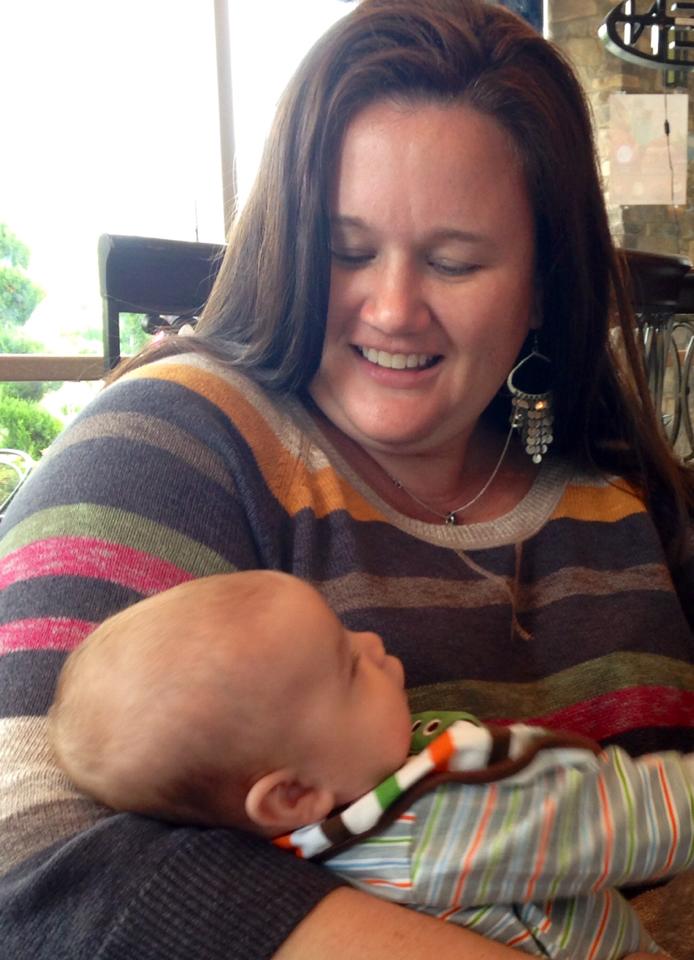
Other people’s children. I don’t remember when I started using this phrase, but I do know that it began as a joke. When looking lovingly on a baby, I will sigh and quietly say, “Wow. I sure love other people’s children.” It always gets a laugh. The implication is that I am a single, childless minister who loves the freedom to nurture children for an hour or two and then send them home with their parents who then do all of the hard work. The phrase became a tool. It succeeds in circumventing any questions about children of my own.

Folmar with Baby

With time, that funny little phrase grew sacred, but not until I began to embrace that part of my calling to ministry. I had to first grow comfortable with being a childless mother-figure in the Church. Accepting this part of ministry did not come naturally. I did not have a childhood that included joyful, thriving, childless women. If there were women without children, people spoke about them with a strong dose of sadness, as if they had a terminal disease. I needed to replace those fearful and sad images with new models that offered a bit of hope.

I stumbled upon Mary Salome when my spiritual director encouraged me to find a person of faith to use as an image of inspiration. Out of curiosity, I looked up the saint for my birthday: Mary Salome or simply Salome. Who? There was little more than a paragraph available for this person on the internet. Happily, I read that she was a different Salome than the woman who danced to have John the Baptist beheaded. She grabbed my attention when I learned that she walked with Jesus through his entire life.
In the Bible, Salome is listed twice in The Gospel of Mark among the women who witnessed Jesus’ death and who later encountered an angel at the empty tomb. Mark describes the relationship between Jesus and Mary Magdalene, Mary mother of James, and Salome, saying, “These used to follow him and provided for him when he was in Galilee; and there were many other women who had come up with him to Jerusalem.”

Early Christian writings, however, are full of her stories and conversations with Jesus. Some claim that Mary Salome was Jesus’ aunt. Others claim that she was Jesus’ sister or Mary’s midwife. In some traditions, she is married with children and in others she is childless.

Most scholars who study Mary Salome agree on the following: she was present at Jesus’ birth. She remained with Mary and Joseph as they raised Jesus. She followed Jesus through his ministry and witnessed both his crucifixion and resurrection.

Women of the early church were familiar with Salome. They had a model for what it looked like when a woman committed to caring for someone else’s child, who happened to be Jesus Christ. What a gift! Little girls long ago were told stories of their sister in Christ, Salome, who knew Jesus’ mother and became one of his disciples.

As I grow more familiar with Salome, I wish that there were t-shirts or blogs that celebrate her ministry. It would be great to have empowering slogans, like “Following Jesus like Salome,” or “Rockin’ Ministry Salome Style” to dissipate some of the extreme awkwardness for female ministers who walk into church doors without a child or a wedding ring.

But we have no bumper stickers or t-shirts. The reality is that Christian communities have a difficult time with childless women. We catch ourselves asking the unfair question that comes to mind when meeting a kind, smart, loving woman past a certain age. Why doesn’t she have children? The question itself can open wounds or add to the experience of feeling judged for lack of children.

Perhaps some women wanted children but were not able to conceive. Some might have lost a baby and could not bring themselves to have another. Still others are called to serve God and love others without having children of their own. Many of the latter feel as if they are somehow wrong or broken because they do not feel called to be a mother.

My awareness of this tension grows with each year that passes. Before I began pastoring in Iowa, I served in the South where most women marry and have children in their twenties. As I settle into my mid-thirties, I let myself laugh a bit when someone hears my marital status and age. There is always a flash of panic or pity in their eyes that is followed by change of subject or a comment about someone they heard about once who found love in their fifties. Apparently, being thirty-ish and single is the same as being fifty-ish when you are ministering in the church.
These predictable moments are why I adopted the phrase, “other people’s children.”

Other people’s children. With time, I embraced the life that God gave me and my sarcastic little quip began to grow sacred. The shift began when I earned my commercial drivers license to drive the church bus. They never told me in seminary that the most humbling and daunting part of ministry is the trust parents give you when allowing you to drive their child through stormy weather on a busy highway. I found myself saying things like “well, I spent church money on the more expensive brakes because I am about to drive to Florida with a bus full of other people’s children.”

It happened when I arrived in the emergency room to wide-eyed and frightened college students whose roommate had been victimized the night before. I came with doughnuts and Mountain Dew. I prayed with them and asked the nurses questions that college students do not know to ask. A week later, one of the girls said to me, “Thank you for being there. We were so scared. It was like you were our mom. I’ve decided that you are kind of like the mom of our college house.” Her tone had a genuine ring with a bit of humor in it, both funny and sacred.

I like to think that Salome would have showed up to the hospital with doughnuts and Mountain Dew. She, after all, was the first Christian to show us how to walk with another woman’s son as if he were her own. Her model of ministry is seen every Sunday in the church where women of all ages and situations seamlessly love and nurture children together. At its best, church is a place where children know the love of an entire community of adults.

Where else but in the church can a child receive a smile, a correction, or a comforting embrace from any adult who passes her way? Where else does God grant us the honor of covenanting together to raise and nurture newborn babies in baby dedications? Where else, but in our inheritance of saints, does a woman witness the birth of a little boy in a manger and decide to spent her life caring for and following him?

Practically, most of my days are spent in an office or car preparing for the few precious hours each week that we have together as a church. I often forget about the mothering nature of ministry until I am in the middle of a situation and find myself loving someone as if they were my own. Those lines between pastoral care and motherhood seem to blur quite often. My ministry is made much more beautiful by the sacred passing moments when I have the honor to love other people’s children.

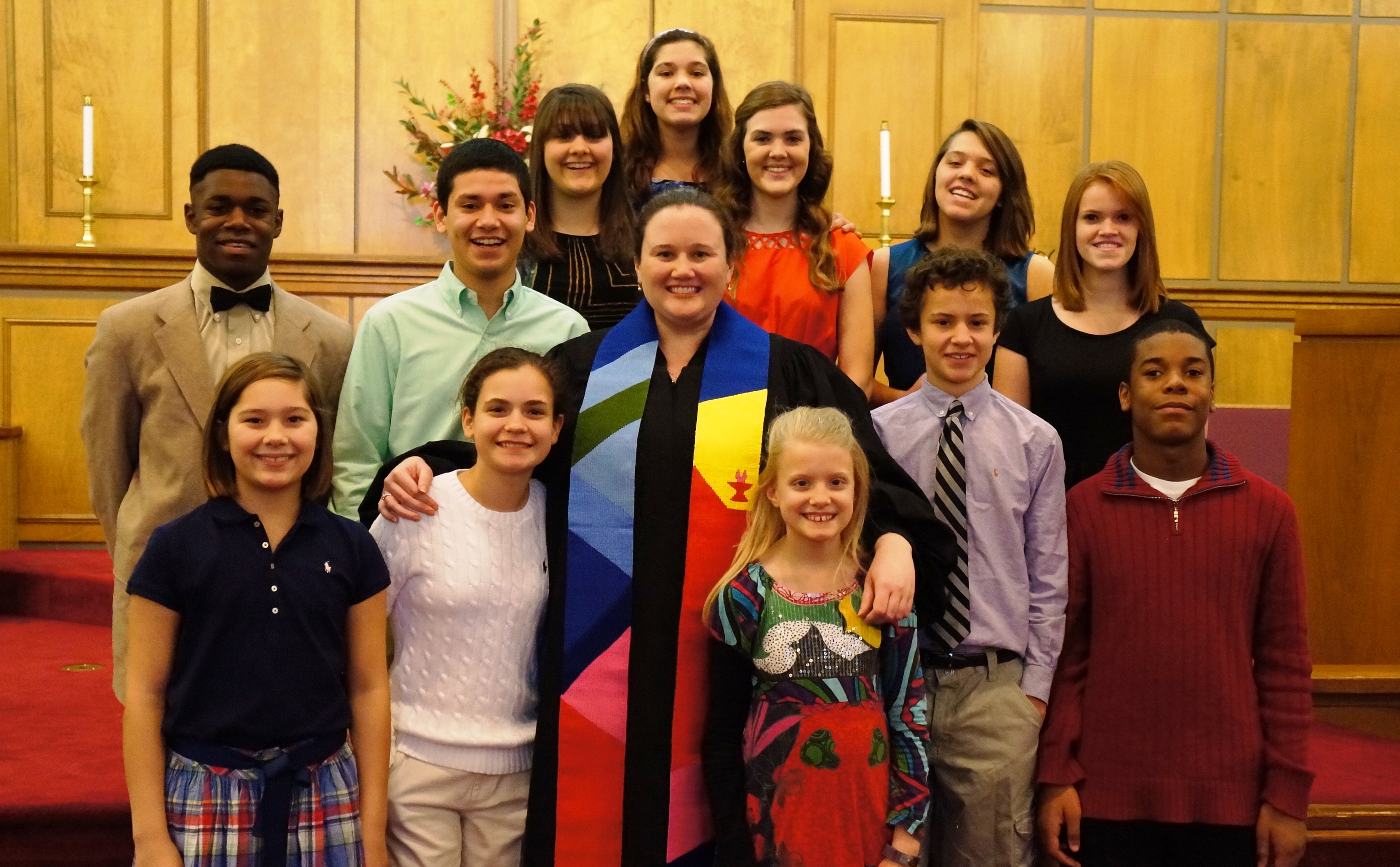
Pastor Jenny Folmar with youth

The above was adapted from Jenny Folmar’s essay “Other People’s Children,” in A Divine Duet: Ministry and Motherhood. (Macon, GA: Smyth & Helwys Publishers, Inc., 2013), available from http://www.helwys.com.

Jenny Folmar grew up in Colleyville, Texas. She earned a Bachelor of Arts in Communications at Baylor University and then went on to Princeton Theological Seminary where she earned a Masters of Divinity. Jenny currently pastors Shenandoah UCC in Shenandoah, IA and formerly served as the Minister to Youth and College at Memorial Baptist Church in Buies Creek, North Carolina. Jenny most enjoys preaching, worship leadership, and late night conversations with students. She and her dog, Tina Turner, are happily adjusting to life in Iowa.

Resolution: Stare Out More Windows

I was designed to stare out of windows. In third grade, while my by-the-book teacher droned through another lesson, my eyes wandered to the window near my desk. Our trailer backed up to a steep hill where Georgia pines stretched up to a sky that could turn a shade of blue no painting could match. I used to look up at those trees and feel myself stretching, too, up out of that stuffy trailer with its stilted rules and into that endless blue sky—before the teacher jerked me back to her lesson plan with a pointed question about what she’d just said.


Image

I started trying to create space so I could breathe a little, stare out of more windows. I opted out of the gifted program in sixth grade when it became clear that computer graphing would be our major project for the year, an announcement our teacher made with great joy. My heart shriveled and I went home that day determined to convince my parents that I needed to be un-gifted. Against all of my past experience, they agreed.

But somewhere on the same genetic code that shifted my eyes toward windows bubbled a compulsion for jumping through hoops. The homework assignment, the study guide, the paper due date all kept me moving past windows and buckling down. I could reduce some of the hoops, but eliminating them altogether was impossible.

So when I missed the cut off on the test that would bump me up to Algebra I in eighth grade, I felt both shame and relief: shame because my math classmates almost all made it in and I had no idea where I’d screwed up on the test . . . and relief because it was one less hoop to demand my attention. I could take higher-level classes in English and history, my natural loves, and maybe look out a few more windows  in regular eighth grade math.

Then in ninth grade, after I had already accepted my place behind the leaders of the pack, my report card revealed that I was ranked higher than I had known in my class of five hundred plus. I must have obnoxiously mentioned this at lunch because someone reminded me that I was in the regular math, and thus science, class. The rank didn’t reflect those less demanding courses. That person was right.

But my hoop-jumping DNA marker had lit up like New York City at that dot-matrix printed ranking number on my report card. I didn’t want to lose ground. So buckled down and jumped high and aimed for the hoops in our no-minority, upper middle class “high school of excellence.”

Then right before my senior year, I found my eyes drifting toward the windows again as I plowed through the long summer reading list. I read a few pages; I stared out the window. Self-chastisement followed, but within a few pages, I’d again find myself staring out the window. Suddenly, the window-staring part of my DNA could no longer be squelched. And that was just the beginning.

All through college, my window-staring mind demanded at least some time alongside my hoop-jumping mind. As I got to pick more of my classes, I even discovered a sweet spot where the window staring and the hoops worked together: Victorian poetry, the short story, the 20th century novel.

In graduate school, I had to jump farther and faster to keep the competitive scholarship that allowed me to go to the school. But the higher I jumped, the more desperate the window–gazing needs grew. I caught every virus that even thought about visiting our campus. I tripped on the stairs I was running up one day and bruised my knee so badly that tears came to my eyes. I needed a nap everyday or my energy sagged so low I couldn’t keep up. And that wasn’t an option.

Yet, along the way, the window-gazing penchant drew to itself like-minded writings and people and practices. I read about contemplative prayer and women’s ways of learning for class and heard my own longings on the page. I went on a retreat and discovered that I craved the sound of quiet. I met the calmest, most grounded woman I could imagine and she befriended me.

I began taking baby steps toward honoring my call to gaze out the window. I took long walks. I prayed. I wrote. I gazed out the window. It was the only antidote I found to the hoop jumping. I felt healthier. Sometimes.

I began to accept in tiny, miniscule bites that I would never be enough or do enough. I am enough. We are enough, loved now, no hoops needed. When I gaze out the window, that’s what I hear. That’s what I always heard, all along.

Hoop-makers don’t want us to listen to that. Hoops don’t want us to think for ourselves or wonder or question or write poetry or sip tea in silence. And they certainly don’t want us to pray (unless it’s by rote) or combine window-gazing with praying. That’s dangerous stuff.

Thanks be to God for that little bright marker on my DNA that would not be silenced or shamed or worked away. Thank God for that window in my third grade room . . . and for my adolescent bedroom window . . . and all the windows that have offered new life through the years. I would never have survived without them.


Alicia Davis Porterfield writes for the sheer pleasure of words on a page in a household full of testosterone. One half of a clergy couple and mom to three boys, she finds herself fascinated by the world around her, including the birds in her own backyard and the love that bind us all together. A native of Atlanta, GA, Alicia lives in Wilmington, NC where history lingers on the corners downtown and the Atlantic bumps up against North America.

Image

Melanie Storie: Resolution: A History of My Life in This Body

I will give thanks to you, for I am fearfully and wonderfully made. Psalm 139:14

7
I am in the bathtub. I sing and play. I wash myself. There is a light brown spot on the back of my leg where the meat of my leg kisses the back of my knee. I scrub at the spot. I scrub and scrub. Until I realize the spot isn’t dirt. It is part of me. I can’t change it.

13
I am in junior high. I am pale and skinny. Knock-kneed and awkward. The other girls are getting boyfriends. The boys don’t notice me. If they do, it’s to tease how tall I am. How white. How skinny. My nose is big. My family gave me this nose like socks at Christmas. Later, I learn to make fun of my nose before others do. I call it a Mack truck nose so everyone will laugh with me and not at me.
I hate my one-piece bathing suit because it pulls uncomfortably and makes my hip bones stick out. But good girls wear one-piece suits – and tease girls with bony hips.
One day, Nostradamus predicted the world would end. That day, I forget my clothes to dress out for P.E. on purpose. I hate the way my legs look in shorts. And if the world ends, who cares if I have to walk laps outside in my favorite jeans and sweater? I walk and pray for Jesus to come now so I don’t have to dress out and show my knobby knees ever again.

17
I have filled out in all the places I am supposed to fill out. I get more attention from boys, but I am wary of them. After all, a few years ago I was knock-knees, Mack truck nose, brace face. I remember.
I can’t tan. I freckle a little. I burn. The other girls go to tanning beds before prom. My mom won’t let me. There is skin cancer in my family. I am white. White and bony like a skeleton. I am prone to fainting spells. The doctor tells me to drink milkshakes to gain weight. I think they are all going to my chest.
I am the lead in the spring musical at school with my best friends. I feel confident and strong. I love the dresses I wear onstage and how I look in them.
A month after the show, a lady recognizes me in the grocery store. She asks me if I was the lead in the play. Yes, I say with pride. You were good, she says, but so skinny. Don’t you eat? Believe me, I do, I laugh. I leave the grocery store and go get another milkshake.

21
I am about to graduate from college and go to seminary. I am still tall, still pale, still unhappy with my nose, but I can walk into any store and buy almost anything in my size and it looks good. I don’t realize at the time how good and wonderful this is. I have a lot of cheap bikinis. Even though I am white, I look good in them.
My hips aren’t so bony anymore. In conversation with one of my guy friends, I tell him how much I want to have children one day. He tells me I don’t have “child-bearing hips.” It bothers me because I’ve always hated my bony hips.
I work at a chain steakhouse restaurant. I hate my uniform. It is truly ugly. One night, a handsome guy (who meets my rule of being taller than me) sits in my section. He has the best blue eyes I’ve ever seen. He tells people later when we relate the story of how we met that he liked how I looked in my uniform.

26
I’ve just birthed a 9 lb. 1oz. baby boy. With the final push, the doctor let me reach down and pull this slimy, wailing love into the world with my own hands. (I briefly think of my guy friend who said the thing about child-bearing hips. Ha, ha!!) This little boy has relied solely on my body for nourishment for nine months. I ate tons of vegetables, drank gallons of milk, and consumed the more than occasional foot long chili cheese hotdog. For twelve months more, I will nurse him. He depends on me, on my body to survive.
When I take a shower for the first time after the birth, I look down at my body and I barely recognize myself. I will never have bony hips. Not bony anything. Not ever again.

37
My body has had two babies and nursed them. My body eats and exercises. My body hugs people who hurt. It watches too much TV and reads a lot of books. It laughs. It cries. It is wonderfully made.
My right foot has a bunion that makes shoe shopping a dread rather than a treat. Where I used to grab a pair of jeans from the clearance rack as I breezed through a store, I now take ten pairs to the dressing room. Which pair will be long enough? Which ones will cover up my belly?
My belly. In college, I wore the popular midriff bearing tops. Now, I laugh at the thought. My belly is stretched and fleshy. The nine pounders demolished it. I shop for tankinis, bathing suit bottoms with skirts, bathing suit tops with extra support. I nursed two boys for a year apiece. They literally drained the life from my chest.
I go to my family reunion. My grandpa has died. Cancer took him from us. But I see his nose everywhere. On uncles and aunts and cousins. It is my nose too. It spreads out all over my face when I smile. And I like to smile.
This white, white skin is my grandma’s skin. She was beautiful and pale. She loved to hold my hand. My soft, white hand.
I make a decision. I get out the tape measurer and measure the body I have. The one that was given to me. The one that I’ve earned with healthy eating and Zumba and chocolate cake and nine pound babies and belly laughs with my husband. Maybe it’s not the one I want or the one from my twenties when I didn’t realize how good I looked because I was always comparing my body to someone else’s. I realize that one day I’ll look back on this thirtysomething year old body and wish I’d realized how wonderful it was.
So, I order it: The green and white polka dot 1940’s style bikini. Maybe I have no business wearing it. Maybe I’ll toss a t-shirt over it in a panic whenever we take to the beach. But, I’m wearing it. I’m fearfully and wonderfully made. I’ll see you on the beach in my bikini. You can bring the milkshakes. This time, we’ll drink them just for fun.

Storie pic

Melanie Storie is a graduate of Catawba College and Campbell University Divinity School. While in seminary, Melanie married Matthew Storie, served as a youth and children’s minister, had a son (Aidan, 12), and finally graduated – while eight months pregnant with her second son (Owen, 9). Melanie has served churches in North Carolina and Virginia as Minister of Children. Recently, she served with the Cooperative Baptist Fellowship in Alabama. Melanie currently lives in Independence, Virginia.

Meredith Stone: Preaching Pregnant in Advent

           When I was pregnant with my first daughter, I was working on a Master’s degree and my husband was serving on a church staff in a small rural community. As the minister’s spouse, who happened to also self-identify as a called minister, I sought ways to be a part of the ministry of the church in whatever place was open to me. One of those places in that particular church was the worship ministry.  So in 2003 on the Sunday before Christmas, I was asked to pull my massively pregnant self up the stairs to the platform during the service, read Mary’s song in Luke 1:46-55, and then sing a solo. In other words, I was asked to be the surrogate Mary.

            While the service that day didn’t include an examination of what being birth-er and nurturer to the Christ-child meant, the people in that church were given a meaningful snapshot of Jesus’ mother.  Sometimes Jesus’ miraculous birth makes us forget about the tangible details.  Jesus was an actual human being who grew inside of a woman.  Mary did carry him in her belly for nine months and he grew from tiny embryo to fetus inside of her.  She had to think about what she ate and the activities she engaged in so that she could be sure to nurture this tiny creature into a fully functioning human being. Mary’s womb was the first minister to the Christ as it provided a place for the baby human Jesus to grow.    

It was with this picture of the pregnant Mary that I approached my second pregnancy-filled Christmas season in 2007. By then I was serving on a local church staff as a Teaching Pastor and one of my responsibilities was to coordinate worship and preach during Advent.  So when one of the lectionary passages for the third Sunday of Advent that year was Luke 1:46-55, I just knew that, again, I brought a unique perspective into reading Mary’s song. 

As I read and re-read Mary’s song that week in preparation for Sunday, I felt a strong connection to her. I imagined her looking just like me – gigantic belly and all.  I envisioned her responding to each kick and punch of the baby in her womb by placing her hand on her belly. And as her hand rose and fell with the movements of her unborn child, I wondered what she thought about and how she pictured that little person growing inside of her?  Being almost eight months pregnant myself, at that point my imagination had constructed a very detailed vision of who my second daughter would be.  So who did Mary picture her son to be and what did she dream for him?

Then as I read through commentaries and articles about Mary and her song for my sermon preparation, I began to see her mother’s dream unfold in the words of Luke 1:46-55.  Mary dreamed about the new world her son would bring into being.  It would be a world where the poor, the downtrodden, and the powerless are restored.  It would be a world where the strong, the rich, and the proud no longer dominate, but the lowly are lifted up and the hungry are fed, where God fills, helps, remembers and is merciful by turning the entire order of society upside down.  It would be a world where her son starts a revolution.

And there she sat. 

Pregnant. 

With the hope of a revolution of justice and redemption inside of her.

And with the expectation that she would deliver that hope to the world.

And looking down at my own pregnant belly, I was reminded that Mary was not the only one pregnant with that same kind of hope.

So when I preached that December morning in 2007, I tried to paint a picture of Mary that is sometimes forgotten – the Mary in-between Gabriel’s visit and the manger.  I attempted to use her pregnancy to illustrate the kind of hope we should all have.  When we hope for redemption and justice, we should have Mary’s kind of hope.  It should be a hope that is assured since we can feel it kicking and punching and growing inside of us.  It should be a hope that is active since, like labor and delivery, bringing our hope to fulfillment is not a passive endeavor. 

And you can only imagine the congregational gasps as I said, “In fact, who better than Mary to illustrate to us the fact that we are all humble virgins whom God has impregnated with hope?  That’s right, you heard me – I’m not the only pregnant one in the room anymore. As followers of Christ we have all been made pregnant by God’s hope and like Mary we have the privilege of giving birth to God’s revolution of justice!”

After church that day, one male member of the congregation said to me, “I will never forget today – the day you made us all pregnant.” 

Note: The above is an excerpt from Meredith’s essay “Pregnant and Remembered Hopes” from the collection  A Divine Duet: Ministry and Motherhood (Macon, GA: Smyth and Helwys Publishers, 2013).

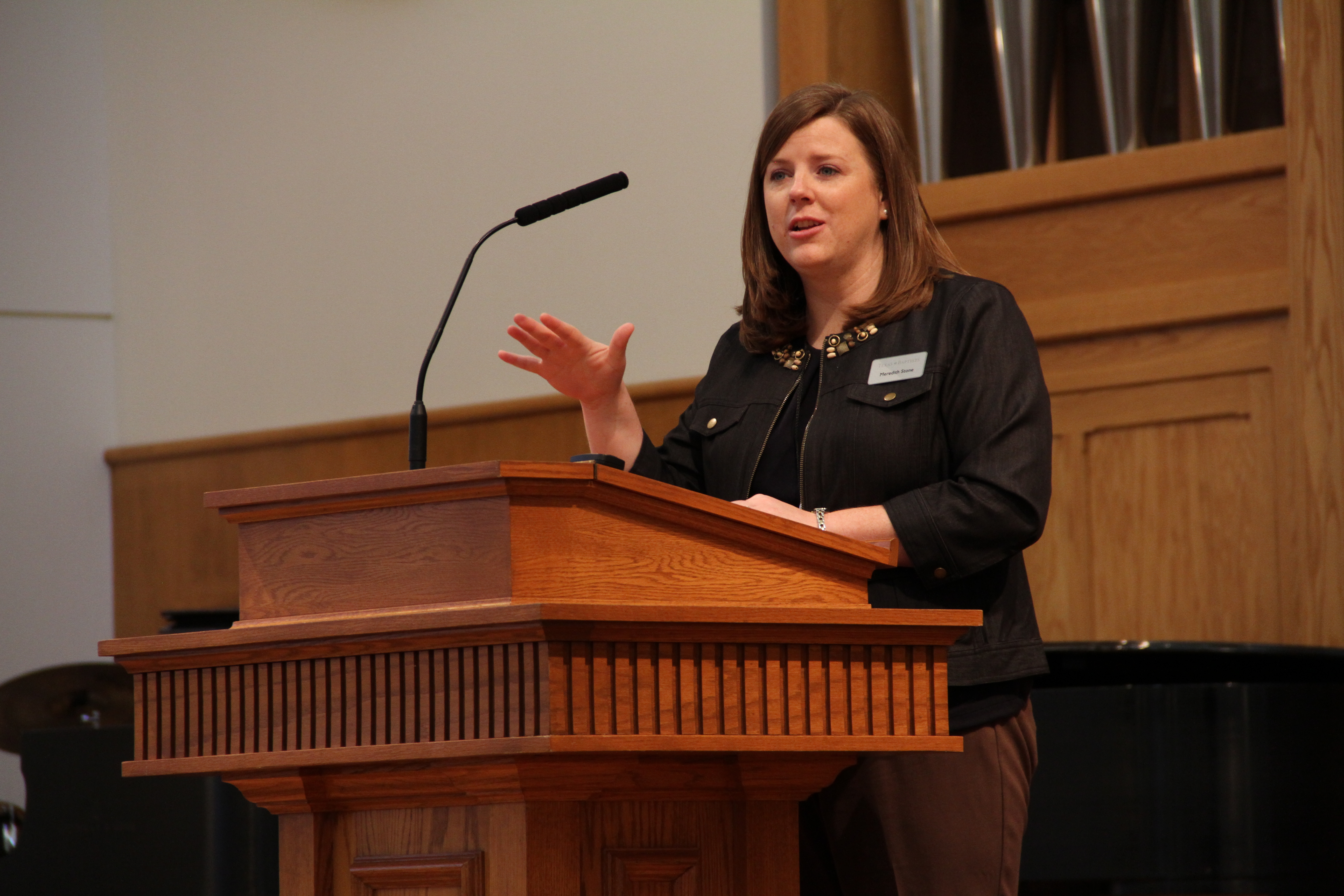
Image 

Reverend Meredith Stone serves as women in ministry specialist for Texas Baptists.  Her work includes resourcing and supporting women serving in vocational ministry across Texas and consulting with churches and institutions that support women in leadership.  Meredith is also working on a PhD in Biblical Interpretation through Brite Divinity School at Texas Christian University.  Meredith’s husband, James, serves as Director of Church Relations for Hardin-Simmons and they have two daughters, Hallie and Kinsey.