All posts by aporterfield2013

Unknown's avatar

About aporterfield2013

I'm a minister and mother who is always interested in learning new things, listening to stories, and living into grace.

Courtney Pace Lyons: Thankful in a Broken World

Being a mother feels like living in a perpetual state of guilt. Whatever I’m doing, I feel guilty for the other things I’m not doing, and I just rotate which thing(s) I feel guilty for not doing.

I’m at work. Guilt for not being with my child. I’m with my child. Guilt for not making progress on my work tasks. I’m resting. Guilt for not exercising more. I’m exercising. Guilt for not being with my child or making progress at work or resting. It’s a vicious cycle where nobody wins.

And now it’s Thanksgiving. There are meals to be prepared and cakes to be baked and special outfits for school plays to be packed and decorations to be made. And if we are honest about all of the hats we mommy ministers wear, let’s add to that list sermons to be prepared and preached, shut-ins to be visited, newsletters to be written, community events to be attended, and meaningful worship services to be planned.

More things we are doing. More things we are not doing. More guilt.

As caretakers and spiritual guides, so much of our time is spent giving of ourselves to others. This work is exhausting and keeps the harsh reality of the world in front of our faces all of the time. We know full well about the realities of this world. Racism. Classism. Sexism. Hatred. Abuse. Betrayal. Injustice.

So how do we turn all of that off and participate in Thanksgiving? Sitting around a table and listing the things I’m for which I’m grateful feels a little forced. Really, I just want to bind up my wounds and cling to hope.

But maybe it’s not forced. And maybe it’s okay, even holy, to bring all of that with me to the Thanksgiving table. Maybe it’s the road to healing. As we give thanks, we remember how God has been at work in our lives. Yes, we still know about the terrible realities of the world, but we see the good alongside of it, bringing the entire picture into view. We remember when God has delivered us from captivity, guided us through and out of the wilderness, and blessed us with a holy communion of friends and family.

And when I was least expecting it, I caught a glimpse of hope to which I could cling.

I was making decorations with my son, and he asked if we could give them to our friends. Making decorations was his reward for having a good day at school, and instead of keeping them for himself, he wanted to share them with others, because he thought it would make them happy. He wanted to take what was given to him as a blessing and bless others. Lord, may it be so with your church also.

We mommy ministers spend all day every day trying to heal the world, and it seems unending at times. And then we come home and care for our families. And with what’s left, we care for ourselves. It’s like we are trying to finish a song with an unresolved note, and no matter how many times we play through the song, it just doesn’t feel “over” at the end.

But there is hope in the world because love bursts forth from tiny places. Even though injustice and suffering linger, God is faithfully at work in the world, bringing about reconciliation and healing, providing for those in need, raising up prophetic voices to speak against injustice, and empowering seemingly little voices to speak big words of love.

Though I feel the weight of the world on my shoulders this season, I am grateful. I am grateful to be part of a church family with social justice in its DNA. I am grateful to share this season with beloved friends and family. I am grateful for my ministry and the opportunity to empower young people to acquire knowledge, in pursuit of wisdom, to serve the world.

My part feels small a lot of the time. Maybe yours does, too. But together, we are doing great things. Holy things.

May this Thanksgiving be a time of respite and encouragement for you, a reminder that God is faithfully working through you and around you, and a reminder that you are not alone. You are part of a global community of sisters and brothers working together for peace and justice.

And every time someone enacts love, no matter how small it seems, may we give thanks, for this is the very hope of our lives and our work and our identities in Christ: that God is faithfully at work making all things new. Amen.

Courtney Lyons Ð head shot Ð 01/23/2014

Rev. Dr. Courtney Pace Lyons is mother to Stanley and works at Baylor University, where she earned her PhD.

Alicia Davis Porterfield: Mommy’s Getaway

photo

This time last year, I had just completed my first week-long writing retreat. It was nothing short of heavenly. One week in the North Carolina mountains in autumn, surrounded by other women writers with a spiritual bent and led by a gifted teacher with the uncanny ability to inspire “Fearless Writing” (Peggy Tabor Millin, www.clarityworksonline.com).

But I had to plan long and hard to save up for the retreat and arrange to be away from home for a whole week.

First I scoured my calendar to make sure no other commitments interfered with the retreat dates–neither mine nor my minister-husband’s, nor the children’s, nor the church’s. It worked! A minor miracle, no doubt.

Then the real work began.

I carefully calculated the deposit and final installment for the retreat and balanced it with the checkbook. I tallied my anticipated income for the next few months and found it would just work out. Check!

I called my parents far in advance to see if they could come help my husband with the boys that week. I marked on my calendar intervals at which to remind them of said commitment. Check and check!

I worked upcoming deadlines and coaching calls around the carved-out week and planned accordingly. As the date grew closer, I paid bills online so everything would be up to date before I left. I found a substitute for Kindergarten Sunday School and Zumba, with help from friends. Check, check and check!

I prepared things at home: mounds of laundry done so plenty of long pants and shorts would be available for the capricious fall weather on NC’s coast; several meals made ahead and frozen so my mom wouldn’t have to cook every night; house cleaned, my parents’ room readied with fresh sheets and flowers; boys’ schedule arranged and outlined for ease. Check, check, check and check!

Lastly, I prepared myself: writing projects gathered and prepped for work at the retreat; packing for mountain weather; and lots of snuggles and hugs savored and stored for time apart from the family.

It was a lot of work. And it was all completely, assuredly, absolutely worth it.

I came back from the retreat refreshed, renewed and inspired. I am a better, more grounded mother when I have time away. I am better, more grounded minister when I have time away. And I am simply a better, more grounded me when I have time away.

My family and the people I serve in ministry benefit from a better, more grounded me. So do other drivers, people in the grocery store, at the bank, at church . . . but I digress.

As a minister married to a minister and mom of three active boys, I have discovered that in order to get away, I must be “wise as serpents and gentle as doves” (Matt 10:16). I have to make it a priority and plan relentlessly and with great determination. I have to assure and reassure myself and my children.

I have to resist the voices, without and within, that suggest that I am “selfish” for taking this time or that I am neglecting my family when I am away. Several voices I hear like to couch the need for time away as a weakness, sort of that “I never had/have time away so I don’t know why you should get it,” approach.  I’ve secretly wanted to reply, “Well, at least I’m not going away for forty days and nights like Jesus,” but haven’t yet.

My kind-hearted husband gets lots of credit and affirmation from others for “letting me have” this time away. Little do they know that my mother coddles him and the boys far more than I do. She keeps the cookie level high and the stress level low. She serves them gravy regularly: on biscuits, on potatoes, with fried chicken, cubed steak and pot roast.

In similar fashion, my father tells family stories that keep the boys and my husband in stitches. He listens attentively to the boys describe their favorite basketball players’ pros and cons, likes and dislikes. He fixes broken window blinds and drawer pulls.

My little brood is not left comfortless when I go away. Far from it.

I need time away. We need time away. This kind of self-care is not indulgent or selfish. It is essential and it is biblical.

Today I am marking next fall’s retreat on the 2015 calendar. Tomorrow, I’ll start planning for that time away. Gratefully.

Some of the retreat participants. The author is in the second row, in purple.

Alicia Davis Porterfield is a ministry-mom living in Wilmington, NC. A writer, Life Coach and Board Certified chaplain, she is the mom of three boys, ages 9, 11 and 13. In her spare time, she likes to sleep.


Sarah Boberg: The Loneliness of Rarely Being Alone

As a mother of a toddler I am rarely alone. I can’t even go to the restroom alone when my daughter is around. She has finally reached the age where I can leave the room until I hear a scream, cry or thump, but other than that we are usually together.

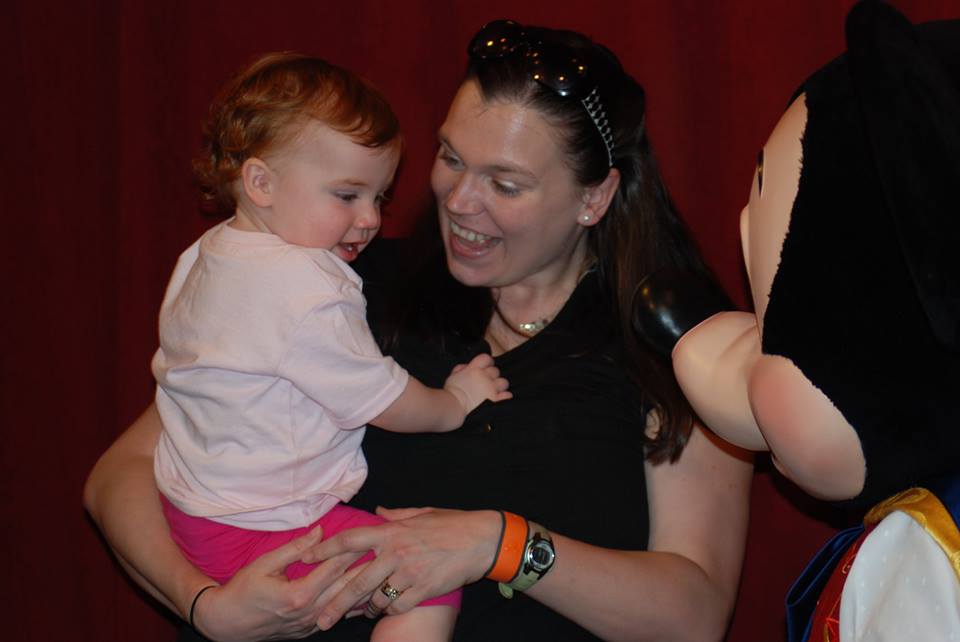
Mom and Mickey

Thanks be to God for daycare, or I would literally never be without her. Even when others are around to watch her, when I am nearby she wants her mommy. This is the blessing and curse of toddler motherhood. The blessing and curse of always being wanted and needed.

The flip side of never being alone is the loneliness I feel as a mother. Those late nights when Scarlet wakes up because her allergies are so bad she can’t sleep and we find ourselves rocking in the recliner in a dark house and there are not even cars passing by on the road. I can’t imagine the loneliness mothers felt at those times before Facebook. At least in my loneliness I can scroll through the lives of others who have gone to rest for the night.

Then there is the loneliness a mother feels after sitting on the bathroom floor for 40 minutes waiting for pee-pee in the potty to happen. The loneliness of wrangling a toddler in Walmart while shopping with a list that is way too long to accomplish alone. As a mother, even though I am rarely alone, I often feel the weight of loneliness. I often feel like I am mothering, parenting, and surviving all on my own.

As a minister I am rarely alone. I am an extrovert and my ministry style is very relational, so I spend a lot of time with others. As a youth and children’s minister, I am always surrounded by people and voices. I can always find myself in a conversation, some simple and some so serious and scary I only survive by the grace of God.

Egg Hunt

As a minister my door, heart and head are always open to others. I am usually with at least one person in my office or surrounded by 10s or 100s in Bible study and events. As a minister I am called to make disciples; this requires being with people. And even when I am not surrounded by the people of my ministry, I am surrounded by their burdens and prayer requests. I am rarely alone with my own discipleship, burdens, and prayers.

On the other hand, while my ministry requires me to be with people for most of the time, I continue to feel alone. Ministers hear and know some of the darkest secrets of people’s lives. We are often entrusted with stories that are hard to hear and hard to bear. Because of this, we often have to keep these stories to ourselves and God, leaving us very few places to release.

As a minister, I do spend time in my own Bible study and prayer time with God. These times often lead me to places and decisions that are not easy and often against the traditions of the church and sometimes I feel like I fight the battle of servanthood, discipleship, and just being Jesus in the world alone.

As a mother and minister I am often caught in this weird place. A place where I am rarely alone, but often feel so lonely. Please don’t think I am literally alone. I have an amazing husband and partner in ministry, parenthood and life. He does his share of parenting and household chores. And as the senior pastor of the church I serve, he is a constant support of the ministry God has called me to.

I am also surrounded by loving family, friends, and church family. I rarely pay for a baby sitter, when I actually ask for one. I would not have made it this far in ministry and parenthood without the great cloud of witnesses that surrounds me on a daily basis. However, even surrounded by this great cloud, I often feel like I am in a fog.

I often wonder what Mary, the mother of Jesus really felt upon giving birth to Jesus. Did she feel the loneliness of rarely being alone? She was an outcast in society, but also never away from the presence of God, literally in her womb. We know she had a friend in Elizabeth, but could Elizabeth really relate?

When Jesus was born, there may have been stable animals around and even shepherds came to visit. It seems like Joseph never left her side. But did she ever feel alone? Did she feel alone in the burden and blessing of raising the Messiah? My answer to many of these questions was found as I read Mary’s song in Luke.

And Mary said: “My soul glorifies the Lord and my spirit rejoices in God my Savior, for he has been mindful of the humble state of his servant. From now on all generations will call me blessed, for the Mighty One has done great things for me – holy is his name.” – Luke 1:46-49

Hearing Mary’s humble offering of song, a crying out to God, I find myself amazed by her humility and hope. I am reminded of the great things the Mighty One has done for me. I am reminded of the mindfulness God has shown in giving me two of the greatest honors and responsibilities a person can have: parenthood and ministry. I am humbled that God has blessed me with joy from the womb, a joy that not all women have the opportunity to experience. I am humbled that God has called me to help point and guide his people back to him. I am humbled by the legacy that my parenting and ministry will leave.

Granted, this reflection does not make the loneliness of rarely being alone magically go away. But it does give me hope. It does make me reflect on the greater purpose of my life. It does make me understand the humility that is required to be a mother and minister. As a mother and minister I understand just a small portion of what it means to put others before myself. I can’t imagine the feeling of putting the all of humankind before my own child.

As a mother and minister I will rarely be alone. As a mother I will often feel alone. However, as a child of God I will never be without the God who made me, loves me, provides for me, guides me, protects me, and keeps me – holy is his name.

Family


Rev. Sarah Boberg is the Minister of Youth and Children at First Baptist Church in Red Springs were she serves alongside her husband, Rev. Bradley Boberg. She is the mother of the beautiful and energetic Scarlet Carolyne and spends her “free” time working on her Ph.D. in Educational Studies with a concentration in Cultural Studies from UNCG.

Mary Elizabeth Hill Hanchey: Fertility Grief: Turning Together

As I left the preschool, I passed a woman who was crying. Hurrying, needing to get to class, I barely stopped to ask if she were OK. I must have still been walking even as I asked – and I smiled and nodded as she responded merely that she would be.

I left the building and was walking across the parking lot when my feet stopped and something powerful turned me around– very suddenly, it felt.

Finding the woman inside, I stopped to look at her face and asked her how I could help. In this stopping and asking I learned that she was afraid she was losing a pregnancy.

Because I responded to the realization that I must go back, because I stopped and turned and sought out her face, I had the privilege of sitting with a woman who was anxious and afraid, and who needed someone who understood this story.

October closed with brisk winds, ghouls and goblins, and remembrances of the saints whose lives we acknowledged on Sunday. Everything has turned–very suddenly, it feels. Our clocks have fallen backwards into a schedule that is darker and the cold will begin seeping into our bones after a luxuriously warm fall. The mountains of my home state saw a very early snow this weekend.

We have turned to a season that is more contemplative, more about inside than outside – both physically and spiritually.

October served as a month of awareness of those who have suffered miscarriages and the loss of infants. This awareness is something that I will carry with me, even, or perhaps, especially, as I navigate the darker weeks ahead. In my own work I have begun to use the term “Fertility Grief” to describe the pain of these losses and the pain of infertility. As an online community who has been offered glimpses of fertility grief this month, we must also make a turn: we turn from becoming aware to meaningful ministry.

The seasons that lie just ahead can be excruciatingly painful for those who are so tangled in fertility grief. There are men and women in our congregations that have been trying for years to start a family. There are women and men in our congregations who have lost pregnancies and grieved without a body to bury or a service to mark their loss. There are men and women in our congregations whose children were stillborn or who were never able to carry their children home from the hospital.

How can we minister to them in the weeks ahead?

Did our faith communities acknowledge these losses as we acknowledged other deaths on All Saints Sunday? How will we address these losses at Thanksgiving when so many focus on the gift of gathering with family? How will we shape the language we use during Advent so that the entire season is not about waiting for a baby?

Where will you be when you pass someone who is aching with the fear that the child inside of them is dying? Or someone whose fertility treatment has failed this week? Or someone who child has died? What will her face look like? What will his face look like?

Will we allow God to pull us back to sit and listen? Will we work to shape the language and practices of our worship services this season so that those who grieve are welcomed–and not injured–by what happens there?

We turn together. We turn toward the inbreaking of light into our darkness. We turn toward the promise of God with us.

We turn toward a call to sit in darkness with those for whom the light is yet to come. So may it be.

IMG_0565

Mary Elizabeth Hanchey is a Coordinator for Project Pomegranate (look for them on Facebook), which provides spiritual resources for those impacted by fertility grief. She lives in Durham, NC with her husband and three children. She is a member at Watts Street Baptist Church in Durham, NC, where she serves as the Interim Director of Children’s Music Ministries. She has recently returned to Duke Divinity School where she is pursuing an MDiv as a Cooperative Baptist Fellowship Scholar.

Christie Goodman: Faithful Action in the Infertility Journey

Our story is one of many that has no explanation. No one knows where things went wrong.

We had done what we were supposed to. Get your career established. Get settled in your marriage. And then have children.

No one – not even my doctors – told us that fertility starts to drop at age 30. We couldn’t help but feel a little deceived later when we learned the truth.

My husband and I struggled for five years to have our first child. Those years involved 126 doctor visits, 104 tests and procedures, and more than 250 needle pricks.

Finally, as a result of in-vitro fertilization, we were expecting our first child. But our story doesn’t end there.

More mysteries were ahead of us: Two IVF babies. Two emergency c-sections. One disappeared twin. Two premature births. A combined 81 days in the NICU – meaning 79 days of leaving the hospital without a baby.


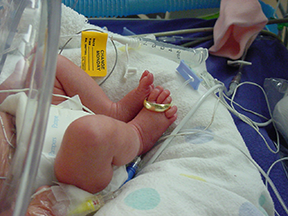
Christie's first daughter in NICU
Christie’s first daughter in NICU

Today, as our daughters are in middle school, we talk often about their perilous births, their challenging weeks in the NICU, and the support that surrounded us.

We don’t talk much about the isolation we felt when we were trying to start our family to begin with. When you’re struggling with a major life crisis or health problem, church it seems would be a logical place to turn for answers.

But many infertile couples find church to be space void of answers, barbed with subtle judgment or brash insensitivity rather than peace, a source of deeper pain rather than solace, and a place of isolation rather than community.

Churches know what to do when a baby is born healthy but not so much when a baby is elusive. It doesn’t have to be this way.

Religious beliefs can contribute to a couple’s sense of hope and help them cope with the stress of treatment. This is a strong foundation on which congregations can build as they seek ways to support infertile and grieving couples.

Of course, church families will celebrate the children in their midst. But it can be done in a way that doesn’t hurt the childless.

Mother’s Day and Father’s Day can be honored with an acknowledgement of those who long for children as well as those who mourn.

Congregations can hold infertility prayer services and offer support groups as some have demonstrated.

And we can tell the stories of our Biblical heroines who faced barrenness.

Their stories of determination ring true today as they did in ancient times. These women did not sit back and wait. They took decisive action.

Sarah, Rachel and Leah each set up a surrogate. Rachel also turned to medicinal aide. Rebekah journeyed with her husband who prayed on her behalf. Hannah is the first woman in the Bible to speak her prayer to God in public and to offer an official vow.

It’s amazing to me that these stories were written in such detail, most likely by men in a patriarchal culture. But it was no mistake.

There is power in seeing the strength of others who are like yourself. And there is hope in the new relationship that God has with these ancient women — a relationship that thrives with women today.

I know that when we were in the midst of our own struggle, these stories were of great comfort to me. I saw that I was in good company and that God was present in our journey.

I don’t believe for a second that God gave us infertility. He cried with us, and he helped us through it.

Early in our struggle, some people would say, “It must not be God’s plan for you to have children,” or “Maybe it wasn’t meant to be.”

I wonder what those people would say now, seeing our daughters. They are God’s creation.

ChristieGoodman

By day, Christie L. Goodman, APR, is the communications manager for the Intercultural Development Research Association, which is dedicated to assuring educational opportunity for every child. In the spare time of a working mom and wife, she has been writing a book on ministering to couples experiencing infertility and traumatic births, based in part on her family’s experience. In the course of her writing, she has researched in depth the gift of these Biblical stories of barrenness and renewal.

Jennifer Harris Dault: Missing Two

A year ago today I sat in the ultrasound room holding my breath. I’m not sure why, other than it was one of those moments that—for me—time stopped.

CRL_Crown_rump_lengh_12_weeks_ecografia_Dr._Wolfgang_Moroder

The ultrasound showed an image of a brand new pregnancy—a rice-sized blob with a little flashing dot that showed that there were two hearts beating inside my body. The heart rate was 110—slow for those beginning days—and the doctor looked concerned as he suggested that perhaps our dates were wrong and this was simply a heart just starting to beat.

“I’m cautiously optimistic,” he said.

Nearly two weeks later, my son Benjamin was born—an early miscarriage. He joined his sister Avelyn, born months before after an 11-week gestation period.

I was the mom of two children that I never heard cry.

Tomorrow I will be 21 weeks pregnant with our second son, a yet unnamed squirmy boy nicknamed “Mops” by a friends 4-year-old son. He keeps growing and thriving, and we can’t wait to meet him and welcome him to his new home.

But this pregnancy has not healed me.

The birth of my son will not replace the children not with me.

Each milestone I hit in this pregnancy, I think about the milestones that Avelyn and Benjamin should have reached.

With each new twinge (or lack thereof), I wonder when I’ll hear bad news about Mops. Bad news I can’t help but anticipate every time we see the doctor or midwife.

The world considers me a first-time mom. Each time someone comments on my firstborn or references the first grandchild on my side of the family, I ache.

This is not my first. I have held two others within me, had my water break, felt their birthing time come as my uterus contracted and urged me to push.

I have held them—small as they were—in my hands. I sang them lullabies and journaled throughout their short lives.

Avelyn and Benjamin were—and are—loved deeply, and their lives mattered to their parents.

And yet, there are no words for the birth position Mops holds. Psychology will name him an only child—or the oldest if we have other kids. He will experience life in a way his brother and sister did not.

If all goes well, I will get to hear his cries, see his smiles, lose my sanity to the sleeplessness of the baby stage, feel my heart grow with love.

But our family photos will always be missing two, the invisible playmates our son should have had.

10728807_742497383906_1320834553_n

Jennifer Harris Dault is the Associate Pastor at St. Louis Mennonite Fellowship and an advocate for those dealing with infertility and pregnancy and infant loss. She is the editor of “The Modern Magnificat: Women Responding to the Call of God” and blogs infrequently at jenniferharrisdault.com

Rachel Hunt Hill: Anna’s Tree

The day after we laid our sweet baby Anna’s body in the cemetery next door to the parsonage where we live, a very kind family from our church, who owns a landscaping company, came to plant a tree in our front yard in her honor.

It was a very exciting event – especially for our four and six year old boys, who even got to sit in the cab of the tractor as the hole was dug for the tree. It was at least 20-feet tall:  a crepe myrtle which, they told us, would bloom white in just a few weeks, as Spring arrived in all its beauty and promise of hope and renewal.

Garin, my husband, watered the tree every three days, just as they had instructed, and we watched for the first buds to give us a hint of the splendor that we would see, a monument of strength and beauty in honor of our precious baby girl.

But as the weeks passed, the tree didn’t bloom.

We watched the other crepe myrtles on the church grounds put forth their leaves, and then buds, and then tiny purple and pink and red flowers, and still Anna’s tree was bare.

When we received the call from the man who had planted it telling us that the tree apparently had not survived the most recent cold snap, I was heartbroken again.

I don’t know why it affected me so, but it did. Even the tree planted in her honor didn’t survive.

We did everything right. We watered each week. We kept the mulch around the base . . . but sometimes, even when you do everything right, the tree just doesn’t make it.

Our very kind friend said that he would come and take it down, and promised to come back in the fall and replace it with a new tree.

And so, one day when I arrived home from work, the tree was gone. Just like that, there was a hole in the ground, covered with a pile of dirt, empty again.

But then.

A few weeks later, I noticed that there was a little sprout of green, poking out of the dirt. It was small enough to be a weed, but maybe not.

And it grew. And grew.

Anna's tree
Anna’s tree

I called Garin outside to look with me, and he said he knew that the man who removed the tree had left the roots.

Just the roots of that tree were left in the ground, but there was life growing, pushing up through the dirt and grass, stubbornly, persistently, refusing to be kept down.

In that moment, staring at that brave little tree, God reminded me of renewal and hope, and that though Anna is gone, she will always be with me, stubbornly, persistently.

And that even when my heart is breaking, life is still all around me, full of hope and wonder and beauty.

And I will always think of these things when I think of my sweet baby Anna.

“But this I call to mind, and therefore I have hope: The steadfast love of the LORD never ceases, and mercies never come to an end. They are new every morning; great is your faithfulness.” Lamentations 3:21-23

Rachel Hunt Hill is a ministry-mom and Board Certified Chaplain. She currently serves with Hospice of Cleveland County.

Rachel Whaley Doll: On the Wilderness of Infertility

Sit with me in the darkness; not because it is easy,

but because your Light will brighten my world

and our friendship will strengthen us both.

Whether serving as a Christian Educator or that other full time church job, minister’s wife, I have spent most of my adult life in the ministry. It has been an amazing journey, filled with beautiful connections and relationships. I have taught and learned with children, youth and adults in three states, and continue to enjoy serving the Presbyterian Church (USA).

I thought all those things would have prepared me to have faith no matter what.

I was wrong.

When my husband, Aaron, and I decided to start a family, we believed that we would be holding our baby within a year, just as all our friends seemed to be. As month bled into month with no pregnancy, we quietly reached out to a few close friends. As year bled into year and we experienced a miscarriage, we became more public with our struggle to conceive.

Most of the ways friends and family reached out were helpful, and I know all of it was out of love for us. But some of the advice and comments were just hard to hear, and made it impossible to go to church at times. Looking back, glimmers of hope and a connection to God were always there, but some days they were not visible through the tears.

When we encounter someone in pain,

it is so easy to go into fix-it mode.

But what is needed is much harder.

I called my friend Marcia and told her we needed to go out for sushi. She knew that meant the in-vitro attempt had not worked, as I could not eat raw fish if I was pregnant.

Marcia is a fellow minister’s wife, and her friendship was such a gift in those dark days. She hugged me tight when we met for lunch, no words needed. We sat down at the sushi counter together, and watched the chefs work their magic.

Then she quietly said, “This just sucks. I had words with God today about you.”

Until that moment, no one had ever simply met me where I was. She didn’t try to fix anything or offer suggestions for success. There was no pity in her eyes when she looked at me. No other words were said for quite a while.

Later, we talked about how her flowers were doing, what was going on in Congress and lots of unimportant things. But the simple act of showing up and sitting with me touched me more deeply than any words could have.

I also had a rocky relationship with God during those years.

At first I turned to scripture looking for comfort. I found stories of women whose wombs were “opened by God” for a variety of reasons.To me this said that if I could find the right combination, of patience or ‘giving it to God’ or whatever, the door would finally open for me.

I even read books that actually said if I had enough faith, God would give me a child. That is horrible theology on a variety of levels, and only serves to add insult to injury for someone dealing with infertility or the loss of a child.

God seemed silent and distant, and I began to look elsewhere for connection, but never felt courageous enough to really tell God all of what I was feeling.

One aspect of prayer that we never talk about are the times you are just pissed off – at God! God actually knows you, and expects a bit of steam from time to time.

Infertility is a dark and painful pit (as are war and cancer) and God has heard a few expletives already!

The most amazing thing happened when I finally got mad at God.

Yes, it was uncomfortable for awhile. Yes, it took some time to ‘make up’ and be friends again.

But the shiny plastic coating of our relationship had shattered, and I felt I could move freer in my own skin. Getting real with God took our relationship to a much deeper level, and once I knew it was safe to be honest with God, I could be honest about everything, even with myself.

Whether you are walking the journey of infertility,

or loving someone who is, know that you are not alone,

and that no matter what, God will not leave you.

Rachel Doll

Rachel Whaley Doll is an educator, Biblical Storyteller, and lover of beach sand. She is also the author of two books, The Exquisite Ordinary, 2012, and Beating on the Chest of God; A Faith Journey Though Infertility, 2014. Connect with Rachel at rachelwhaleydoll.com.

Alicia Davis Porterfield: Unsuspecting Saints

In the past four months of Ordinary Time, our blog has focused on Ordinary Saints, those everyday people in our cloud of witnesses who have imprinted our souls.

Hebrews 12 photo

We met an aging rock star whose unique voice and perseverance has captivated and inspired a ministry-mom for years.

We met several grandparent saints who spoke blessing throughout our lives and church sisters and brothers who helped raise our children over the years.

We learned of unexpected friends, older and younger, who showed up on our paths and surprised us with blessing.

We met a prophet-preacher named Prathia Hall, who led and proclaimed and helped forge the path many of us walk today.

We encountered an imagined saint, an unmet great-grandmother whose keepsakes revealed a passion for biblical and theological study.

We met an Army chaplain sister who guarded a nursing chaplain while she pumped in the back of a Humvee.

We were introduced to a Somali saint who welcomed in her sisters with food and grace.

We met a mothering saint who helped raise dozens of children and blessed their families through her call as an in-home caregiver.

None of these ordinary saints thought of themselves as anything special. Most of them had little idea of the huge impact they made on those around them.

These saints simply lived into their call, daily and authentically. They weren’t perfect. They weren’t famous. They weren’t hyper-spiritual.

They lived lives that make room for the other. They listened. They spoke blessing. They challenged with great love. They believed in us.

The arc of their lives draws us towards God.

What a gift it has been to give thanks for these Ordinary Saints week after week. What a gift  to look right next door,  into our own histories and family trees, into our own story as a people of faith . . .  and find such amazing, faithful, ordinary saints.

May we live in such an open-hearted way that we become, more and more, ordinary saints to our neighbors, families and faith communities, as well. Amen and Amen.

Looking forward: October is Pregnancy Loss Awareness month. We will honor this focus with a series of posts on infertility and pregnancy loss, a painful reality in our communities of faith and our own lives as ministers.

Too often these losses are surrounded by silence or unhelpful attempts at care. In sharing our stories and experiences around infertility and pregnancy loss, we hope to share authentically and strengthen support for families and communities dealing with these struggles.

Contact Alicia Porterfield at aporterfield@ec.rr.com to learn more.

IMG_2292

← Back

Thank you for your response. ✨

Alicia Davis Porterfield is a writer, minster and mother living in Wilmington, NC. She is the editor of A Divine Duet: Ministry and Motherhood (www.helwys.com) and moderator of this blog.

Jennifer Lane: Military Ministry and Sister Saints in Sacrifice

This season after Pentecost, the Spirit is speaking to me through sisterhood: the unique and powerful sisterhood I have found in the Army Chaplain Corps.

Often these sister saints are other female Chaplains like Mary Miriti, Sharonda Watson, Lauren Hughes, Brittney Wooten, Delana Small and Roxanne Birchfield (yes, the one from “Survivor Phillipines”.) However, sometimes they are other women serving veterans like Rev. Jennifer Crane, VA Chaplain and Mary Ross, Deputy Director, OSDTN.

In the summer of 2013 after four beautiful months of nursing my new baby (Justice Ryan Lane) at home with family, I left for Chaplain Basic Officer Leadership Course (CH BOLC for short), where I continued breast pumping during the course of CIMT or Chaplain basic training and 16 hour grueling Army training days.

I learned the meaning of sacrifice.

Other amazing mothers and fathers at my school supported me in what was essentially an experiment in many ways:

1) Because Army funds were cut, the soldiers at Chaplain School would live in ‘barracks’ and eat in the Drill SGT dining facility (DFAC) like other none-officer soldiers.

2) We marched everywhere we went ( about 6miles a day.)

3) With unwavering encouragement from leadership, including CH (LTC) Karen Diefendorf, I proceeded to be able to finish nursing (from a distance) and boost my child’s immunities through mother’s milk.

Many female Chaplains including CH (COL) Kristina Moeller, CH (LTC) Karen Diefendorf, CH (MAJ) Renee Kiel, and CH (CPT) Delana Small have laid down a path for me of guidance, wisdom, love, and Esprit de Corps that is invaluable to new Chaplains in training.

Veteran women like Mary Ross at Operation Stand Down Tennessee, Inc. have also inspired me in following my call.

In the Army, I realize that the Saints next door are also the women who have come before me. Anything that feels hard to me was likely harder for them, and they persevered. “Hooah,” ladies!!

USACHCS (Chaplain School) did an amazing job of supporting me in this motherhood and ministry experiment.

I believe this should encourage other young women of child bearing age who might be on the fence regarding joining military chaplaincy. Where God calls you and commands you, God will provide the path to succeed in all you do! This includes motherhood and ministry, even in the military.

My battle buddies were as hardcore (“Hooah” in the Army) about helping me breastfeed as they were about helping me get through gas chamber training, rappelling and completing road marches.

One of my battle buddies, Mary Miriti, is from Africa. She grew up in the bush watching grazing goats alone in the dark. Did I mention she was barefoot?

She was not only helpful with my interesting situation–she was over-zealous! She would sneak me extra fruit and water so I had enough energy to breastfeed. She would hide with me in the back of Humvees in 100 plus degree South Carolina heat standing guard.

She would even offer to do it for me! Yes, you heard me right. She said that in Africa such behavior was polite. My American space bubble began to feel a bit small but I declined her offer even when exhausted.

With the love and support of Saints next door like Mary, and by the grace of God, I did graduate from CIMT that summer and CH BOLC on August 15, 2014.

Although leaving your family is intellectually, emotionally and spiritually jarring, the love of other female Chaplains made me feel like I could succeed and excel no matter what the challenge.

Mary Ross, a former Army NCO and Commander of the National Women Veterans of America explained to me before I left for Chaplain School that these friendships forged in tears, heat, and dirt could sustain me. She encouraged me to be honest about how hard it was to be separated from my family.

This is sacrifice. It does not feel good, but it’s crucial to our American way of life.

“Thank you for your service” is wonderful, but make sure to also honor our families and say thank you to them because some of the hardest sacrifices made are made by our families.

Those in the Christian community can be a great resource for our families affected by military commitments and loss as they remind them of God’s love and care and support them in whatever ways possible.

Although God’s love is strongest when I am home with my family, I have also been blessed to feel God’s love in the empathy of the other Chaplains at school going through similar feelings of loss and separation and in the hugs of those who have reached out to support me in my multi-faceted call within a call.

There should be no shame in missing our families, even in a Hooah Army culture.

When the bravado comes crumbling down, God’s love is there in sometimes surprising ways to fill your heart with joy until you are reunited with those who know you best.

Lane Baby Dedication at Church

A chaplain candidate in the U.S. Army, Jennifer Lane, JD/MPA, is in her final year at Vanderbilt University Divinity School. She has studied internationally and served with numerous nonprofits, most recently as a chaplain with Operation Stand Down Nashville, working with homeless veterans. Jennifer and her husband James have a toddler son, Justice Ryan Lane.