Monthly Archives: June 2016

Christie Goodman: Everyday Theology: Like a Mother Wren

There are several milestones in a child’s life that parents celebrate: sleeping through the night, taking those first steps, going to the restroom on their own, making their own breakfast, first day of school, and so on. My husband and I had one of those events this month when our youngest daughter turned 13 – sigh, a teenager.

Not much has changed really, but such events cause us to press the pause button for a bit. Thirteen years ago, she would spend her first 46 days in a hospital NICU. Like her sister two years earlier, she was born nine weeks premature. Weighing under 3 pounds, she was surrounded by big machines and tangled wires. We turned her over with our fingertips.

But I can see now how her personality was already forming. Both of my daughters had to go without feeding for a few days while in the NICU due to some internal bleeding. My first daughter cried hungrily but strategically, only when a nurse was close enough to hear. My second though, took it in stride. No fuss. No stress.

With the pause button still pressed, I remember some of the things going on around us at the time. Just weeks before her birth, a family of barn swallows constructed a nest right above our front door. Every day, I would take a peek at how the family was doing. Once hatched, the baby birds clamored loudly whenever a parent hovered mere inches away with food. They were silent the rest of the time. And when we stepped out onto the porch, one or both parents would swoop down at us doing everything they could to protect their brood and keep us away.
birds-June2016

Somehow, I felt a connection – however small – to this little family. Their infants were fully dependent. And the parents were remarkably protective. When we finally were able to bring home our littlest one, still hooked to on a monitor, we were super-protective too. Other than doctor visits, we didn’t take her out of the house until she was several months old. We made visitors wash their hands before they could even look at her. The same had been true with her sister. And the same was true with our friends with newborns, especially those with preemies, even as our children grew.

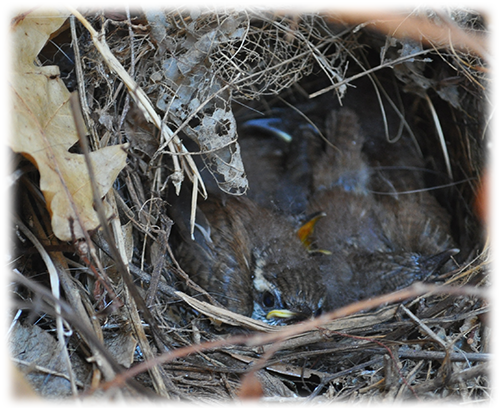
Fast-forward 13 years. As we prepared to celebrate my latest teenager’s birthday, and for just the second time in my own life, we have a new bird’s nest outside our door. From what we can tell, this is a family of Carolina Wrens. We know something these parents don’t. Two months ago, that flower pot was a hideout for a snake. Last month, some large rodent was hanging out there. Now, it is home to these delicate babies. So we have been watching them in earnest.

We’ve noticed that the parents’ protectiveness looks different than the swallows’. The food deliveries do not lead to loud frantic squeaking. And the parents don’t try to frighten visitors. Oftentimes, when we peer into the nest, we only see the babies. No doubt a parent is nearby, watching, but not imposing, ready to guide their little ones to eat and eventually to take flight once the coast is clear.

New research came out last week revealing that, compared to mammals, bird brains have many more neurons per square inch. This helps explain why they have such complex cognitive abilities in their tiny brains. Various species of birds can store food, make tools, understand cause-and-effect and even plan for the future. So maybe these guys on my porch aren’t as helpless as they appear. I know my 13-year-old isn’t.

I’m learning that the wren’s style of protection is like the role of parents of teenagers. Nearby. Watching. Not imposing. Our babies are no longer completely dependent. Our job is to let them try out their new wings even when they stumble. It is in fact the stumbling that reaps learning and confidence to take the next step.

Perhaps this is what “free will” really means. Maybe it is not just about having the space to believe or not believe, to follow or not follow. Rather, we have ample room to reach, falter, learn and get back up again, stronger. In this space, we are most able to grow to become who he has created us to be – something I have to remember when my teens begin to fluff their own wings.

ChristieGoodmanAPRb2in

Christie is manages communication for the Intercultural Development Research Association. With two daughters, she and husband Paul are active with Girl Scouts, March of Dimes and Woodland Baptist Church. https://www.facebook.com/christie.goodman.apr
Jennifer Andrews-Weckerly: Everyday Theology in the News

Before I became a parent, I used to be the brunt of many jokes about parenthood. The jokes were justified. Though I devoured The Baby-Sitter’s Club books as a preteen, I never really did much babysitting in real life. It turns out babysitting was not as picturesque as it seemed in the books.

By the time I was a college student, most of my girlfriends were gaga over babies and kids. I, on the other hand, held them at arm’s length, having no idea how to do any sort of mothering activities. And heaven forbid there be a group of children all together. I was like a deer in headlights with too many kids around.

When I became a priest, I was terrified I would have to do children’s ministries. I did not know how to talk to kids, and I certainly did not know how to explain complicated theological concepts to children. I almost cried the week when I prepared my first “child friendly” sermon as an associate.

Becoming a parent meant I quickly got over the physical stuff with children. In fact, I have become much more like my college friends, dying to hold little babies. But what never did come naturally was learning how to talk to children in an accessible way about God. I know this to be true from the many times my six-year old’s eyes have glazed over as I tried to explain something about church or God.Jennifer and Simone.jpg

This handicap has become especially challenging these last couple of weeks. For some reason, my oldest daughter has become fascinated with the news. Whether on TV, looking at pictures in the paper, or listening to snippets of NPR before she makes me change the channel to music, my daughter has started paying attention – and paying attention has meant that questions have started coming.

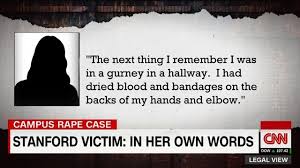
Last week, the questions were about what a boy from Stanford did to hurt a girl. I struggled to know how graphic to be with a six-year old about sexual assault, consent, and our bodies. Part of the challenge is that my daughter’s questions are usually pretty basic: “Why is he in trouble? Why are people mad?”

Stanford Case.jpg

I try very hard to give her basic responses, but how do you not talk about the objectification of women, the bias of our justice system against sexual assault victims, the difference between healthy, responsible sexual activity and rape, and white, male privilege?

This week, the news is haunting me again. The questions were again basic: “Why are they talking about people dying? Why did he kill all those people?” Which topic do I try to tackle: gun violence, homophobia, or cultural differences? She knows that women can marry women and men can marry men, but I am not sure we have used labeling words like gay, lesbian, or transgender. We have talked about Mommy’s aversion to guns, but she does not understand how people procure and use assault weapons.

Newsprint.JPG

And I certainly have no idea how to bring God into all of this. Luckily, she seems to get caught up in the details of the news instead of waxing philosophical with me. But someday she will. And I do not know how I will delicately explain my sense of who God is versus who others say God is.

Though they were not related by blood, Naomi and Ruth were mother and daughter by choice. In a defining moment in their relationship, Ruth declares, “Do not press me to leave you or to turn back from following you! Where you go, I will go; where you lodge, I will lodge; your people shall be my people, and your God my God” (Ruth 1.16).

Naomi’s job from there on out is to teach Ruth the ways of her people and her God. There will be no escaping Ruth’s presence. So Naomi better start teaching and talking to Ruth.

I remember when my daughter was three or four, I used to immediately skip the news channels when looking for something on PBS or Disney. Now, my daughter wants to watch the news. I suppose her desire to watch, listen, and read is a gift to me – a chance for me teach her about the evils of this world and how God is an agent of love and light despite darkness. That is what I tell the adults in my life every day.

Now I have to figure out how to tell that same story so that a six-year-old, a twelve-year-old, a sixteen-year-old, and a ninety-year-old alike can understand. I will likely fumble my way through. I suppose it is a good thing that God has always worked through me in spite of me.

Andrews-Weckerly Family.jpg

Jennifer Andrews-Weckerly is a minister and mother of two living in Williamsburg, Virginia with her husband, Scott. In her free time, she enjoys watching movies and having dance parties in the kitchen.

Photo credits:

http://www.abc.net.au/rampup/articles/2013/11/06/3885317.htm

http://www.wcyb.com/news/money/why-ashleigh-banfield-read-stanford-rape-victims-letter-on-cnn/39925028

Ashley Mangrum: Everyday Theology: Turning People into Humans

I have avoided introducing my children to superheroes for as long as possible. I walk past the superhero aisle at Target, and when asked about the action figure wearing red with a spider on his shirt, I say, “That is Spiderman. He can make spiderwebs with his hands.” I always redirect the conversation because, to be honest, I don’t know how to talk about superheroes with my two and four-year-olds.

Superheroes use weapons to fight the “bad guy” (or in some cases another superhero, further complicating the matter and scraping the bottom of the superhero barrel). The enemy is always defeated by physical force and is often injured or killed in the process. I find it difficult to explain how fighting, injuring, or killing another person (or at least another weird, red, mutated being) is justified only because it’s the “good guy” doing the fighting, injuring, or killing.

Maybe it is just me, but four seems a little young for a discussion about Just War Theory.

When children play superheroes, they no longer pretend to save someone from a fire, for example. They pretend to fight each other–the sad and inevitable outcome of a radically desensitized culture obsessed with violence and victory at all costs. In superhero world, violence is required to bring peace and make the world a better, safer place. I don’t think this view of the world is consistent with the teachings of Jesus.

However, it would seem that my avoidance of superheroes has come to an end. My son has picked up on their existence. We do not live in a hole, so it was bound to happen sooner or later. My son loves to write stories (well, he likes to tell a story and have it written down by someone who can actually write), and one of his most recent stories was about superheroes:

Once upon a time, there was a school bus and a highchair. More than anything else in the world they wanted to be humans. And Batman comes and turns them into humans. Then Batman sees some bad guys coming. Oh wait, this is Spiderman. And Spiderman uses his spider webs to catch the bad guys. A chair and a tree come and they want to be humans, too. Batman turns them into humans because Batman is there and Spiderman is there, and they both have powers to turn people into humans. Then they all go back home. The end.

photo 2

It seems all my family’s talk of peacemaking has muddied the superhero waters. According to the imagination of my four-year-old, superheroes turn people into humans. This may seem like mere semantics, but I think he is onto something.

In her book Leaving Church, Barbara Brown Taylor writes, “the call to serve God is first and last the call to be fully human.” To be fully human in this sense is to be the person God has created and called you to be, and by living into our true identity, we serve God. To be fully human is not only to recognize one’s own humanity but, perhaps more importantly, to recognize the humanity of others and to value it.

It requires us to acknowledge that each human being comes with a story and a context, hopes and dreams, hurts and disappointments–even the ones we do not like and want to vanquish with superhero strength. Superheroes help us see each other not as mere people but as humans called and created by God. We each have the power to turn people into humans.

I foresee many, many more conversations about superheroes in my future. And I will tell my children that anyone and everyone can be a superhero. Anyone can make the world a better, safer place simply by choosing to love others. Real superheroes use words and not weapons. I will teach them to use their brain and not their brawn to work for what is right.

Real superheroes make peace, not war. They fearlessly live into their humanity as creatures of God. And they help others to do the same.

photo (1)

Ashley Mangrum is a minister and mother of two living in Davidson, North Carolina with her husband, Ben. In her free time, Ashley is an aspiring artist and cupcake connoisseur.


Griselda Escobar: Everyday Theology and the Ordinary Task

She says she does not know when it began. She cannot pinpoint what caused it. She could not recall the first time she realized it. All she knows for sure is where she is now.

Life has become overwhelming.

The work that once filled her heart with passion became difficult to fulfill. Preparing lunches, making schedules, and following those schedules somehow transformed into too much. Times of enjoying the moment and the family she loves felt scarce. Her child’s laughter –which makes her smile as she thinks of it–could not change the feeling. The continual support of a loving husband were not lifting the weight.

What happened? she asked. How did I get here?

As time went by she has tried different approaches and sought for answers to help her deal with her feelings. She has kept praying. But at times she continues to doubt herself, her feelings, her faith.

Her God has not changed though. And she has become amazed at how God continues to mold her faith . . . in the everyday ways.

In 2nd Kings 5 we find the story of Naaman,  a powerful military leader in a vulnerable place. He was not accustomed to being out of control. In fact, he was always in control.

Here Naaman finds himself in an uncommon situation, a situation completely out of his control: he has contracted leprosy. He is in desperate need of healing. His wife’s servant girl refers him to the God of Israel.

Out of resources, out of control, he goes. He starts at the palace with the king, but leaves empty handed. He’s then referred to the prophet Elisha, who doesn’t even go out to speak to him in person, but sends a servant to relay the message.

Elisha tells Naaman to do an ordinary task in an ordinary place. He is not sent to a special location renowned for its healing miracles. No one promises him an extraordinary experience.

Instead God simply told him, through Elisha, to go and bathe himself seven times in the Jordan.

Naaman goes away angry. He is thoroughly unimpressed with the prophet of Israel. “’I thought that he would surely come out to me and stand and call on the name of the Lord his God, wave his hand over the spot and cure me of my leprosy. Are not Abana and Pharpar, the rivers of Damascus, better than all the waters of Israel? Couldn’t I wash in them and be cleansed?’ So he turned and went off in a rage.”

What kind of healing involves just ordinary basic hygiene?! Where was the drama? Where was the flair? Had his servants not intervened and convinced him to try these simple instructions, Naaman may never have been healed.

But God picked an ordinary way to heal him. Here in this ordinary place, doing an ordinary task, in the presence of only his companions, God brought a miracle. Naaman’s healing reflects the sacredness of the ordinary in the hands of an extraordinary God.

Mental illness can be a hard thing to talk about. It is often not discussed, especially by those dealing with it, because it carries a different stigma than being diagnosed with diabetes, heart disease, or hypertension. So it stays hidden in the shadows far too often, with sufferers cut off from resources and people who might help them. In the church especially, our silence and judgment has damaged those who most need us.

The stigma around mental illness might be similar to the stigma that accompanied leprosy in biblical times. Leprosy was viewed as a punishment for personal sin. Today, in many faith communities, depression or other mental illnesses are viewed as a result of a lack of prayer or faith or even because of a “bad spirit.”We turn away from what we don’t understand.

The embedded theology in this stigma around mental illness says that those who struggle with mental illness or love someone who does are being punished by God–or at least forgotten, cast aside, like damaged goods. It says that we are to blame for the illness we are experiencing and our ongoing struggle only testifies to our lack of being “right with God.” If we really loved God (or God really loved us), we wouldn’t be wrestling with this illness.

Unraveling the embedded theology around the stigma associated with mental illness unmasks it as completely false. We do not worship the One who hands out illness, whether  heart disease or depression, cancer or bipolar disorder, as punishment. We worship the One who is near to the broken hearted, who reached out to those everyone else had shunned, who brought healing to people who suffered from all kinds of illnesses. The more we expose the lie of the stigma, the more we shed light on the truth of God’s love and grace.

Today the woman at the beginning of this story is receiving the help that she needs and joy has begun to seep back into her life, especially in the gratitude of ordinary tasks. She has begun to enjoy family game night and movie night. Her laundry room has become holy ground; the act of washing dishes has become a sacred act.

Her home is the holy of holies and she has grown grateful for this process and the family who will experience her healing as witnesses of God’s power. The ordinary tasks of daily life have become a reflection of a loving God. There is no ordinary work, task, or place with an extraordinary God.

13348822_10209309612439391_1329748157_n

Griselda Escobar is an ordained minister living in Corpus Christi with her husband and son. An experienced chaplain, she enjoys serving God in different church opportunities through preaching and working with women and children.