Tag Archives: faith

Katrina Stipe Brooks: “The Magic of a Ministry Reframe”

One afternoon last summer my spouse came home from work smiling. Not simply happy, mind you, but his face was beaming. In response to me asking the reason for his mood, he simply said, “I am going to be Santa Claus this year.”

Curious, I responded, “Um, okay. Where did this idea come from?” Moments later I understood.

Initially asked by a colleague, “Can you grow a beard?,” my spouse accepted an invitation to be Santa Claus for his colleague’s small business. From that day on I was married to Santa Claus.

Look! It’s Santa!

Do not get me wrong, my husband was born for this role. Look at his face, his beard, his smile… the twinkle of mischief in his eye. All the years we have been together he has radiated joy and showered blessings of hope on weary folks.

Grandpa/Rev. Dr. Santa Claus with Granddaughter Ivy

But him being Santa Claus took me off guard. I was not ready to be Mrs. Claus.

Honestly, it is not a vanity thing. I am aware that I am a woman of a certain age. Since my fiftieth birthday I have navigated a chronic autoimmune illness and daily I attempt to mitigate inflammation with meds, diet, and exercise. “Things” once in a certain place are no longer in that place as my body changes.

If I could find the right style for the natural colored, “mind of its own” hair I have sported since the pandemic lockdown, the short white hair with silver undertones would be an asset. Most days, it is not. Refusing to have unnatural brows, I struggle to find just the right eyebrow color to brush in brows reminiscent of the thick full ones I had for years. (I may have finally found one.).

And while I never had perfect skin, my skin sensitivity has drastically changed my skincare and makeup routines. The products I used no longer work and finding new products has been a financial endeavor akin to launching a new business.

I am aware that I am a mature adult; I just do not feel sixty-one.

What does ministry look like when you are sixty-one?

In my thirties and forties, I had an office and a congregation to serve. I had a chair that hugged me on hard days and a pulpit that swaddled me when I proclaimed the intersection of God’s story with God’s people. There were church folks who advocated for me and encouraged me, especially during challenging days.

In my fifties, I had an office and a campus community. I had students and colleagues who partnered with me to stand as beacons of hope during a pandemic that touched almost every student and employee in a tangible way. I had the energy and passion of young adults deconstructing their faith and reconstructing a faith organic to who they were becoming to remind me to stay on my own spiritual journey.

Yet here in my sixties, I do not have an office, a congregation or a campus community to serve. I do not have a chair that hugs me, or a pulpit that swaddles me, and I do not have students and colleagues to draw energy from, or journey with on spiritual pilgrimages. All the “traditional things” that count when people speak about ministry and pastors are no longer part of my life.

Does that mean I am no longer in ministry?

Absolutely not. I remain called to share hope, love, grace, joy, and blessing in this season of ministry. Replacing the more traditional “ministry things,” I have lounge chairs that hold me as I dream and imagine possibilities on the lanai. I have pool sounds and smells that bring me comfort. I meet the coolest people at the coolest places, including church.

For the first time I have extended family within an hour of where I live. Monthly I meet with my nieces (who are only now experiencing church as married young adults with children) just to get to know each other. I am able to visit my son and his family in Kentucky and journey with them in person during times when their life is hard to manage.

As the “stay at home” member of a multigenerational, multiracial, neurodiverse home, ministry looks like preparing meals, washing clothes, managing finances, navigating home and pet maintenance, and not taking it personally when a conversation escalates out of control, or someone is having a day when a typical way of communicating causes more frustration than needed.  

During this season I am able to reach out almost immediately when someone comes to mind rather than wait for a block of time to share a word of love and care. Best of all when a story wells up, I am able to fashion and form it into something I can share with others without having to clear my calendar and reschedule multiple meetings and events.

What does ministry look like at sixty-one?

I am still figuring that out. In many ways ministry looks like it always has as I continue to love God and neighbor and continue to proclaim in word and how I live my life the intersection of God’s story with God’s people and their stories.

In other ways, ministry has been reframed for my season. One day I may return to a more traditional form of ministry, complete with all the typical “ministry things,” but for now this is what my ministry season looks like even if I am still figuring out what that means.

To be honest, it is a wondrous and magical adventure. Besides, I am married to Santa Claus. How cool is that? 
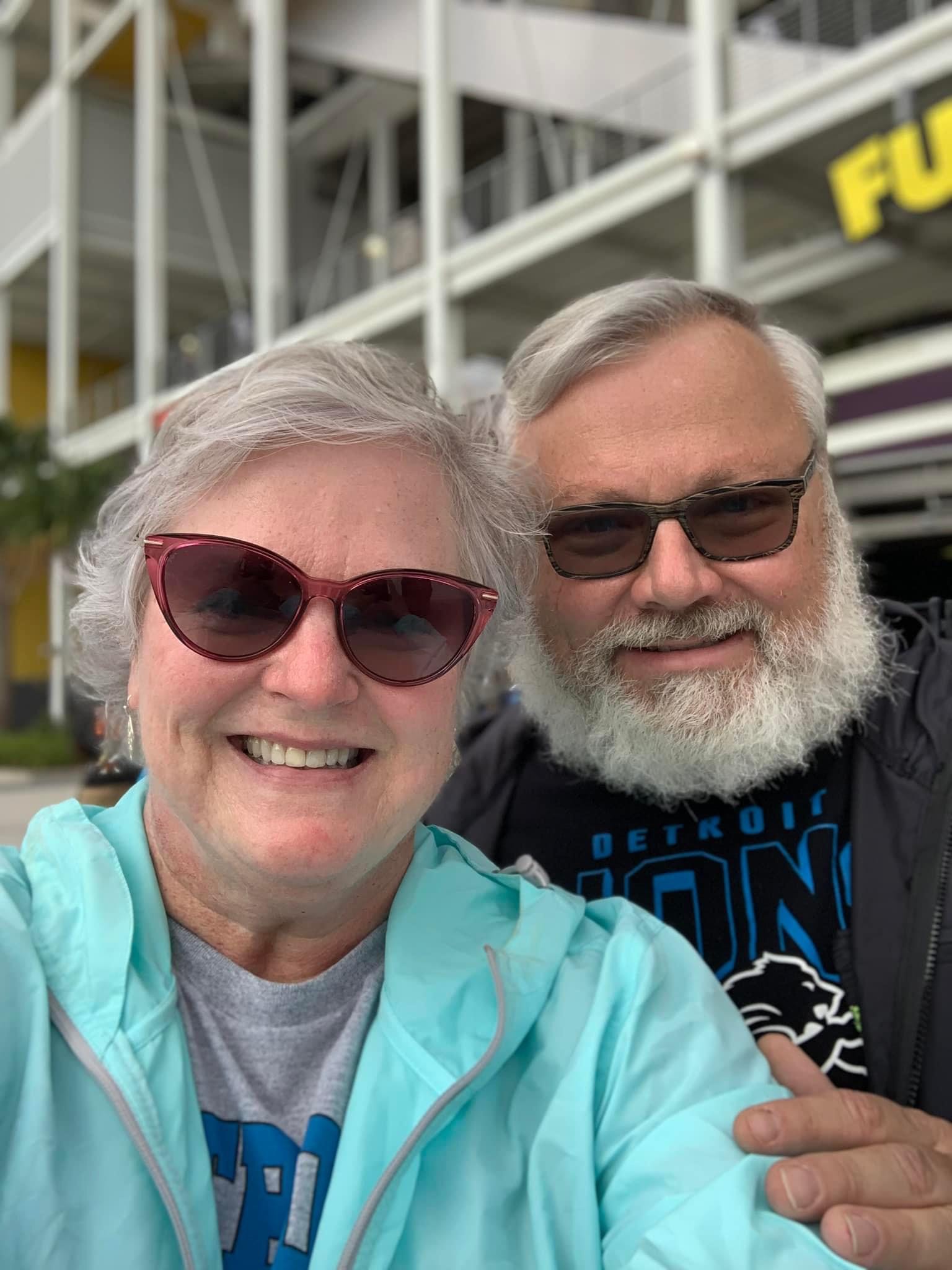
An original contributor to our book A Divine Duet: Ministry and Motherhood, Rev. Dr. Katrina Stipe Brooks has served in a variety of ministry roles: co-pastor, campus pastor, college pastor, youth pastor, coach, and retreat leader, among others. She currently lives in Florida and can frequently be found joining in the magic of Disney and engaging in ministry wherever she is.

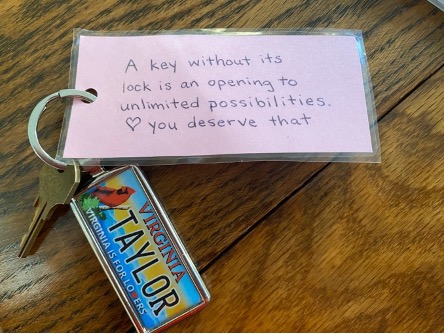
Virginia Taylor: Unlimited Possibilities

I listen to the Lectio 365 app for my daily devotionals. Sometimes, if something stands out to me, I will write it down in my planner. On Friday, Februrary 3rd, 2023 I jotted down, “Do not be afraid, I hold the keys” (Revelation 1).  The next day I received the key chain pictured above. God had my attention! 

First of all, the person who gave me the key chain was my daughter’s best friend’s boyfriend. Now, this young man barely knew me. We had been at the same group dinner a few times over the course of a year and a half and our conversations could best be characterized as casual chit chat.

But, I had sent a gift to him via his girlfriend—it was a pen I had found while clearing off my desk one day at church.  I thought of him because it had his name on it—Calvary. Shortly after that, Calvary went on a trip to Virginia and decided he would get something for me with my name on it—Virginia—to reciprocate. That alone would have been super thoughtful, but what he did with that key chain, adding a key and handwritten note, changed my life.

At the time, I was in my fourth year in a ministry position at my church and pretty happy. Hear me clearly: it was not perfect, but I loved the staff, I loved the families and children I worked with, and it was all very comfortable and easy. When I got the key chain, I told our ministry staff about it and asked them to pray for me.

Over the course of the next couple of weeks, I became more and more uncomfortable. Verses like, “Open the gates and I will go in” (Psalm 188:19) jumped out at me, or this prayer, “Holy Spirit, show me if I am too settled in this world. Shift me from my anchoring places of my own security” (Lection 365, 2/8/23). Then, on February 15th, in a commentary on the passage of Jesus calling the disciples, I heard, 

“Christ remains the Great Disrupter, challenging me to trade what I know for the great unknown, and all that I own for a greater cause…There is a wildness about the life of the pilgrim who leaves what is nailed down, obvious, and secure, and walks into the unknown without any rational explanation to justify the decision or guarantee the future. Why? Because God signaled the movement and offered it his presence and his promise” (Lectio 365, 2/15/23).

Before my husband left for work that morning, I said to him, “I feel like I need to resign from my job today or else God may cause our house to catch fire (and hopefully not be consumed) in order to get through to me.”

And that’s exactly what I did. It’s hard sometimes for people to understand that you would walk away from a perfectly good job to go to “nothing.” They like it better if you are going to something bigger and better.

I had a bit of a cushion that made it easier for the people in our congregation to accept, because by the time the church heard I was leaving, we had found out that our daughter and her husband and our first grandchild were moving from Chapel Hill to Ohio. So, in most people’s minds, I was leaving so that I could spend more time with my family.  While there was a kernel of truth in that, the real truth was that God had moved me to “leave what was nailed down, obvious, and secure, and walk into the unknown.”

I spent the next three months traveling back and forth from Chapel Hill to Ohio. I was enjoying the freedom of being able to come and go as I pleased, but in the back of my mind I was thinking about what I might do next vocationally. I have worked, sometimes more than one job at a time, since I was 15 years old, and while I am in my 60’s and close enough to retirement age, I had a sense that God wasn’t finished with me yet. I wasn’t uncomfortable; I would describe it more as curious.

And then everything became clear.

Ka’thy Gore Chappell, Executive Director of Baptist Women in Ministry of North Carolina called to tell me that BWIM NC had just received word that they had gotten a grant from the Lilly Endowment. I was aware that BWIM NC had applied for a grant and that it had something to do with preaching, but that was as much as I knew. Imagine my surprise when Ka’thy said that the grant included a part-time position for a grant director and that they would like for me to fill that role.

Surprised, but not really.

In that moment I could see clearly that God had led me to trade in what I knew for a greater cause.  And what a cause it is—to use the generous resources of the Lilly Endowment to give Baptist women in our state opportunities to become better preachers and ministers. 

“There is a wildness about the life of the pilgrim who leaves what is nailed down, obvious, and secure, and walks into the unknown without any rational explanation to justify the decision or guarantee the future. Why? Because God signaled the movement and offered it his presence and his promise” (Lectio 365, 2/15/23).

My prayer is that if you are reading this, you too will live into the unlimited possibilities of God’s presence and promise. 

💙 You deserve that!

Rev. Dr. Virginia Taylor has served in a variety of ministry positions, from senior pastor to college minister to children’s minister and more. She’s mom to an adult daughter and now grandmother to a beautiful granddaughter! She and her husband Ralph live in Chapel Hill.

Aileen Lawrimore: “Read It Again”

“Hey Mommy, we need to talk,” my daughter, Trellace, a freshman at Georgetown University was in her first college level religion class and she was not happy. 

“Mom! The book of Judges is awful! I never knew all this was in the Bible!”  

Trellace, born in 1994 after the Cooperative Baptist Fellowship (CBF) split from the Southern Baptist Convention (SBC), was as much a church kid as I had been. But she came along when CBF churches like ours were still trying to figure themselves out; we had not yet created reliable literature to help our volunteers teach kids biblical truths.

Determined not to be fundamentalists, some of us failed to teach fundamentals at all. As a result, there’s a whole generation of faithful little Baptists who missed out on the kind of focused Bible teaching I had received in my formative years. 

I was a child in the seventies. I went to GA’s and Acteens on Wednesdays and Training Union every Sunday night. I competed in “sword drills” so much that I could turn to a text in Haggai as fast as I could one in Genesis or Revelation. In the churches of my childhood, “read-the-Bible-through” efforts restarted every January. “Read the Bible Daily” was a tick box on our offering envelopes which we turned in weekly, containing at least 10% of our allowances.

Say what you will about old-timey SBC churches; but they taught us how to be disciplined and intentional students of Holy Scripture. 

Trellace also went to church every Wednesday and Sunday. But our church focused on God’s love, forgiveness, and grace and glossed over some of the nastier bits of the biblical narrative. Trellace had hardly even heard of Satan, let alone realized that God takes a lot of heat for ungodly behavior. Judges caught her off guard. 

“Levite’s concubine?” I asked her.  

“What? No. . . who is that?” 

“Never mind.” She’d find out soon enough.  

“Okay so anyway, Judges,” Trellace continued. “So much war and devastation. How could God call for all that evil?” 

Aha. She’d just begun the book then. She had not even met Jephthah’s daughter yet, bless her heart. “How many times have you read the passages that bother you?” I asked her. 

“Um once, why?” 

“You need to read them again.” 

She wasn’t having it. 

“Here’s the thing,” I said. “There are not many things we know with absolute certainty about God. But there are two truths I keep in mind when I’m reading the Bible. First, we know that God loves us more than we can imagine, and mere humans cannot change that, no matter what. Second, we know God is a God of grace and mercy. God is always ready to forgive us, ready to offer us a second—or 102nd chance.”  

“So then why did God ordain all this fighting, killing, and just meanness?” Trellace asked, teetering between skepticism and relief. 

“Well, that’s why you need to read it again. Maybe you misunderstood.”  

“Yeah Mom, I don’t think so.” 

“Here’s the thing: God is NOT a Big Bad Meany. We know that. We know that we know that. This is an absolute. There may be infinite additional truths about God, but this is one we know for certain. So, when it looks like God is being a Big Bad Meany, we know that there is more to the story,” I explained. “So, we need to read it again.” 

This has been a failsafe method of Bible study for me for decades.

Sometimes there’s a nuance in the text that I overlook. For example, Psalm 109. In this text, the Psalmist is nothing if not a Big Bad Meany. But a close look will remind readers that it is not God pronouncing these evils; this is a psalmist’s honest prayer that his own wicked desires be sanctified. It’s a beautiful example of how to be authentic before God, regardless of how ugly we look in the moment. 

Other hard texts might depict antiquity seeking explanations for life’s successes or failures. It’s not like they could check satellite images, order MRI’s, or run blood tests. They made sense of things the best they could. And often that meant throwing God under the (not yet invented) bus.

I remember getting downright furious with God for killing off Uzzah. You’ll find the story in 2 Samuel 6. David and the boys are celebrating the return of the Ark of the Covenant when the ox leading the cart that holds the Ark stumbles. Uzzah reacts reflexively and catches the ark before it falls. Then, according to the text, God strikes Uzzah dead for touching the Ark.  

That’s some serious Big Bad Meany behavior, right? I tagged the text for future discussion with my father, a pastor. In those pre-cellphone days, we had to wait for face-to-face visits for conversation, or at least until after 10 when the long-distance rates went down. 

A few weeks later, sitting in his living room, I recalled the Uzzah story. “Daddy!” I said, “God’s just being petty here. Uzzah was only trying to help. Would God prefer that the Ark fall into the road?”  

“Hmm,” Daddy said, hardly looking up from the solitaire game he had laid out on his lap desk. “I always figured Uzzah had a heart attack when he realized what he had done, and the people gave God the credit because they didn’t understand science.”  

For parents who are also biblical scholars, we give you thanks, oh Lord. 

Of course, there are also times when the texts won’t become clear upon subsequent readings. Faithful students learn to live with this because contrary to Descartes’ declaration of cognito ergo sum, we cannot always think our way into understanding. Often, we need to sit with our questions, live in the mystery of faith. As difficult as that can be, it’s a lot easier if we remember that God is NOT a Big Bad Meany. 

“Oh,” Trellace said. “I get it. Okay. Thanks. Headed to class. Love you Mommy!” 

“Love you too Trellace,” I signed off. 

Help her to keep reading, I prayed. Help her to keep asking questions. And help her always to find shelter in the truth that you love her more than she can imagine, and that you are not now, never have been, and never will be a Big Bad Meany. 

Rev. Dr. Aileen Lawrimore is a minister, writer, and parent of three adult children who currently pastors Ecclesia Church in Asheville, NC.

Photo from pickpik.com.

LeAnn Gardner: Everyday Theology: Subversive Hope

If you are anything like me, the energy and current of our world can squelch my hope in the future in a matter of seconds. I start to fear for my boys, and before I know it, I’m parenting out of fear. I’m wife-ing out of fear. I’m friend-ing out of fear. Which is not at all the person I want to be.

Newsprint

There is indeed a lot to fear. What I have come to learn about myself is that I cannot let myself go down the spiral of anxiety for too long. Given my personality, sitting in that place would leave me immobilized, isolated and hopeless. It does not help anyone, including these littles I am parenting to stay in that place. I don’t want them to have a mother whose modus operandi is fear.

Nor do I want to live in denial. Because pretending or ignoring that nothing bad happens in our world is inauthentic as well. So what can we do to care for our hearts so that we are not constantly bogged down with helplessness?

First, we decide to ingest images of hope. I am a visual person. If I see something one time, it is locked away forever in my mind’s eye. Because my vocational choices have led me down paths where I heard, day after day, stories horrific of abuse and neglect, I have to be very disciplined about what I choose to hear and see.

This vocation of hearing people’s sadness has put certain things off limits for me- certain movies, books, etc I cannot read. When someone tells me of a great book they have just finished, I ask questions. “Is it graphic? Does it involve abuse of any kind?” If the answer is yes, I can’t do it. Same goes for TV. My husband knows not to even ask me to watch a Quentin Tarentino movie. It’s just not ever going to happen.

This is a conscious decision on my part. This may not be a big deal to you, but I know that for hope to have its full potential to enter my heart, I have to keep certain visuals out of my mind. This is where I’m sounding very preachy and again, everyone is different. What kind of inventory needs to be done in your mind to make room for the seed of hope?

I also believe we have to be intentional about letting the good things in as well. There is new research that says our brains are wired to pay more attention to the negative than the positive. Neuroplasticity means that by simply training the brain to stop and pay 15-20 seconds of attention to small positives (a stranger’s greeting, a sweet kiss from a baby, the sweet signs of a loved one in your life, the chance to feel your lungs and legs working) can actually rewire your outlook to be more positive. Hope is intentional and subversive.

Nadia Bolz-Webber, a Lutheran pastor in Denver, talks about her tendency to become angry and hopeless- and quickly. One Sunday, right before she was to serve the Eucharist to her congregation, someone said something to her that elevated her cortisol levels rapidly and high. She spotted infant twins in the congregation and instinctively asked the parents if she could hold one of the babies. That day, she served the Eucharist with a baby in one hand and the elements in another. She knew that she had to replace her anger with good energy- the energy of an innocent baby- to get through the service and to offer her congregants the elements.

Now not all of us have access to babies when our stress elevates, but the point is it could be helpful to have a strategy to mitigate the stress and fear that enters our brains and hearts at a rapid pace. As we continue being bombarded by election coverage, perhaps we can be on the journey to exploring a good balance of being informed, but not overcome by this election season, knowing that our ultimate hope does not rest in a candidate, but in a Savior.

We surround ourselves with hope bearers. Being in a community of faith makes this one easy for many of us. In my community of faith, we hope together, as a body of Christ, as we gather school supplies for kids who are in a difficult place. We work alongside Metanoia, a holistic community development non-profit, to make lasting community change. And on a micro level, we surround ourselves with intimates who don’t have their heads in the sand, but who believe alongside us, that love wins every single time, even if at that particular time it doesn’t feel like it.

I’m not talking about Pollyanna faith here-I’m not talking about someone who says to a person in deep grief: God wanted one more angel in heaven. NO. I’m talking about the people, who in deep vulnerability, walk alongside the wounded as they grieve, recognizing that pain, death, poverty and suffering are realities.

But even beyond pain, I believe that a church community are witnesses to the wholeness of our lives- even the seemingly mundane part of our lives. We not only celebrate the big things: baptisms, weddings, graduations, births, but we show up and bear witness to new jobs, beginnings of school years, lost teeth, basketball games and new homes. We bear witness to one another’s lives.

Unknown-1

We roll up our sleeves and become agents of hope ourselves. What if, instead of allowing our fear to immobilize us or make us angry, we meet fear in the face and defiantly say, “I’ll show you!” And what we show is service. When we fear, we serve. When we have anxiety, we serve. When someone moves, we help them pack. When someone has a baby, we take them food. When youth go to camp, we go as a chaperone. When the church needs locking up, we stay late and lock up. When the children need teachers, we teach. When the tables need moved, we move them. When the Spirit lays someone on our heart, we call them.

My rolling up of sleeves service will look different than your roll up your sleeves service because we are different in our giftings and callings. The point is, as we wait, as we long for the suffering of the world to end, we serve. And we celebrate the good that is already happening in our midst. God knows no one is glad that the Charleston shooting of nine innocent souls happened, nor the trauma of the survivors. But the hope that peeks through in tragedy is God’s business and we have seen the Gospel on display many times throughout the aftermath of that unspeakable tragedy.

Every night as I lie in bed with my four year old or as I rock my two year old, I sing a hymn. It is my quotidian act of subversion; to sing this song of hope into their ears. Hear these words:

“Go my children with my blessing, you are my own. Waking, sleeping, I am with you, never alone. In my love’s baptismal river, I have made you mine forever, go my children with my blessing, never alone.”

We are not alone. We belong to God, the one who gives us our hope. We are loved. We love. And we speak truth to the hope that propels us. Love wins….every single time. Amen.

IMG_5543

LeAnn Gardner is a right brained social worker and minister married to a left brained engineer. Together they (sometimes) compose a full brain. She is mother to two boys, ages 4 and 2 years.


Hannah Coe: Ordinary Miracles: The Miracle of Trust

Trust vs. Mistrust.

Perhaps you’ve heard the phrase? It’s Erik Erikson’s first stage of psychosocial development. In the early months and years of life, children learn to trust (or mistrust) people and their environment. When they are hungry, does someone feed them? When they need to be held, does someone hold them? When they have something to say, does someone listen?

I’m a minister who works with children. I’ve heard the facts, but there is nothing like experience to prove that the window of 0 to 3 years is a crucial time for children to develop a sense of trust. This is why the nursery is such an important place in the church. It’s why the childcare for infants and toddlers during worship is so important.

Please pardon the clunking noise. It’s me stepping on my soap box.

Caregivers teach children that they can trust God. Children form their foundational understanding of God through their experience with adults. Children learn love when we love them. Children learn grace when we offer them grace. Children learn trust when we build a trustworthy environment. Ministers can remind caregivers (over and over again) that they embody God’s love for children. They are teaching children to trust, enabling them to have faith.

I am forever learning to trust God. I am forever learning to act like I trust God. Trusting God occasionally comes naturally. Most of the time, it’s unnatural. I cross my arms and turn my back. In my best two year old voice, I pout, “I don’t want to!”

I don’t want to trust that God is working all things together for good. I want things to work out my way. I don’t want to trust God’s timing. I want to force my timeline on the projects and people around me. I don’t want to trust God to provide what my family and I most need. I want what I want when I want it.

Jesus wasn’t kidding when he said God’s kingdom belongs to children. My firstborn recently turned three. Her trusting soul is an (extra)ordinary miracle. She wakes up in the morning and trust-falls into my arms. She calls for help when she is hurt, sad, or nervous. When she asks a question, she presumes the answer to be honest and true. When I react inappropriately and apologize for my actions, her forgiveness overflows from a bottomless well of trust that can only come from God.

I am most often learning trust rather than teaching trust. Does that seem ironic to you too? Indeed, it is the mysterious, irresistible, beautiful, and challenging irony of ministry and motherhood.

Today we live in a world of mistrust. That is why I find trust to be miraculous—an unexpected occurrence for which there is no rational explanation. Against the backdrop of a difficult world, the trust exhibited by children is a miracle. Amid pain, grief, and suffering, people choosing to put their trust in God is a miracle. In the midst of seismic cultural shift, churches that trust God’s call to minister are a miracle.

The other day, as I walked out of a local hospital after doing pastoral visits, a chaplain came over the intercom to offer a morning prayer. I did not hear the whole prayer. But the first line of the prayer stuck with me:

In you, O Lord, do I place my trust. You are the strength of my life.

As we ride the unpredictable waves of ministry and motherhood, may our souls be anchored by trust in our Lord. May our ministry—in and outside our homes—proclaim the life-giving strength that comes from God.

OLYMPUS DIGITAL CAMERA

A Georgia native and graduate of Mercer University’s McAfee School of Theology, Hannah Coe serves as Associate Pastor of Children and Families at First Baptist Church in Jefferson City, Missouri.  Hannah and her husband, David, are parents to Katherine and Annalina. They enjoy playing, eating, and the occasional nap.

Melanie Storie: Apistos, Pistos (Unbelief, Belief)

John 20:24-29 (RSV)

 Now Thomas, one of the twelve, called the Twin, was not with them when Jesus came.  So the other disciples told him, “We have seen the Lord.” But he said to them, “Unless I see in his hands the print of the nails, and place my finger in the mark of the nails, and place my hand in his side, I will not believe.” Eight days later, his disciples were again in the house, and Thomas was with them. The doors were shut, but Jesus came and stood among them, and said, “Peace be with you.” Then he said to Thomas, “Put your finger here, and see my hands; and put out your hand, and place it in my side; do not be faithless, but believing.” Thomas answered him, “My Lord and my God!” Jesus said to him, “Have you believed because you have seen me? Blessed are those who have not seen and yet believe.”

Matthew 16:20-23 (RSV)

From that time Jesus began to show his disciples that he must go to Jerusalem and suffer many things from the elders and chief priests and scribes, and be killed, and on the third day be raised. And Peter took him and began to rebuke him, saying, “God forbid, Lord! This shall never happen to you.” But he turned and said to Peter, “Get behind me, Satan! You are a hindrance[a] to me; for you are not on the side of God, but of men.”

What state should you live in? Which Jane Austen heroine are you? What 80’s song best describes you?

If pondering these questions keeps you up late at night, then might I recommend a Buzzfeed quiz? For me, there is something giddily ridiculous about taking a Buzzfeed quiz. The questions themselves often have nothing to do with the subject matter and the results are dubious at best.

My results on the above mentioned quizzes were Montana (beautiful, but no sweet tea or grits, so it’s out), Fanny Price (not Elizabeth Bennett?!), and “Don’t Stop Believing” (I do have it on my iPhone…). There’s even a quiz entitled “Which disciple of Jesus are you?” Somehow, an algorithm including favorite colors and vacation spots yields me a result of Matthew.

This time, I’m sure the Buzzfeed gremlins are wrong. I am a Thomas and I’m raising a Peter.

Thomas gets a bad rap for his undue reputation as a doubter. Not to get too scholarly, but the word often translated as “doubt” in regards to Thomas is more literally “unbelieving.” Jesus is more closely saying, “Change your unbelief to belief, Thomas.” Then Jesus offers Thomas his wounded hands.

Thomas is often used as a cautionary tale. Don’t be like Thomas. Don’t question. Don’t doubt. Just believe. Thomas reacts to the news that Jesus is alive by questioning. “I’ll believe it when I see it.”

I would have reacted the same way.

I grew up in church and made my profession of faith in 6th grade. I was baptized soon after in a hideous yellow overall outfit that I loved. I had a special love for Jesus and a desire to be more like him.

As I grew into my teenage years, my belief in Jesus never really wavered, but I had questions for the people who taught me at church. Why are Christians the only ones to get to heaven? Is it those people’s faults if they haven’t heard about Jesus, a cross, and a tomb? Didn’t Confucius have his own version of the Golden Rule? What does that mean?

I once asked a church camp leader, “When did Jesus know he was the Messiah?” The leader responded by saying that Jesus always knew. At that point, I was older and knew better than to question further. A few years prior to that, I would have asked how a baby could have divine knowledge.

It would have saved me a lot of heartache from weird looks and lectures if one of those leaders had recognized that maybe all of my questions were the beginnings of a call to ministry. One mentor of mine told me that I was “analytical.” It took me a while to realize it was a compliment.

I was so used to the funny look I got when I started to ask the questions I asked. It was the look that said, “Please just listen to the lesson and accept it like everyone else.”

Now, I accept that analytical side of me. Honestly, it’s the part of me that keeps me Baptist when other denominations sometimes seem more attractive to me. I don’t really need or want anyone else to tell me what is “right” when it comes to my faith. I will work on my unbelief and belief between the Holy Spirit, the Bible, and my own mostly capable brain.

My oldest son, Aidan, was baptized a couple of years ago in the New River by his pastor father with our church family gathered around. My youngest son, Owen, might “walk the aisle” any day now.

IMG_0417

As parents, communicating our faith at the point in our children’s lives when they are moving from concrete to abstract thinking is a daunting task. My conversations with Owen have been different than my conversations with Aidan were. Aidan is a Thomas like me. Owen is a Peter. And Peter is a different bird all together.

On Good Friday, my boys and I walked through the Stations of the Cross at our church. These stations are designed for people to walk alongside Jesus in his final hours. As we reflect on those hours in the life of Jesus and his followers, the events become more personal to us and our relationship with Jesus is renewed.

Aidan, Owen, and I walked through the stations separately and I could see Owen growing more concerned and emotional as he touched palms and nails and surveyed the wondrous cross. I exited the sanctuary behind him and he broke into tears. As I hugged him, he cried, “I hate the Romans!” As I comforted him and offered him explanations for what he experienced, he said, “I don’t think it’s right that Jesus died for people. I love Jesus. He didn’t deserve it. He did everything right. He shouldn’t have died.”

Peter. Peter. Peter. I could almost hear Jesus admonishing, “Get behind me, Satan!” but in the context of my situation, that would have been cruel, so I just held Owen and gave him comfort.

Who can explain where belief comes from? Is it born from questioning and searching? Does it arrive in a rowboat when the Messiah asks you to feed his sheep?

All of us have our own journey. I can’t take Owen’s journey for him. I can only guide him along the way. This conversation his Sunday School teacher, his Children’s Minister, Matt, and I are having with Owen is a delicate dance. We all want him to come to faith in Jesus, but more than anything, I want him to have a faith that is his own.

Even though I cannot see it, I know that Jesus holds him with wounded hands. Just as he held Thomas and Peter. Just as he holds you and me.

IMG_0477

Rev. Melanie Kilby Storie lives in Shelby, NC with her pastor husband, Matt, and her two sons, Aidan and Owen. Currently a tutor at a local school, Melanie is finishing work on a novel, Wildwood Flower set in the Appalachian Mountains of North Carolina about a girl who can talk the fire out of a burn.

Katrina Brooks: Forever Friends

Ash Wednesday came and went in my world without its typical markings. No breeze in the air. No warm sunshine. No scrumptious aromas. No reflective liturgy and no ashes on my forehead.

Like most of the great adventures I have embarked upon, this Lenten journey began whether I was ready or not. Like clockwork on Wednesday, my inner self called my name and demanded I begin this year’s quest by counting my blessings.

Two of the greatest blessings in my life are Tia and Debbie. One I met the weekend I came as a candidate to be one of her pastors. The other I met through our daughters before her family became a part of the church.

With both it was love at first sight. My success over the years with female friends was zero, so no one was more surprised than me when we bonded.

10257797_10203819615154585_3925856032933793633_o10462497_10204283240866237_2868494803822658823_n

Tia invests herself vocationally as an academic principal for middle schoolers and Debbie as a dean of students for a liberal arts college. Tia has a boy and a girl. Debbie has two girls. Tia and Debbie both grew up in ministerial homes…one in the north and one in the south. Debbie is a bit older than I am and Tia a bit younger. Tia builds things and Debbie makes beautiful things.

I am the nontraditional one. I am the one who prefers wild finger nail polish and a hair color I was not born with. I am the one who brazenly challenges orthodoxy. I am the one who lacks homemaker skills and I am the one who is still trying to find herself vocationally after all these years.

These women “get me” even when I do not “get” myself. Having entered their lives as their pastor, I was not prepared for their friendship. Maybe it was their professionalism or maybe it was because they grew up in ministerial homes, but something inspired them to seek me out as more than “their pastor” … I was their friend.

In 2011 the season for being their pastor came to an end when my spouse took a job in a different state. I would like to say it was an amiable transition, but truth be told I fought the move. One day I will write it all down, but for now let’s just say my beloved friends pulled me through. They knew enough about grief and about me to realize that no matter how “adult” I was pretending to be when I exited the church system, I would crash and crash hard.

Unable to stop the crash, these blessings of mine walked with me. They listened and cried with me. They offered insight and thought-provoking questions. They let me grieve.

When the grief slid into depression they upped their game and intentionally connected with me in spite of the miles. Their love kept me afloat.

10357700_10203819612514519_8500076164426706554_o

When I could not find a job, these friends of mine reminded me of my gifts and talents. They pushed me to try something new and not dwell in the past. They inspired me to dream again and boldly step into a new adventure. When I did find a job and it was something outside my wheel house, these women dared me to try.

As I fashion and form who I am in this season of my life, Tia and Debbie continue to inspire me. They ask bold questions and send me thought-provoking books. They encourage me to step out and not settle. They dare me to dream big and insist I boldly step into new adventures.

These women unashamedly remind me to be the one I am destined to be and not less than. They challenge my inappropriate self assessments and dare me to try new things. They invite me to question and to wrestle with my unrest. Our friendship bears witness to a love that keeps covenant.

Gratitude for a love that never gives up, never fails, seems to be the perfect starting marker of a Lenten quest.

These women and I do life together, challenging each other to continue to be formed and fashioned by the One who modeled what love is. In spite of the miles that separate us, we commune together and are real together. We laugh and cry, weep and celebrate.

What began as a relationship between congregants and their pastor has become something very precious to me. I am the minister I am because of Tia and Debbie. I am the mother I am because of Tia and Debbie. I am the disciple I am because of Tia and Debbie, my forever friends.

Brooks pic

Rev. Katrina Stipe Brooks has served as a pastor, campus minister and youth pastor. Part of a clergy couple, she is also a mother to a daughter in Divinity School and a son in college.

Becky Brooks Jackson: Of Saints and Steel Guitars:
An Improbable Friendship

Mitch Albom has Tuesdays with Morrie. I have Thursdays with Robert Vaughn.

 Robert and June showed up one Sunday morning at Windsor Park Baptist Church where I served along with other worship leaders in a praise band. An elderly couple in Sunday-go-to-meeting clothes, the Vaughns appeared in all ways to be “churched.”

It was no surprise to find out then, that Robert was a retired Southern Baptist Pastor. Time had already siphoned his strength and diminished his vigor, but on this first Sunday after relinquishing independence and moving in with their grown son, Robert and June wanted to worship with Christian brothers and sisters. Many of us gathered around this impressive, silver-haired gentleman in his suit and tie.

Though frail in form, Robert still possessed a thundering, ministerial voice and our pastor, Grover Pinson, often called on him to pray a blessing before a meal or a benediction over our congregation. Like the booming bells in Wagner’s Parsifal,[1]<Brother Robert’s simple utterance, “Our Father…” silenced colicky babies, fidgety children, and possibly all the screeching crickets within a square mile. Windsorites certainly perked up when Robert called on God, but I wondered if his voice didn’t cause the great cloud of witnesses to turn and pause as well.

 One Sunday, Grover informed us that this solemn, stately pastor also played a mean steel guitar. That night we worshiped with our usual praise band accented by this Grand Ole Opry octogenarian. It was a hoot!

A few years after Robert and June joined Windsor, I was slated to preach my very first sermon in chapel at Logsdon Seminary on our South Texas School of Christian Studies’ campus in Corpus Christi. Unbeknownst to me, Pastor Grover spread the word and on the day of chapel he showed up with a number of our sainted senior adults, including Brother Robert.

I was pretty sure that Brother Robert possessed a strong strain of fundamentalism and wondered if he had, perhaps, come to spy out my liberty. Yet after I preached, he told me I did a fine job and exuberantly thanked me for the message.

The next Sunday, he called me over to his pew and when I leaned down to greet him, he declared, “I want you to know that I have NO PROBLEM with you preaching! You are called!”

Now, my granddaddy was also a Southern Baptist preacher, and while he was living would not have condoned me preaching from any pulpit. So Brother Vaughn’s pronouncement felt to me like a surrogate blessing from my own grandfather.

Since our initial meeting, Pastor Vaughn has endured heart surgery and multiple set-backs, including months with a respirator which ravaged his clarion voice. Now he speaks in a whisper and requires a breath for every word or two. This man who loves to sing and worship, can only stand briefly and whisper lyrics.

To make his loyalties clear to his fellow congregants, in every service and on every song, whether favorite old hymn or contemporary praise, he follows the lyrics in the bulletin and lifts his free hand in praise to God. Every music minister needs at least one Robert Vaughn in her congregation!

Robert Vaughn 1
I spend a little time on most Thursdays with Brother Robert, but I have lost track of when our meetings started. He asked me one day to come by to play hymns and sing for him. Then, after a few visits, he admitted to me that he wanted to play the steel guitar again, but needed someone to sing to keep him on track. Otherwise, “Pass me Not, O Gentle Savior,” frequently segued into “I Need Thee Every Hour,” and his practice sessions became frustrating. So now we worship together with an old steel guitar and my rapidly aging voice. And we share joy.

The Wednesday night after my new congregation called me to be their worship leader, Pastor Grover telephoned me and described how Brother Vaughn made his way to Windsor’s business meeting, shuffling along with his walker. Robert stood and in his halting, whispering voice, made a motion that the congregation license me to the gospel ministry! What a gift of affirmation!

Though we are no longer members of the same local church, Robert and I still meet once a week as health and schedules allow. We sing through at least five, sometimes as many as ten hymns. (Every now and then, with an impish grin on his face, Robert breaks out into to some Hank Williams or Johnny Cash, too!) We share concerns and then we pray for each other. We pray for strength to serve and breath to praise until the day God calls us home.

Like Robert, I love to worship God through music and I thrive on leading others to do the same. If the Lord allows me to live as long as Robert, my voice will become more brittle, my asthma will scar my lungs, and arthritis will steal the dexterity I need to play the piano or cello. But Robert is preparing me to live a life of praise when the gifts of youth are gone. And when at last “nothing in my hand I bring, safely to thy cross I’ll cling.”

At the end of each visit, Brother Vaughn always thanks me for my time and asks me not to forget him… Forget him? That is unthinkable! As Paul reminded his beloved church at Philippi, “I thank my God in all my remembrance of you, always offering prayer with joy in my every prayer for you all, in view of your participation in the gospel from the first day until now.  For I am confident of this very thing, that He who began a good work in you will perfect it until the day of Christ Jesus.” ~ Philippians 1:3-6


Becky and Robert Vaughn.jpg2

Becky Jackson served as a pastor’s wife as well as a volunteer church musician and worship leader for twenty-four years before answering a personal call to ministry. When her husband, Doug, became a professor, Becky went back to school and completed a BA in Music from Texas A&M-Corpus Christi (2010), and an MDiv from Logsdon Seminary (2012). Between those two degrees, she trained and completed her first marathon. Becky serves as the worship leader at Lexington Baptist Church, Corpus Christi, TX. She and her husband Doug have two grown sons, Jay and Landry, and a rescued Bullmastiff named Spurgeon.

[1] http://www.roh.org.uk/news/ringing-the-changes-in-parsifal-the-bells-of-the-grail-hall


Rev. Dr. Courtney Pace Lyons: “We Are Dancing Still.”

Image

Easter has a strange rhythm for me. As a child, I looked forward to wearing a new dress to worship and an egg hunt in the backyard. As a believer, I came to appreciate the deeper meaning of Easter, the celebration of Christ’s resurrection and our salvation. As a minister, I looked forward to worshiping with my congregation, planning special performances, and proclaiming the good news that Christ is risen. Though I wished I could be with my family on Easter morning, I cherished the rare opportunities my congregants had to worship with theirs.

This is my fourth Easter as a mother. My son was just a few months old for his first Easter, dressed in the most adorable blue gingham outfit, a gift from Pam Durso. That was my last Sunday at a church where I had been ministering for three years, a strange experience of loss and newness at Easter.

My family came to celebrate Easter with us the next year as well, and after a busy morning of leading worship, I treasured watching my son in his first egg hunt. He was delighted at the first egg he found. He studied it, showed it off to me and his grandparents, and would not put it down. I had to point to several other eggs before he caught on that there were many eggs to be hunted.

My son’s third Easter, I preached my first Easter morning sermon. My parents and grandmother came to hear me preach, and we enjoyed a special lunch at a nice restaurant in town after church. I remember my grandmother ordered cheesecake as her lunch, and I loved her for seizing the day. But it was also my first Easter divorced, and our visitation schedule worked out that my son was with his dad. It was the first time I remember Easter feeling unresolved.

This year, my son’s fourth Easter, was a blend of my childhood and our new life together. We attended church together, the first opportunity we have ever had to do so where I did not have a responsibility in the worship service. Then we joined my family for a meal in the house where I grew up, and Stanley hunted eggs in my old backyard. Even as we are beginning a new tradition for our family of two, I was able to share some of my childhood Easter memories with him. These bones shall live.

As I have pondered the rhythm of Lent, into Easter Sunday, and how this fits in the larger flow of the year, I feel a little off beat. For more than a year, life felt like one long journey of suffering on the way to more suffering, like Good Friday with no Sunday. There were good days and incarnational people, don’t get me wrong. But if you have ever gone through a season of grief, you know that it doesn’t always wrap up neatly for holidays. You sing and dance, but from the depth of your sorrow instead of elation. And sometimes when you sing and dance, you feel a majestic, unshakeable joy rising up within you, shooting out through your limbs, reminding you that the God in whom you hope has been and will continue to be faithful. And sometimes when you sing and dance, you feel nothing, but decide to keep hoping anyway.

Palm Sunday of last year was our first Sunday at what has become our new church home. “Hosanna, Hosanna, he comes in the name of the Lord. Hosanna, Hosanna, he comes in the name of the lord,” we sang as the children waved palm branches around the sanctuary. This year, my mother and grandmother came with us for Palm Sunday, and we sang “Hosanna” as the children waved palm branches. I realized, as my son and I walked hand in hand around the sanctuary waving and singing together, how far we have come this year. The weight of my grief has been cast off, and I have been made new. If last year was the journey to Jerusalem, this year has been the deliriously ecstatic sprint from the empty tomb to proclaim the good news that He is Risen! As I remember Christ’s resurrection, I feel my own. These bones shall live!

In our church bulletin on Palm Sunday, I saw a quote from Ann Weems: “Our hosannas sung, our palms waved, let us go with passion into this week. It is a time for preparation…each of us must stand beneath the tree and watch the dying if we are to be there when the stone is rolled away. The only road to Easter morning is through the unrelenting shadows of that Friday. Only then will the alleluias be sung; only then will the dancing begin.” My journey of unrelenting shadows had led me to Easter morning, and there would be singing and dancing. And this time around, I sang and danced with elation Christ has risen from the grave, and my heart was so full of joy and hope that I had to sing and dance about it! Alleluia!

Jan Richardson writes: “In the years to come I will learn how necessary it is to keep dancing, how celebration is not a luxury but a staple of life, how in the grimmest moments I will need to take myself down to the closest festival at hand. It will not do to drown my sorrow or to mask my despair or to ignore the real suffering of the world or of my own self. I will go to beat out the message with my feet that in the darkness we are dancing, and while we are weeping we are dancing; sending shock waves with our feet to the other side of the world, we are dancing still” (from Night Visions: Searching the Shadows of Advent and Christmas).  

We have all experienced suffering or loss of some kind, and some of us have even hit the bottom of the barrel and been reborn from our own ashes. Thanks be to God that suffering and loss are not infinite. Thanks be to God that out of broken earth, flowers burst forth. Thanks be to God that dead bones live.

This Easter, whether you are in a season of mourning or celebrating, whether your heart is heavy-laden or fancy-free, whether you feel like an abandoned and hopeless disciple or witness to the inbreaking of the Kingdom of God around you, may you know the height and depth and width and breadth of Christ’s love for you. May your life be rich with dancing and singing, even if the best you can do is sing slightly out of tune and dance off pace. As you move to the rhythm of the music, celebrating the good news that Christ is Risen and death has been defeated, may you feel the resurrecting power of Christ in you and around you and through you. These bones shall live, indeed! Alleluia!

Rev. Dr. Courtney Pace Lyons is the proud mother of Stanley. She currently serves as Assistant Director of Student Success and Instructor of Religion at Baylor University. She holds an Honors B.S. in Computer Science Engineering from University of Texas at Arlington, an M.Div. from George W. Truett Theological Seminary and a Ph.D. in Church History from Baylor University. She is a member of Equity for Women in the Church and worships with her church family at Lake Shore Baptist Church in Waco, TX. She and her son Stanley love to take walks, read stories, and ice skate together.

Image