Courtney Pace Lyons: Puppy Love

In a previous life, I was terrified of dogs. I was the kid at the backyard birthday party who couldn’t go into the backyard because there was a dog there. And I’m not talking about a large, intimidating dog. I’m talking about a cute little fluffy dog, of which I was absolutely terrified.

But one day in 2006, I received an email from a neighbor inviting me to adopt a foster puppy. I couldn’t explain my sudden deliverance, but I wanted that puppy. I felt called to her.

From the moment we met each other, we were completely smitten. I named her “Jovie,” and found myself doing all kinds of “puppy mommy” things like buying her jackets, baking gourmet dog treats, and scheduling puppy play dates.

image

I was not yet a mother when I adopted Jovie, but I was serving as a youth pastor. In so many ways, I feel that I became a mother when I was a youth pastor, which you can read more about here. The cumulative effect of caring for my youth and now caring for this puppy intensified my desire to have my own children. I was just starting a doctoral program, which meant that having a family would have to wait a few more years.

So I adopted another puppy. This time, a border collie corgi mix whose owner didn’t want her because she was the mixed-breed offspring of her full-breed border collie mother. She was playful and happy, all the time. Her coat was solid black, like a bear. I named her Winnie, after Winnipeg the bear, the namesake of Winnie the Pooh.

winnie

When Jovie passed away unexpectedly in June, 2009, exactly one week to the day after my Papa Stanley passed away, I was devastated. When I discovered Jovie’s body, I also discovered Winnie sitting there at her side. I guess that Winnie sensed Jovie was not well and stayed by her side until I could get there.

A few days before this happened, I officiated my Papa’s funeral. He was our family’s minister, and now I am our family’s minister. And in order to make it through his service, I had to suppress my own grief.

When Jovie died, my walls collapsed, and I was beside myself with grief from so much loss in my family. Having Winnie was such a comfort. Not only was she maybe the most loyal being I’d ever known, but she forced me to play again.

In time, my heart opened to adopting a new puppy. As long as Winnie had been in the family, she was one of two dogs, and I could sense that being alone was hard for her. She needed a playmate.

And then I met Scrabble. She was a white Brittany spaniel dachshund mix with the cutest markings on in her fur: a brown heart on her back and what looked like a brown Mickey Mouse on the top of her head. At the pound, I learned that her owners were both soldiers at Ft. Hood and had been deployed overseas, forcing them to put her up for adoption.

Scrabble dictionary Scrabble and winnie together

Scrabble was not as energetic as Winnie, and it took a while for them to learn how to be sisters. But in what seemed like no time, we were all a family.

Not long after, I celebrated that I was expecting a baby! On the first anniversary of my Papa’s death, I told my grandmother that I was pregnant with my son Stanley, named for her late husband. Friends coached me in how to introduce puppies to babies, and their suggestions worked. The puppies tended to keep their distance from Stanley, but as a mother, I treasured the feeling of having us all be family together.
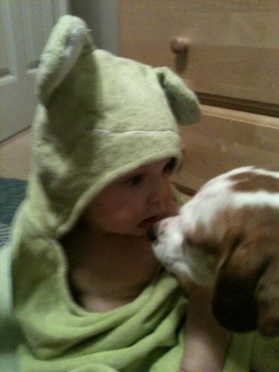

Stanley froggie towel looking at scrabbleStanley smile hug scrabble

When Stanley was learning to walk, he would try to chase the puppies around the couch. When Stanley would cry, Winnie would sit by his crib until I could get there. She was always faithful with the ministry of presence.

As I was going through a difficult divorce, I was grateful for the companionship of my puppies. They helped me feel physically safe in my home as a single mother. They eased some of the loneliness of the times when my son was visiting his father.

My ex ended up with the dogs in our divorce. Not long after he assumed ownership of them, he gave them away. The family with which he placed them lost them the very next day, which I learned when I received a call from the microchip company. The dogs had been found in a parking lot of one of the busiest intersections of our town.

I helped return the puppies to the family, with gritted teeth. I contacted the family a week later to ask how the puppies were doing and was told that they had been given away to another family. My heart was breaking for them. They must have felt so confused and alone.

Two years passed, with no word. I often thought about them, wondering how they were doing, wondering if they were still alive, wondering if they thought about me like I thought about them.

And out of the blue, in December, I received a call from animal control in a town several miles away that they had picked up Scrabble. They had tried to contact her owners multiple times but heard no response. Since my information was on her microchip, they legally gave Scrabble back to me. She was home!

When I picked up my son that afternoon, I told him that we had a puppy. He gasped with excitement. He wanted to race home to meet her. I showed him a picture of him with her when he was little, but I don’t think he understood yet how special this was.
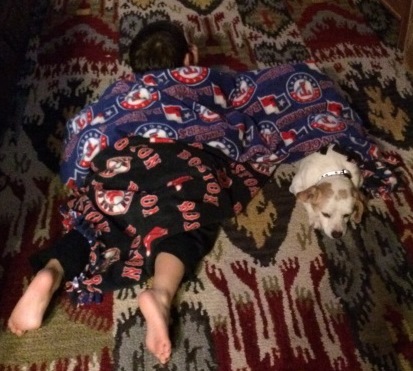
stanley on floor blanket with scrabblestanley walking scrabble

They took to each other instantly. He worried she might be cold and got a blanket for them to share. And they laid there on the rug watching TV together, like the brother and sister I had always hoped they would be.

He loves helping take care of her. Twice a day, he measures her food and puts it in her bowl. (Scrabble eats from a Snoopy bowl and Stanley thought she looked kind of like Snoopy. I did, too, when I chose his baby bedding. Like mother like son.)

He likes to help me hold the leash when we take her out. He likes to pack her toys and snacks when we go on trips. He even likes to share his hats with her, which for him is a really big deal. He tells me sometimes, “Mommy, I’m a good puppy brother.” I smile and agree.
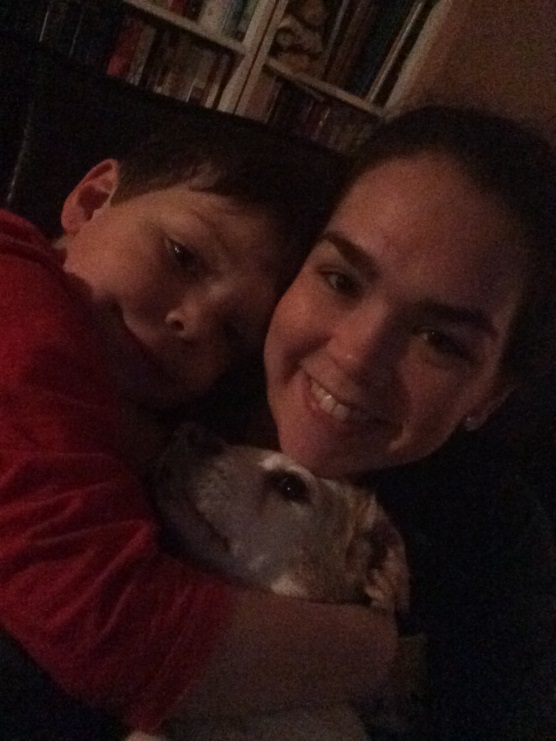
family picture stanley red shirt

I don’t know where Winnie is. Animal control said that she was not with Scrabble, and I pray that wherever she is, she is safe and happy.

My heart rejoices that Scrabble has come home, that my son will grow up with her. There has been so much healing for me since Scrabble came home to us. It’s like a piece of me has come back, like a ripped seam has been mended.
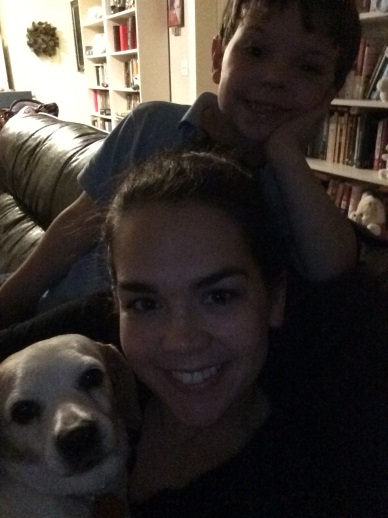
family picture stanley blue shirt

This February, as you reflect on the love in your life, I encourage you to celebrate love in all its forms. This month of love is about so much more than romance.

For me, February is about my family. And we are celebrating how blessed we are to have each other.

. Courtney Lyons Ð head shot Ð 01/23/2014

Courtney Pace Lyons serves at Baylor University, where she earned her PhD, as Assistant Director of Student Success and a Lecturer in the Department of Religion. Proud mother of Stanley and Scrabble, Courtney also wrote “Rev. Dr. Mom” for A Divine Duet: Ministry and Motherhood (www.helwys.com). Her blog is at courtneypacelyons.blogspot.com.

Joanne Costantino: “‘Frozen’: It’s Just a Movie!”

Tayler and Toddy in 2015 snow

When the Disney movie Frozen was released early last year, I was in no rush to see it.

Then I stumbled across a post by Kathryn Skaggs, who blogs at “A Well Behaved Mormon Woman.” The post was entitled “Frozen: Not Gonna ‘Let It Go’ When Movie Advocates Gay Agenda.

At first I thought her initial post about the movie was amusing. She saw subversive messages, particularly advocating homosexuality, as the whole point of the movie.

What followed after her blog post was essentially an onslaught of negative responses that were often so tasteless and rude, she had to shut down the comments. Rightly so. She was expressing her views in her own venue.

My grandchildren had seen the movie, twice, and had already purchased the soundtrack and memorized every song. After reading the post and her follow-up post, “Frozen: My Response to Outrageous Reactions” I decided to check out what all the fuss was.

I really enjoyed the movie, and even bought the soundtrack for myself. I wanted to share my feelings with Ms. Skaggs, but she had locked out reciprocal comments. It’s understandable. Although the social online forum has opened up a means for all kinds of engaging conversation, it also opens an avenue for some folks to respond anonymously with false bravado and self-righteous scorn, as happened in this case.

Kathryn Skaggs is someone who is forthright about her discipleship to Jesus Christ in the Mormon Church. With a great deal of personal fortitude, through her beliefs and testimony, she is a bold voice in opposing what she finds contrary to the LDS Church and teachings. She is admittedly conservative.

And yet I find that she and I have a lot in common with our life paths. Although I hold much more liberal views than Kathryn, we were both married at 18, have successful marriages, a passel of grandchildren and are proud of the lives our own children have forged for themselves.

We find our writing to be meaningful. I write about the “Life I Claim I didn’t Sign Up For” and she writes about her life as an active, socially conscious and well-informed conservative woman with a firm belief in the doctrine of her Church. We are both good listeners and always open to the discourse of any subject, especially if it’s about what we value and believe.

But we will not hesitate to respectfully disagree. She opposes ordination of women. And being a liberal minded Catholic lay woman, I am a proponent of ordained women in the Catholic Church – it is time. We find purpose in our words as strong women. Most relevant to me is that we are both young grandmothers.

Back to the movie “Frozen.” If I saw the same movie over and over, as she did, (I think she saw it about four times with her grandchildren), I’d probably begin to see some subversive message as well. No wonder she couldn’t let it go!

I enjoy taking my grandkids to see a movie, ONCE, not over and over and over. I want my time with the grandkids to be entertaining and enjoyable, not a necessary teaching moment in reality, let alone morality. Movie theaters are dark for the main reason that the viewer will be undistracted and suspend reality long enough to be entertained – let it go.

It is questionable to me that my 8, 17 and 18 year old grandchildren would make the assumption that “Let It Go” is an allegory for any kind of sexuality, unless they were directed to that line of thought.

As a matter of fact, the 8 year old Meghan (Todzilla) was fascinated by Anna more so than Elsa. She found Anna to be spunky and brave in her determination to seek out her sister on her own and convince her to return home. It also didn’t hurt that Anna sang more songs. Our Meghan is pretty spirited herself; maybe she relates to Anna’s spunky spirit.

The 18 year old, a first year college student, sings “Do You Wanna Build a Snowman?” on her iPod, out loud, as I drop her off at her train station in the morning. I enjoy the childlike joy this blossoming young woman exudes as she sings about playing in the snow with her sister.

THAT’s what “Frozen” is about to me: family, fearlessness, and letting go long enough to just play and accept the grace of just being present in each other’s life. And that’s a powerful message.

mike and Joanne prom

Joanne Costantino is a Philly girl and “cafeteria Catholic” laywoman living in the wild suburbs of South Jersey, where she still pines for city life. She graduated from college in 2008, two weeks shy of the birth of her 4th grandchild. The “accidental matriarch” of a life she didn’t sign up for, Joanne chronicles that life at www.weneedmoresundaydinners.blogspot.com.

Becky Caswell-Speight: “Wake Up! God’s Calling”

Last Sunday, during a lesson on God calling Samuel (I Sam. 3:1-10), one of the children looked up at me and said, “Boy I’m sure glad that I’m not Samuel. I like to sleep too much. I wouldn’t have woken up if God kept calling after me.” After a few inner giggles, I replied, “Yeah, I really like my sleep, too.”

This conversation reminded me of my two girls and one of the many interactions that happen in our family because of the movie “Frozen.”At our house we have a love/hate relationship with the movie.

My four year old daughter Evelyn LOVES it! Her entire room from the calendar to the bedspread is decorated in “Frozen.” She has cups, plates, dolls, stuffed animals books and posters all displaying Elsa, Anna, Olaf, and Sven. She loves to play pretend and dress up in her Elsa costume and the day is pure perfection if she has the chance to wear an Elsa braid.

IMG_2133

Her big sister Ainsley, one the other hand, if she never has to hear about Elsa’s ice powers again, it won’t be too soon. You might think her dislike exists because her younger sister woke up to breakfast and the movie every single morning for six months. But you would be wrong.

I believe that her pure dislike for the movie came about the time her younger sister memorized every song and line and started using it to torture her–I mean, wake her up–in the morning.

A normal morning sounds a bit like this:

Evelyn: Sissy! Psst! [shakes Ainsley a little harder] Psst! Psst! Sissy! [shakes Ainsley again] Wake up, wake up! Wake up, Sissy!
Ainlsey: Evelyn, leave me alone [said in the most groggy go away voice that she can muster].
Evelyn: I just can’t! The sky’s awake, so I’m awake. We have to play!
Ainlsey: Go away, Evelyn!

This interaction is always topped off by Ainsley with a dramatic flop onto her back and a hand on her forehead for added effect. This repeats at least three or four times until Ainsley drags herself out of bed and into the playroom to act out whatever scene Evelyn has chosen.

Back to Samuel: As Samuel was lying down after a long day of caring for the Temple, he hears, “Samuel!” He thinks it is Eli calling, but Eli says no. So Samuel goes back to bed. Twice more, as he is  beginning to go back to sleep, he hears, “Samuel.”

Still not recognizing God’s voice, Samuel goes back to Eli each time. Eli, being a smart man, finally tells Samuel if he hears his name being called again it is God and to reply accordingly.

Finally after the fourth call, Samuel finally understands that it is God’s voice calling his name and he answers, “Lord, speak, for your servant is listening.”

Why couldn’t Samuel hear God’s voice? If it is God’s voice wouldn’t you think he would recognize that? Samuel thought Eli was calling him. Even after hearing God’s voice three times he still had to rely on Eli to help him understand.

Samuel could have been tired. Maybe it wasn’t the perfect time for Samuel to recognize God’s call. If he was anything like Elsa, my oldest daughter Ainsley, or my little Sunday school friend, he could have missed the call once or twice because he “really likes his sleep.”

The good thing is that God calls us. Sometimes God calls us and we don’t hear the call. Sometimes God calls and we don’t understand it. Sometime God calls and we aren’t ready to follow it.

The good news is that even if we don’t understand the call, God keeps calling. God keeps calling.

So . . . how is God calling you? How is God helping you wake up to follow your calling?

May God give us ears to hear and courage to follow.

Rebecca Caswell-Speight, Minister of Families with Children at Smoke Rise Baptist Church in Stone Mountain, GA, has served as a minster in many settings. Recently transplanted from Louisville, KY,  she and her husband, Josh, are parents to two vibrant, growing girls.

Jenny Call: Empowering the “Good Girl”: a Disney Princess I Can Get Behind

I don’t go to movies often as I would prefer to curl up with a book, but checking out the latest Disney movie, “Frozen”, seemed like a nice family activity to wind down Thanksgiving. I had heard positive reviews of both the movie’s message and music, but I was still surprisingly blown away. This may become my favorite Disney movie of all time. While the animation was lovely and the characters were charming, I resonated with the themes of the story as they connected with a book I’ve been reading. After savoring Emily P. Freeman’s latest book A Million Little Ways, : Uncover the Art You Were Made to Live, I began reading her earlier work, Grace for the Good Girl: Letting Go of the Try-Hard Life.

I’m a self-proclaimed “good girl”, and was often derided as a “goody-two-shoes” in my younger days. Performing well at school and at church became a mask for me, a way of creating an image of having it all together. The outer shell of “perfection” hid the fears and chaos I held inside. Somehow I had received the message that if I did all the “right” things then I would find happiness. It’s still a battle I fight daily, balancing my Pinterest ideals with a lovely (but not perfect) reality. I struggle with my inner critic and the voices of a culture that sells me the idea that I must buy more and do more to be more. There are the societal norms that regulate what I “should” say and how I should act as a woman, and religious dogma that sometimes narrowly defines (and denies) my role and call as a woman in ministry.

I’ve hidden behind my “good girl” persona, doing what I can to please others, be nice, and do what is expected of me. I’ve hidden and apologized for my anger and have not spoken up when I should have. I’ve relied too much on myself, as Emily Freeman describes the good girl in her book, “Hiding behind that good-looking mask, her arms are folded too tightly to give and receive grace, or to fall into an embrace from a God who sees beyond her good reputation” (Grace for the Good Girl, p. 45). It has caused me to keep others (and sometimes God) at a distance, and has allowed fear to make too many of my decisions.

This is where I most connected with the movie “Frozen”. The story centers around two sisters, who being Disney main characters are, of course, princesses. The elder sister, Elsa, has a special gift of creating snow and ice just from her touch. This provides magical snowy playscape for the sisters until Elsa accidentally hurts Anna with her powers. Elsa feels guilty and afraid and vows to hide what she now sees as a curse. When she is unable to control it, she ends up hiding herself away, putting distance between the sisters. After their parents die in a shipwreck (why do parents so often meet an unfortunate end in Disney movies??) and Elsa is preparing for her coronation as queen, her magic is unintentionally revealed. In fear, and for others’ protection, she runs away from her home, creating a new castle for herself out of ice (there’s a strong metaphor). She is alone, but finds freedom in finally being able to be who she truly is without hiding. She is surprised by the beauty that results.

At this point in the movie, Elsa (voiced by Idina Menzel of “Wicked” fame), sings “Let it Go”. Here are some of the powerful lyrics:

Don’t let them in, don’t let them see,
Be the good girl you always had to be.
Conceal, don’t feel, don’t let them know.
Well now they know.

Let it go, let it go
Can’t hold it back anymore
Let it go, let it go
Turn my back and slam the door
And here I stand and here I’ll stay
Let it go, let it go
The cold never bothered me anyway

It’s funny how some distance makes everything seem small
And the fears that once controlled me, can’t get to me at all.
Up here in the cold thin air, I finally can breathe.
I know I left a life behind, but I’m too relieved to grieve.

There are twists in the plot that keep the movie from being a traditional Disney story. In fact, the movie pokes fun at the idea that the females need to be rescued, or that all is made right with “true love’s kiss”. In the end, it’s the bonds of sisterhood that are the evidence of true love, and the strength of the female characters save the day. Love is the cure for the power that has become destructive, and it restores everything to wholeness and beauty. Elsa learns that there is power and freedom in letting go of the walls she has built and seeking connection with others. Her strength comes in learning to embrace and use her gift, viewing it through a lens of art instead of fear.

What if we could all do the same? What if we could break through the places where fear has frozen us and find the empowerment to be who we were created to be?

photo-1
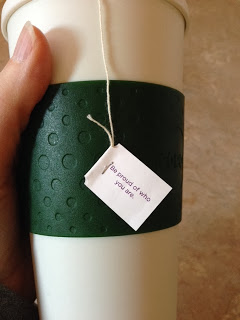
Perhaps I should take my tea bag wisdom seriously.

This post originally appeared on Jenny’s blog www.called.blogspot.com on November 30, 2013.

SONY DSC

Jenny Call is a minister, mother and chaplain at Hollins University, a women’s college in Virginia. Her essay, “Letting Go” (how apropos!) was published in A Divine Duet: Ministry and Motherhood www.helwys.com.

Anna Kate Shurley: Discovering the Winner

Epiphany

Matthew 2:1-12

Three days before Thanksgiving, our family piled into our dirty minivan and headed north from Mississippi to Virginia, where we would be celebrating the holiday with my parents. One of our many pit stops took us to a nice convenience store somewhere in rural Alabama. It was a perfect place for our preschooler and toddler to stretch their legs and run off a bit of their abundant energy.

Much to our children’s delight, this convenience store had its own claw game (you know, the machines that allow you to wager a dollar that you can pick up and retain a stuffed animal with a mechanical claw), which is one of their favorite ways to spend (and lose) our money.Mercifully, we didn’t have any cash on us, so we couldn’t lose any money this time around.

Virginia (the preschooler) quickly found something else to hold her attention, but Oliver (the toddler) was still fascinated by the claw game, and chose to linger in its general vicinity. Several people walked past Oliver on their way to the restrooms, and many looked at him and smiled. Ever the outgoing, friendly PK, he smiled in return, and usually said hello.

One gentleman, after watching a couple of these exchanges, walked past Oliver, looked at him, smiled, and said, “He’s a winner! That boy there is a winner!”

As Oliver’s mother, I have had similar thoughts about him every day of his life. Doting of this magnitude makes sense coming from a proud and grateful parent.

But what was it about our son that evoked such high praise from a stranger in a convenience store? Was it his delicious chubby cheeks, big brown eyes, and strawberry-blonde hair? Was it his fun personality? Or was it, quite possibly, some sort of hunch that our boy is destined for something extraordinary?

We celebrated Oliver’s second birthday on December 26. As wonderful as he is, I don’t ever compare him to the Christ child whose birthday we celebrate the day before.

But this year, on this Epiphany Tuesday, I can’t help but think back on the exchange between our son and an Alabama stranger and wonder if Jesus’ encounter with the Magi might have had some similarities. If some New Testament scholars are right, Jesus could’ve actually been a toddler by the time the wise men reached him.

When I consider this possibility, my imagination runs wild. What was the Christ-toddler like during this unusual visit? Did he hurl gold, frankincense, and myrrh across the room just for fun? Did he demand snacks and juice mid-morning? Did he insist on snuggling with his mother (and pulling her hair, and wiping his runny nose on her clean robe) as they entertained their guests?

Aside from the grand star that hovered over his house and a dream about King Herod’s nefarious plans for him, what was it about this little boy that compelled the Magi to “[leave] for their own country by another road” (Mt. 2:12)? How did they know that he was the Holy One, and why did they care? How could they know that this little boy would be THE Winner, who would give the world its salvation as his most gracious prize?

We know the Epiphany story; we tell it every year. We know the Christ whose coming has made all the difference for us. Even so, I believe we have to discover him again, and again, and again—year after year, and even day after day.

Can we believe—this day and every day—that he has, in fact, won for us abundant life? Can we place “the hopes and fears of all the years” at the feet of the holy child of Bethlehem, trusting that God’s plans are perfect and God’s grace is sufficient?

In these early days of a new year, it is difficult to know what our life of Christian discipleship will look like. What will surprise us? What will empower us? What will challenge us? What will frighten us? What will cause us to question our vocations, our choices, or our very selves?

My hope and prayer is that in the midst of all that comes our way this year, we will discover our Winner. I hope and pray that we discover the Christ who has won the battle against all that might otherwise keep us from doing and being all that we have been called to do and be.

After all, He is born. He is risen. He is here. Hallelujah indeed.

photo

Anna Kate Shurley has been a youth minister, campus minister, and hospital chaplain. She hopes add “author” to her list of vocational identities this year as she transforms her doctoral dissertation into a book. Anna Kate currently serves a congregation of two (her children, Virginia and Oliver), in Gulfport, Mississippi, where she lives with them and her husband, Will.

Alicia Davis Porterfield: Liminal Space

In these last days of 2014, I find myself in liminal space. I’ve been in such space before, but didn’t know what to call it, until I learned the word “liminal” back in my chaplaincy training (CPE). As so often happens for me, finding the word empowered me to claim the reality I’d felt for years.

The word liminal comes from the Latin for “threshold.” In liminal space, we are in between what has been and what is coming, on the threshold of something new that God is doing, but not there yet. It’s the bend in the river, where what has been is over and what is to come is yet unseen.

Untitled

In my own experience, liminal space brings great learning and stretching–and usually, plenty of anxiety. I’m not so good at waiting. The in-between usually feels hard.

But sometimes, being on the threshold is exactly what I need and it feels like it.

As 2014 winds down and 2015 is yet to begin, I am in the in-between. In the church year, this is the sixth day of Christmas (six geese a-laying, anyone?), smack in the middle of the full twelve. I am at my parents’ home in the North Georgia mountains, where I am both child and mother, caregiver and care-receiver.

Several years ago, my parents retired to the valley where my mother grew up and built mom’s dream home on a piece of land owned by her father. From their sunroom, I can see the house where my mother grew up and where my sisters and I (and the other dozens of grandchildren) visited throughout our childhoods. One of the many cousins lives there now.

For me, being here in my parents’ house at this time of year is a good physical space to match my experience of liminal space. I am not in charge here. I am not THE mama in this house. I am not responsible for everything (which is how it often feels in my own home). I assist, I suggest, I lend a hand, I help cook and clean up, I do a few projects my mother has put on hold. My sister who is also here does the same. We work and laugh together, remembering and retelling family stories.

In these days of Christmas leading to the New Year, here in this house, my daily anxieties are at bay. I am not haunted by closets that need organizing or writing assignments I need to complete. I do not worry whether I am adequately contributing to God’s kingdom and using my gifts as I “ought.” I have no to-do list. The push of preparing for Christmas is over and the rush of resolutions and back-to-the-grind has not begun.

I just get to live into these relationships that are here now. I visit with cousins who drop by and another whom my sister and I stopped to chat with on our afternoon walk. I snuggle my three year old niece and we stay in our pajamas until late morning playing with blocks and making cookies. I listen to our children laugh together at the kitchen table eating the delicious meals we have cooked together.

Tomorrow, we head home. The miles will roll under our wheels and the hours in the car will slowly tick past. The bend in the river will stretch out into a new set of rapids and deep pools we’ll need to navigate by the grace of God. But not yet.

Now, in this liminal space, in this small sacred place and time, God offers the chance to be. And be at peace.

Thanks be to God. Amen.

IMG_2387

Alicia Davis Porterfield is mother to three boys, half a clergy couple and grateful for every moment of rest she receives. She edited A Divine Duet: Ministry and Motherhood (www.helwys.com) and is the midwife of this blog. Contact her at aporterfield@ec.rr.com to claim your spot for a post.

Jeanell Cox: Birthing Baby Jesus

I birthed baby Jesus three times. But before you move on to the next Christmas Eve post citing heresy, please bear with me. I have three boys who were each invited in turn to portray the infant Jesus in church Christmas pageants in two different congregations.

I have a distinct memory of being asked the first time. I was terrified as a first time mother at the thought of handing over my weeks old baby to the teenage girl who was playing the part of Mary. What if he was fussy? Hungry? Just wanted his Mom or Dad? What if she had never held a newborn before? Or, more honestly, what if I simply wasn’t willing to let someone else hold him?

I was at the very beginning of figuring out who this little baby was and how to respond to his cries. I had no intention of giving him to someone else for an hour. But I did, swallowing down my anxieties about the whole thing. And it wasn’t long before I figured out why.

As the young woman clothed in blue began to slowly walk down the candle-illumined aisle, my heart welled up and tears fell down my cheeks. There was my boy snuggled up in white muslin blankets, bright-eyed and cooing at the beauty of the lights against the darkened room. I was transformed in that moment.

Suddenly the fear was gone, and a renewed sense of the importance of Jesus’ arrival as a tiny infant filled me. The world needed an infant to see the love of God so mystically expressed in bright big eyes, round cheeks and snuggles. My sweet baby boy ended up quietly asleep in the arms of his caregiver for the rest of the pageant.

And the second and third times I handed my baby boys to the teen portraying Mary, the fear was gone, but the transformative tears remained.

Bearing babies into the world is hard work, whether they come by fostering, adoption, marriage, or otherwise. Bearing Jesus into the world is sometimes painstaking work.

It may require relinquishing the things that we most fear. It may ask of us things that we never thought possible. It may require working to manage the demands of ministry and the deep desire to care for one’s spouse, child, pet, or self.

It may sometimes require more energy or investment than we think we can muster. It may feel futile, even when God is most at work. It may feel like a risky adventure in uncharted waters. But in our persistence and our willingness to face the fears that come, we are transformed.

Yet we have the opportunity to discover that each and every time we bear Jesus into the world once more, he is also born anew in us.

Perhaps Meister Eckhart says it best:

“We are all meant to be mothers of God. What good is it to me if this eternal birth of the divine Son takes place unceasingly, but does not take place within myself? And, what good is it to me if Mary is full of grace if I am not also full of grace? What good is it to me for the Creator to give birth to his Son if I do not also give birth to him in my time and my culture? This, then, is the fullness of time: When the Son of Man is begotten in us.”

Go forth, and may Jesus be born in you and in the world once more this Christmas.

familypic2

Jeanell Cox is a mother of three boys and a Board Certified Chaplain. She is currently a CPE Supervisory Education Student at Duke Hospital in Durham, NC.

Jenny Call: Oh, Joy

As we circled the dining room table to light our family’s Advent wreath, the kids got into a fight over who would light the pink joy candle.

I was not feeling very joyful after a full day of trying to keep them engaged and at peace along with working a few hours, attending an evening church service, and participating in our annual tradition of driving around to see the Christmas lights.

advent 3

I was tired and frustrated, and wondered why the reality of our family traditions never matched the glowing image in my head of how it “should” be. I was ready to give up on the Advent candle-lighting entirely, but my son reminded me that we had skipped our Bible story reading the night before and had promised to do two tonight.

Should it really be this hard for us to have regular devotions in a family where both parents are ordained ministers? I often feel like I’m failing in the spiritual development of my children, a difficult irony as I have devoted my life to faith and ministry.

The expectations for ministry, discipleship, and parenthood are set exceedingly high for Advent and Christmas. Not only do we preach on waiting, but on the lofty gifts of the season: hope, peace, joy, and love. Meanwhile, the only gifts my kids can think about are American Girl dolls and Legos, and the waiting is excruciating for them.

We speak about light, but our world seems engulfed in darkness as we struggle with reports of torture from within our own government, racial injustice in our law and courts, and increasing allegations of sexual misconduct in our universities.

I remind the college students I serve who are going through finals about the importance of self-care and rest, but my own calendar is full of events with little space for Sabbath renewal. We talk of the joy of the season, but so many people are grieving, hurting, and lonely. We work hard to create magical memories for our children, but worry that it will lead to selfishness and entitlement.

It can feel like too much, and the demands and expectations become a burden instead of opportunities for joy and celebration. Meanwhile we are all waiting to feel something different . . . to be fulfilled.

Our family is in the process of joining a new church. As we were talking to the Associate Rector about the membership process, she asked how the church could help support and nurture us in faith. We answered that they were already providing what we needed.

I asked (with a little hesitation) how we could better serve the church. I want to be actively involved in serving the church, and yet part of me is so weary that I wonder what I have left to give.

But her words were thoughtful and encouraging. She responded, “Just keep doing the ministry you are doing. You are doing the work already. In fact, your most important work is in the ministry of parenthood, and that is so hard. Let us feed you so that you can keep ministering to those in your care.”

I felt both the relief and the challenge in those words.

Too often, I find myself depleted and find it difficult to serve the ones closest and most important to me. I am short on patience and short on faith that the seeds we are planting will take root.

But that’s where the meaning of Advent hits me.

I have always loved the mystery and tension of the “now…but not yet” nature of waiting for something that has already happened. We share the Gospel, knowing that it is true because we have already experienced it in our own lives.

But we wait for fulfillment, when the good news will truly be born in our hearts and transform us. We light candles to remember the light that shines through us from Christ, even in the darkness that surrounds us. We wait, and yet we already have the gifts of hope, peace, joy, and love; they are just waiting to be accepted and opened.

I see these gifts in the wonder of children waiting on Christmas. I see it in my daughter who takes a communion wafer, breaks it, and whispers to me, “The body of Christ.” I hear it in my son singing wholeheartedly with the Christmas hymns. I feel it in the welcoming community of a church that accepts us for who and where we are in our journey.

I know it in the joy that is revealed to me when I understand that God is already present in our messy beautiful lives, just as they are. Emmanuel, God with us. Thanks be to God.

SONY DSC

Rev. Jenny Call is the chaplain at Hollins University in Virginia, a mother of two school-aged children and part of a clergy couple. Her essay, “Letting Go” appeared in A Divine Duet: Ministry and Motherhood (www.helwys.com). She blogs at www.hopecalls.blogspot.com.   

Kerrie Clayton Jordan: A Blended and Blessed Advent

Advent is upon us, the season of waiting expectantly for the birth of the Christ-Child. Waiting for all the Christmas decorations to be put up, waiting in line to buy Christmas presents, waiting for the oven to finish baking all of our Christmas goodies.

As ministers we wait for the special worship planning, choir cantatas, and Sunday School Christmas parties to be complete. As moms, we wait for our children’s Christmas wish lists and make plans for our special family holiday traditions.

Earlier this year, I was reminded of another group of people who may be waiting for the holidays to be over! In November I was invited to attend a community memorial service hosted by our local hospice center, and I was reminded of how difficult the holiday season will be for those who have lost loved ones, who will be facing a time of “firsts” without their parent, child, or sibling. For them, the Advent and Christmas season will often be filled with tears and memories of their loved ones.

It will be a season of grief and sadness for some.

As I reflected on the grief that some families will experience this year around the holidays, I thought about my own family. We’ve not lost any close family members or friends this year, but there will inevitably be some times of grieving and sadness in our home.

Why? Because we are a step-family with children who have experienced loss through divorce. On the outside, we may look like all is well when we attend church and family functions, but every step-family is born out of loss and it becomes part of who we are.

Four years ago, I became a wife and stepmother (although I don’t particularly care for the term “step,” I just use “mom”), and in that time, I’ve noticed that the holidays are a particularly difficult time for us.

For many reasons, my kids haven’t seen or heard from their biological mother in nearly 4 and ½ years, leaving behind questions and confusion. Holidays bring about memories and serve as reminders of her instability and abandonment, as well as thoughts of past traditions that can no longer continue.

When I joined the Jordan family in December of 2010, I thought I could make the holidays better for everyone involved. For me, it meant I was no longer the only single person at holiday gatherings.

DSC_8149

For my husband and children, I thought it meant that their holiday could finally be complete because there was someone in charge of decorating, cooking, shopping and organizing Christmas festivities. I thought it would be an added bonus that they now had my extended family to shower them with love, gifts, and attention at Christmas.

Surely, they would appreciate this new blended, non-traditional family and we all would live happily ever after, right?

These last few years have been both rewarding and difficult. I am so blessed to have my own little family, and children always seem to make the holidays more fun; but I wasn’t prepared to deal with the grief that also lived in my house around Mother’s Day, Thanksgiving, or Christmas.

As much joy as the holidays can bring, they also allow some of the stages of grief to express themselves throughout the season.

Anger is probably the grief stage I’ve seen the most in our teenager. Death of a parent is certainly difficult, but it is even more difficult when the parent chooses to walk away from his or her children. The hurt our teenager feels is one that should never be experienced, and there is no replacement for the love a child should receive from his biological mother. His family has changed, through no fault of his own, and he is mad at his mother for the choices she made.

I see bargaining most often in our younger child. She thinks that if she could just send her missing parent a present or if she could just see her and hug her, then everything would change and her mother could be “fixed.” Her innocent mind doesn’t understand the reality of the mental instability and the danger she could face.

Close to a holiday earlier in the year, she came to me with tears in her eyes and said that she’d seen a picture of her family with her “other mama” (that’s what she calls her biological mom) and that she didn’t want anyone to take it down or replace it. At this, she collapsed in my arms with giant crocodile tears as I explained that our love doesn’t always cause people to make the right choices.

The next stage of grief, depression, is also part of our holiday season. Holidays often bring up memories of traditions that had been important, and I often hear it in their voice and see it in their eyes when they talk about how those traditions changed. “I wish we could do _________ again” or “I wish we could see ______ one more time” are sentiments shared during the season.

Although grief can rear its head at any given time, it seems the holidays bring it up the most often. In the last four years I’ve been a mother, I’ve noticed that emotions are heightened and hearts are more tender around this time of year.

Advent is a busy time of year for ministers but I pray that we will all be an encouragement to those non-traditional families around us. Many families will be split up at Christmas as children divide their time between parents. Some will be grieving due to a loss to something other than death.

At a time of year when most agree that family is important, some will still be trying to figure out how to be a family again in a different situation than past years. Pray that this Advent season will be a time for blended and other non-traditional families to grow closer to one another and to find peace in the midst of loss.

DSC_8307

Rev. Kerrie Jordan is a wife to David and mother to Walker and Hope. She is a graduate of East Carolina University and Campbell University Divinity School, and serves as the Minister of Music at First Baptist Church in Smithfield, NC. Her essay “Once Upon a Time: the Tale of a Not-So-Wicked Stepmother” is part of A Divine Duet: Ministry and Motherhood (www.helwys.com).

Lynn Brinkley: Advent–This is About Hope!

I spent my Saturday after Thanksgiving watching ESPN’s “30 For 30” documentary on the 1983 NC State Basketball team. The documentary came on back to back, and it was so good, I watched it twice! An amazing story of how an unexpected “Cinderella team” managed to win the National Championship under the legendary coach, Jim Valvano.

In the documentary, “Jimmy V” said he often inspired his team based on the idea that “ordinary people do extraordinary things!” His ’83 team certainly proved that philosophy.

One of his players, Thurl Bailey, (who many deemed an “ordinary” center and no match for the 7-footer from Virginia, Ralph Sampson) shared a letter the team received from a wife whose husband was battling cancer. She became inspired by the ’83 team and played the games for her husband on TV. The wife hoped her husband would hear the progress of his favorite team as he laid in his hospital bed in a coma.

After sharing this letter, Bailey said, “This isn’t just about us winning games, this is about hope!”

This year, I found the transition from Thanksgiving to Advent disappointing to say the least. After a joyful season of giving thanks, observing the beauty of God’s creation in the trees and leaves, and spending time with family and friends over a bountiful meal, I felt overwhelmed with the commercialism of “Gray Thursday,” “Black Friday,” and “Cyber Monday.” I felt saddened over what is happening in Ferguson, MO, and our inability as a nation to deal effectively with racial discrimination, racial profiling, race relations as a whole, and issues regarding immigration.

Despite what is happening in the present world, I have the audacity to hope!

Mark’s Gospel, Chapter 1, vv. 6-7, reads, “Now John was clothed with camel’s hair, with a leather belt around his waist, and he ate locusts and wild honey. He proclaimed, “The one who is more powerful than I is coming after me; I am not worthy to stoop down and untie the thong of his sandals.

John would have been deemed an “ordinary” citizen in his day. After all, his clothing and his diet seems to suggest that to be true. Yet John saw himself as an unworthy servant who proclaimed One that would come and do extraordinary things. One that would come and restore Israel and the weight of the government would fall on his shoulders. He would be born to a poor peasant mother who would be favored by God to birth the Messiah.

“Ordinary people do extraordinary things!”

He will give hope to those who lie in hospital beds. He will give hope to those who feel inferior or disenfranchised. Most of all, He will give hope to those who are in need of a Savior.

Let us remember Advent is a sacred time on the Christian calendar. The Season of Advent is not about getting good bargains and waking up early to beat the rush. Advent confronts a troubled society and cradles it through a God in the crib.

May the God who calls “ordinary people” to do extraordinary things call us to be unworthy servants like John. May we proclaim to all who are in need that “this is about hope!” Hope in the one who was, and is, and is to come!


Lynn Brinkley formal

Reverend Doctor Lynn Brinkley is mother to Taylor and Director of Student Services at Campbell University Divinity School, where women’s gifts and calling are celebrated. An experienced preacher, Dr. Brinkley utilized her DMin studies to create a manual for preaching etiquette for guest preachers and host churches.