Category Archives: Uncategorized

Rachel Whaley Doll: On the Wilderness of Infertility

Sit with me in the darkness; not because it is easy,

but because your Light will brighten my world

and our friendship will strengthen us both.

Whether serving as a Christian Educator or that other full time church job, minister’s wife, I have spent most of my adult life in the ministry. It has been an amazing journey, filled with beautiful connections and relationships. I have taught and learned with children, youth and adults in three states, and continue to enjoy serving the Presbyterian Church (USA).

I thought all those things would have prepared me to have faith no matter what.

I was wrong.

When my husband, Aaron, and I decided to start a family, we believed that we would be holding our baby within a year, just as all our friends seemed to be. As month bled into month with no pregnancy, we quietly reached out to a few close friends. As year bled into year and we experienced a miscarriage, we became more public with our struggle to conceive.

Most of the ways friends and family reached out were helpful, and I know all of it was out of love for us. But some of the advice and comments were just hard to hear, and made it impossible to go to church at times. Looking back, glimmers of hope and a connection to God were always there, but some days they were not visible through the tears.

When we encounter someone in pain,

it is so easy to go into fix-it mode.

But what is needed is much harder.

I called my friend Marcia and told her we needed to go out for sushi. She knew that meant the in-vitro attempt had not worked, as I could not eat raw fish if I was pregnant.

Marcia is a fellow minister’s wife, and her friendship was such a gift in those dark days. She hugged me tight when we met for lunch, no words needed. We sat down at the sushi counter together, and watched the chefs work their magic.

Then she quietly said, “This just sucks. I had words with God today about you.”

Until that moment, no one had ever simply met me where I was. She didn’t try to fix anything or offer suggestions for success. There was no pity in her eyes when she looked at me. No other words were said for quite a while.

Later, we talked about how her flowers were doing, what was going on in Congress and lots of unimportant things. But the simple act of showing up and sitting with me touched me more deeply than any words could have.

I also had a rocky relationship with God during those years.

At first I turned to scripture looking for comfort. I found stories of women whose wombs were “opened by God” for a variety of reasons.To me this said that if I could find the right combination, of patience or ‘giving it to God’ or whatever, the door would finally open for me.

I even read books that actually said if I had enough faith, God would give me a child. That is horrible theology on a variety of levels, and only serves to add insult to injury for someone dealing with infertility or the loss of a child.

God seemed silent and distant, and I began to look elsewhere for connection, but never felt courageous enough to really tell God all of what I was feeling.

One aspect of prayer that we never talk about are the times you are just pissed off – at God! God actually knows you, and expects a bit of steam from time to time.

Infertility is a dark and painful pit (as are war and cancer) and God has heard a few expletives already!

The most amazing thing happened when I finally got mad at God.

Yes, it was uncomfortable for awhile. Yes, it took some time to ‘make up’ and be friends again.

But the shiny plastic coating of our relationship had shattered, and I felt I could move freer in my own skin. Getting real with God took our relationship to a much deeper level, and once I knew it was safe to be honest with God, I could be honest about everything, even with myself.

Whether you are walking the journey of infertility,

or loving someone who is, know that you are not alone,

and that no matter what, God will not leave you.

Rachel Doll

Rachel Whaley Doll is an educator, Biblical Storyteller, and lover of beach sand. She is also the author of two books, The Exquisite Ordinary, 2012, and Beating on the Chest of God; A Faith Journey Though Infertility, 2014. Connect with Rachel at rachelwhaleydoll.com.

Alicia Davis Porterfield: Unsuspecting Saints

In the past four months of Ordinary Time, our blog has focused on Ordinary Saints, those everyday people in our cloud of witnesses who have imprinted our souls.

Hebrews 12 photo

We met an aging rock star whose unique voice and perseverance has captivated and inspired a ministry-mom for years.

We met several grandparent saints who spoke blessing throughout our lives and church sisters and brothers who helped raise our children over the years.

We learned of unexpected friends, older and younger, who showed up on our paths and surprised us with blessing.

We met a prophet-preacher named Prathia Hall, who led and proclaimed and helped forge the path many of us walk today.

We encountered an imagined saint, an unmet great-grandmother whose keepsakes revealed a passion for biblical and theological study.

We met an Army chaplain sister who guarded a nursing chaplain while she pumped in the back of a Humvee.

We were introduced to a Somali saint who welcomed in her sisters with food and grace.

We met a mothering saint who helped raise dozens of children and blessed their families through her call as an in-home caregiver.

None of these ordinary saints thought of themselves as anything special. Most of them had little idea of the huge impact they made on those around them.

These saints simply lived into their call, daily and authentically. They weren’t perfect. They weren’t famous. They weren’t hyper-spiritual.

They lived lives that make room for the other. They listened. They spoke blessing. They challenged with great love. They believed in us.

The arc of their lives draws us towards God.

What a gift it has been to give thanks for these Ordinary Saints week after week. What a gift  to look right next door,  into our own histories and family trees, into our own story as a people of faith . . .  and find such amazing, faithful, ordinary saints.

May we live in such an open-hearted way that we become, more and more, ordinary saints to our neighbors, families and faith communities, as well. Amen and Amen.

Looking forward: October is Pregnancy Loss Awareness month. We will honor this focus with a series of posts on infertility and pregnancy loss, a painful reality in our communities of faith and our own lives as ministers.

Too often these losses are surrounded by silence or unhelpful attempts at care. In sharing our stories and experiences around infertility and pregnancy loss, we hope to share authentically and strengthen support for families and communities dealing with these struggles.

Contact Alicia Porterfield at aporterfield@ec.rr.com to learn more.

IMG_2292

← Back

Thank you for your response. ✨

Alicia Davis Porterfield is a writer, minster and mother living in Wilmington, NC. She is the editor of A Divine Duet: Ministry and Motherhood (www.helwys.com) and moderator of this blog.

Jennifer Lane: Military Ministry and Sister Saints in Sacrifice

This season after Pentecost, the Spirit is speaking to me through sisterhood: the unique and powerful sisterhood I have found in the Army Chaplain Corps.

Often these sister saints are other female Chaplains like Mary Miriti, Sharonda Watson, Lauren Hughes, Brittney Wooten, Delana Small and Roxanne Birchfield (yes, the one from “Survivor Phillipines”.) However, sometimes they are other women serving veterans like Rev. Jennifer Crane, VA Chaplain and Mary Ross, Deputy Director, OSDTN.

In the summer of 2013 after four beautiful months of nursing my new baby (Justice Ryan Lane) at home with family, I left for Chaplain Basic Officer Leadership Course (CH BOLC for short), where I continued breast pumping during the course of CIMT or Chaplain basic training and 16 hour grueling Army training days.

I learned the meaning of sacrifice.

Other amazing mothers and fathers at my school supported me in what was essentially an experiment in many ways:

1) Because Army funds were cut, the soldiers at Chaplain School would live in ‘barracks’ and eat in the Drill SGT dining facility (DFAC) like other none-officer soldiers.

2) We marched everywhere we went ( about 6miles a day.)

3) With unwavering encouragement from leadership, including CH (LTC) Karen Diefendorf, I proceeded to be able to finish nursing (from a distance) and boost my child’s immunities through mother’s milk.

Many female Chaplains including CH (COL) Kristina Moeller, CH (LTC) Karen Diefendorf, CH (MAJ) Renee Kiel, and CH (CPT) Delana Small have laid down a path for me of guidance, wisdom, love, and Esprit de Corps that is invaluable to new Chaplains in training.

Veteran women like Mary Ross at Operation Stand Down Tennessee, Inc. have also inspired me in following my call.

In the Army, I realize that the Saints next door are also the women who have come before me. Anything that feels hard to me was likely harder for them, and they persevered. “Hooah,” ladies!!

USACHCS (Chaplain School) did an amazing job of supporting me in this motherhood and ministry experiment.

I believe this should encourage other young women of child bearing age who might be on the fence regarding joining military chaplaincy. Where God calls you and commands you, God will provide the path to succeed in all you do! This includes motherhood and ministry, even in the military.

My battle buddies were as hardcore (“Hooah” in the Army) about helping me breastfeed as they were about helping me get through gas chamber training, rappelling and completing road marches.

One of my battle buddies, Mary Miriti, is from Africa. She grew up in the bush watching grazing goats alone in the dark. Did I mention she was barefoot?

She was not only helpful with my interesting situation–she was over-zealous! She would sneak me extra fruit and water so I had enough energy to breastfeed. She would hide with me in the back of Humvees in 100 plus degree South Carolina heat standing guard.

She would even offer to do it for me! Yes, you heard me right. She said that in Africa such behavior was polite. My American space bubble began to feel a bit small but I declined her offer even when exhausted.

With the love and support of Saints next door like Mary, and by the grace of God, I did graduate from CIMT that summer and CH BOLC on August 15, 2014.

Although leaving your family is intellectually, emotionally and spiritually jarring, the love of other female Chaplains made me feel like I could succeed and excel no matter what the challenge.

Mary Ross, a former Army NCO and Commander of the National Women Veterans of America explained to me before I left for Chaplain School that these friendships forged in tears, heat, and dirt could sustain me. She encouraged me to be honest about how hard it was to be separated from my family.

This is sacrifice. It does not feel good, but it’s crucial to our American way of life.

“Thank you for your service” is wonderful, but make sure to also honor our families and say thank you to them because some of the hardest sacrifices made are made by our families.

Those in the Christian community can be a great resource for our families affected by military commitments and loss as they remind them of God’s love and care and support them in whatever ways possible.

Although God’s love is strongest when I am home with my family, I have also been blessed to feel God’s love in the empathy of the other Chaplains at school going through similar feelings of loss and separation and in the hugs of those who have reached out to support me in my multi-faceted call within a call.

There should be no shame in missing our families, even in a Hooah Army culture.

When the bravado comes crumbling down, God’s love is there in sometimes surprising ways to fill your heart with joy until you are reunited with those who know you best.

Lane Baby Dedication at Church

A chaplain candidate in the U.S. Army, Jennifer Lane, JD/MPA, is in her final year at Vanderbilt University Divinity School. She has studied internationally and served with numerous nonprofits, most recently as a chaplain with Operation Stand Down Nashville, working with homeless veterans. Jennifer and her husband James have a toddler son, Justice Ryan Lane.

Alicia Davis Porterfield: Danielle Glaze: An Ordinary Sister-Saint

photo-8

North Carolina’s Campbell University Divinity School (CUDS) has a Commissioning Service for incoming students every fall. The worship service is carefully planned to welcome in new students, inspire them as they begin their academic journey and affirm their call to ministry.

As simple as it sounds, the service reflects the school’s intentional commitment to provide loving, supportive community for the students it shapes and shepherds for serving God, the church and our hurting world.

Every time I go to that service– or anything CUDS  offers–I sense the deep roots of that loving community.  And I wish I had  experienced that kind of care back in my own Divinity school journey. Thankfully, I get to absorb it now, and it is a balm.

This year, I attended the service as the invited guest of one of my dearest sisters in ministry: the Reverend Danielle Glaze.

Colleen Kelly, CUDS graduate, and Daniele Glaze, CUDS first year M.Div. student
Colene Kelly, CUDS graduate, and Danielle Glaze, CUDS first year M.Div. student

Danielle is one of the most authentic, secure-in-her-faith, joy-filled people I have ever met. She simply radiates God’s love and presence. Having faced the valley of jarring loss and come out on the other side, this single mother of two teenagers inspires me with matter of fact, living in the moment trust in God.

One of my favorite things about Danielle is her ability to acknowledge fully the pain and struggle of a hard time in my life or hers or anyone for whom we are praying . . . and yet hold that hard time in the larger context of God’s great and abiding love for us.

When I share my heart with Danielle, I know absolutely that I will be heard, honored and prayed for in that moment and in the days to come. She has that ability to be in the pit with me while letting me know that the pit is not God’s last word for any of us.

So it was with great joy that I attended her Commissioning Service as an invited guest. This service marks a new part of Danielle’s journey, one she had wondered about and prayed over for a long time: Divinity School.

A dedicated student of scripture, natural teacher and gifted preacher, Danielle will flourish at CUDS. I have no doubt. It is my turn in our sister-friendship to know that truth while she is living into it.

I can’t wait to hear what she is learning and how God is at work in this first semester. I can’t wait to hear how much the people at CUDS appreciate her and value her participation in their loving community.

Thanks be to God for Ordinary Saints like Danielle, who inspire, encourage and model what it means to trust God every step of the way. Blessings as you study, my sister! So grateful to be on this journey with you.

IMG_2292

Alicia Davis Porterfield writes, ministers and mothers three boys in Wilmington, NC.  A Life Coach and retreat leader, she moderates this blog and edited A Divine Duet: Ministry and Motherhood (www.helwys.com).


Holly Sprink: On an Ordinary Somali Saint


You are a busy woman. You have a lot of people to love, a lot of people counting on you, a lot of entries on your “To Do” list. Your iPhone announces it’s time for you to make your weekly visits, so you drive a little too fast in order to meet others with lives and stories and calendars pretty much like yours.

You’ve decided to make these weekly visits together, so you carpool and chit chat the fifteen-minute drive away. There is slushy brown snow everywhere, making for a longer drive: you turn on the heated seats in the subfreezing temperatures. You are all a bit frazzled from the day, for you are busy women. You have a lot of people to love.

You exit the highway, mindful to lock your doors and keep purses out of view. You drive by signs you can’t read, restaurants serving food you don’t recognize, and all ages of pedestrians. The windows in the car are icing over.

You are heading to a friend’s apartment, one that takes you down a handful of stairs to reach the front door. At the bottom of the stairs, you and your friends discover three inches of water, along with plastic milk crates someone has upturned in order to make stepping stones to the front door.

You wondered how your friend, an aging diabetic, stepped over these stones wearing her long, flowing jilbab. You wonder that the water hasn’t frozen into a miniature ice rink. The apartment, adjacent to the furnace room, has always smelled strongly of gas. The addition of the standing water has surely made the apartment uninhabitable.

You are relieved not to find your friend at home. You call. She answers, happy to hear from you, but unable to tell you “I’ve moved,” at least in English, and you don’t speak Somali. You picture her talking to you on her flip phone, fitting the top part of the phone into her hijab and then letting it hang there like she always does. “Sook, sook,” she says, “sook, sook.” A phrase you know: “Wait, wait.”

You wait in the cold with your friends. After hearing a flurry of chatter on the other end, you meet eyes with the others. A neighbor, who can speak a bit more English, has been handed the phone. “Move, move,” she says. You think you hear the words “new apartment.” You thank her and ask her the address, but she doesn’t understand. She says they are close by.

You say, “I’m wearing an orange wool coat. Can you see me?” You make your way between parked cars out into the slushy street, scanning the surrounding apartments and turning in a circle, as if surrendering.

You see each other. She is standing outside in the cold, gesturing. You and your friends walk a block or so and hustle into the warmth of her new apartment. There are warm kisses for cold cheeks, hugs, and shoes piled at the door. You add your boots to the pile and all sit down, cross-legged on the rug. You and your friends compliment the new apartment while she flies to the kitchen and brings out a tray with bottles of water for each of you.

You have the same conversation you always have. There are only so many words. You ask about her family. “Good. Good. All good.” You ask about her health. “Blood sugar,” she says, and shows you her prescription bottles. You talk a little about your own families and the other Somali friends you have in common. You ask her how her reading is going. “Good. Good. All good,” she says.

But conversation comes haltingly for one who was denied the opportunity to read or write in her own language, let alone someone else’s. You take in the prayer rugs, Arabic letters, and gold-gilt pictures of the Ka’aba on the walls. The unsteady words fall to silence.

Sook, sook! Sook sook!” she says. She jumps to her feet, grabs boots and a coat, and is gone before you have a chance to speak. You didn’t think she could move that quickly.

Suddenly alone, you look around at your circle of friends and laugh. She must’ve gone to get the neighbor again to help with translation. You chit-chat amongst yourselves about your own lives, your own schedules. Conversation flows easily again, even in this dim, incense-scented room.

It is increasingly awkward for you to be in this apartment without its hostess. Five…ten…fifteen…twenty minutes go by. She is still gone. You are busy women with a lot of people to love, your children will be getting off the bus soon, and so forth. At what point do you leave? How would you lock the door?

Through the front door she comes, at length, bringing the frigid temperatures into the room with her. She is carrying a disposable metal tin, steam escaping its edges. Cumin and curry signal your senses before your minds can comprehend her gift: she left you, walked several blocks to the nearest Somali store in sub-freezing temperatures to buy hot food for you, and walked back again.

You think of her sacrificial love as your hold the warm sambusa in your hand, and wonder over the pocket money she spent on you. Is it the curry bringing on tears or your prayers, as you ask God to help you love others as she has loved you just now? For she is not a busy woman and she doesn’t have a lot of people to love.

Sprink

Holly Sprink received a B.A. in English from Baylor University and an M.Div. from George W. Truett Theological Seminary. She is the author of Faith Postures: Cultivating Christian Mindfulness and Spacious: Exploring Faith and Place. She enjoys the adventure of life with her husband, Matt, daughter, Lucy, and son, Mikias. You can probably find her somewhere in the Kansas City area writing, knitting or connecting cross-culturally.


Joanne Costantino: Kathy Vermitsky–Ordinary Saint, Extraordinary Mothering

Soon after the birth of my first grandchild,Tayler, my daughter Katie searched for childcare for her newborn baby as she was about to return to her job. She searched and interviewed several people and places and seemed to find something lacking in every person and place. This was a brand new mom looking for someone to take care of her brand new baby.

On the day she found the right person, Kathy Vermitsky, Katie phoned and excitedly asked if I would come right away to meet Kathy, who ran an in-home daycare.

“She’s perfect! You’re going to love her! She reminds me of you!” Katie gushed. While I took that as flattery, I reminded Katie that this was her decision and not ours.

“I’m already going to sign up with her–I just want you to meet her and she wants to meet you.” And so I did. That very day was the serendipity of God’s blessed plan.

Kathy at the Vatican

Kathy and her family were very active in our church. She was a Eucharistic minister, her husband John helped run the St. Vincent DePaul society, her son was the altar server at Katie’s wedding, and Kathy’s uncle was the founding pastor of our parish, St. Jude’s.

When I met Kathy I did find her to be much like me, plain spoken and forthright. I liked that. We both had little tolerance for conversational tap dance. At this first meeting it was obvious that she ran a “tight ship.”

Granddaughter Tayler began daycare with Kathy the following week. Over the next 15 years Kathy and I also built a friendship that was based on more than the fact that she was the daycare provider for my grandchildren. She and I shared a mutual philosophy on child rearing: “love ’em and feed ’em and leave ’em alone, but give them structure and rules.”

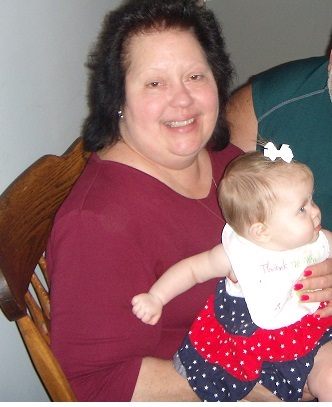
kathy and Isabella

When my infant grandson suffered a Traumatic Brain Injury, and required therapy and early intervention, I took a leave from my job. My daughter Chris found herself a single mom with a baby with special needs . . . so I stepped in so she could continue to work.

As I began to get my grandson’s therapies in place, Kathy insisted she take him in her care.“You need to go back to your job, and this is my job.”

Kathy took his therapist visits into her home and worked them into her daily routine with the other children in her care. While most children aged out of Kathy’s daycare,  she kept my grandson in her care for the next 13 years, arranging with his school bus to pick up and drop off at her home. She was essential in his progress and development.

Kathy mothered and nurtured every child who came into her care, even if she didn’t have immediate affection for the parent. When it was time to leave daycare and attend school, every child was fully prepared for kindergarten. They could read, write and recite the alphabet, print their name and recite their address and phone number. They were accustomed to structure and routine mixed with play and down time and afternoon hugs after nap time. The children had a singular love and respect for Kathy that was unique . . . different from their own Mommy, but not very different.

Kathy celebrated with us: birthday parties, christenings, communions, proms and graduations. She simply meshed in. Upon her arrival the kids would excitedly chant, “Kathy’s here, Kathy’s here!” Soon they would jockey for turns to sit on her lap or nestle under her arm. Although these events were supposed to be her day off, she would simply wave it off. “It’s fine,” she’d say and take another kid to her lap.

Kathy 8th tayler 8th grade

Kathy was a Mom’s Mom. She ran a tight ship from the comfort and security of a home where toy boxes and miniature toy kitchens lined the walls of her living room. Her back yard was peppered with trikes, bikes and wagons. Every child who passed through her loving and capable arms understood what was expected and what was accepted.

She not only mothered the children in her care, she mothered the Moms. It was more than her job. It was her vocation. When one of the young Moms would complain about some disagreement with Kathy, I reminded them, “She takes care of your children while you go to work. Do you know someone who can do it better?” And that would be the end of it. Kathy made our life easier.

Kathy’s sudden death, three years ago this September, left a sudden vacuum that can never be filled. When she died, it was the first death and loss of a loved one that my older grandchildren actually grieved. At her funeral mass, the church of St. Jude was packed with folks she touched in her years of service to the young people she shepherded.

They are the legacy of Kathy’s unconditional love and extraordinary mothering.

mike and Joanne prom

Joanne Costantino is a Philly girl and “cafteteria Catholic” laywoman living in the wild suburbs of South Jersey, where she still pines for city life. She graduated from college in 2008, two weeks shy of the birth of her 4th grandchild. The “accidental matriarch” of a life she didn’t sign up for, chronicles that life at http://www.weneedmoresundaydinners.blogspot.com.

.


Elizabeth Grasham: Gran Marie, the Saint

For the longest time, I didn’t know my great-grandmother’s name. When I greeted her, I called her “Grammaw Ree.” It wasn’t until I was a teenager that I finally asked my father what her name was. Turns out, I had fudged the pronunciation for the last several years, though in a way barely discernible: her name was Marie. Everyone else was calling her “Gran Marie.” Oops.

oldhands-1

Gran Marie, or Marie Spainhower, lived into her late 90’s and was sharp as a tack till the day she died. Every night she prayed and listed the names of all her children, grandchildren, great-grandchildren and great-great grandchildren (in birth order, I might add!).

I remember sharing a room with her one night and she sang hymns to herself till she slept; song after song after song, a limitless memory of music. With my grandmother’s help, she even wrote out some of her memoirs. Some of the stories were stirring, some were tragic, most suffused with love and faithfulness.

What I remember most about Gran Marie was what happened when she went into the nursing facility. Gran Marie was blind near the end of her life and lived at my grandparents’ home. For many years, my grandparents faithfully cared for her with the help of home health services.

My grandparents were committed to taking care of her for as long as possible, but Gran Marie insisted upon going into the care facility against their wishes. Transporting her around was a bit difficult because of how frail she was and because of her need for a wheelchair.

Because of that, she missed out on seeing her friends and she missed going to church services. From what I remember of her memoirs, I’m sure she remembered her younger days of raising livestock and chasing children and disliked even the perception of being a burden upon anyone else.

So, despite my grandparent’s protests, despite her doctor’s objections, Gran Marie went to the Church of Christ nursing home. And get this — she asked for a roommate. No private room for her!

Her reason? She hoped that God would send her someone who needed to be ministered to.

Gran Marie was blind, Gran Marie only got around with the help of a wheelchair and she wanted to continue to minister to others. I was in seminary at this point and my great-grandma’s servant heart humbled me.

She got her wish. Her roommate was suffering from what seemed to be dementia and she would become very agitated at night. Whenever this happened, Gran Marie would slide herself out of bed, into her wheelchair and roll over to her roommate’s side. She would pat her hand and sing to her until she subsided. Then Gran Marie would head back to bed.

Thinking about that scene brings me to tears . . . makes me hope that I can one day be as loving and graceful as she was.

Gran Marie loved deeply, loved freely and served all people with an openness of spirit that welled up from her deep faith in God. No matter her age, no matter her bodily ability, she heard the cries of the “least of these” and acted with compassion.

She was and is one of the saints of God and I am privileged to have her in my cloud of witnesses.

e&g

Rev. Elizabeth Grasham is the Senior Minister at Central Christian Church (Disciples of Christ) of Galveston Island, TX. She is the mother of Gareth (4), an avid geek, and a life-long book-lover. Elizabeth tweets about all the bizarre children’s tv shows she has to watch and makes some delicious homemade pop-tarts.

Nikki Finkelstein-Blair: Stella, The Imagined Saint

CameraAwesomePhoto


I don’t have any memory of being given the bag. It’s a big, flat plastic bag from someone’s craft-store shopping trip. It must, at some point, have come from my grandmother’s house. She had a basement full of this kind of thing: ancient magazines and books, antique papers crumbling into dust. When I visited her each summer I’d come home with souvenirs that I dug up from the boxes of stuff she’d forgotten she had.

There’s no telling how old I was when I scored this particular haul, but it was in my possession by early 1998 when I was filling out my seminary application and writing admissions essays. I had a journalism degree and a few years of marriage under my belt; my husband was finishing his seminary education and I was wondering whether I could (or should) pursue the lifelong sense of call I’d had.

I remember spilling out the contents of the bag, an inch-deep stack of scrapbook pages, dismembered from whatever album covers once contained them. Each oversized page was adhered front and back with black and white photographs, newspaper clippings, brochures and bulletins. Between the pages were layered diplomas and certificates from the old-school Baptist training unions, Sunday School Board, and WMU programming.

And a continuing-education completion certificate from a night-school program held at Central Baptist Theological Seminary–the school to which I was about to apply as an MDiv student.

 I never knew my great-grandmother, and never knew anything about her until I explored that stack of pages. Turns out she was a journalist; her byline appears on many of those newsclippings and “local interest” snippets. She was a church leader, attending and reporting on many women’s ministry meetings. She was a student, over and over again, as witnessed by the many different certificates she earned. Though “back in the day” most of her her bylines and accolades were listed by her husband’s name, I think of her not as “Mrs. Howard” but as, simply, Stella.

 I have tremendous memories of my grandmothers and my great-aunts and their dedication to God, to the church, and to learning. But Stella caught my imagination.

Though not an imaginary person, she can only be an imagined saint in my story. I have few actual pictures of her (a demure debutante) and an image in my head shaped by the tales I’ve heard (a roving husband?) and the collection of memorabilia she saved (a writer, a learner, a leader). I can only imagine where she struggled, how she celebrated, whether she ever felt that she’d fulfilled her calling.

Did she chafe at being recognized as “Mrs. Howard”? Did she dream of setting off on her own missionary journey? Did she have a room of her own, a place to write, a Remington typewriter and spools of ink ready and waiting? Did she discover herself in the intersection of wifehood, motherhood, and ministry, or was she constantly weighing, balancing, wondering, dreaming, stretching, resting–the way I do? Did she wonder whether she was leaving a worthy inheritance to her daughters, granddaughters, great-granddaughters?

 Did she wonder whether the God she served and the church she loved might ever call one of her great-granddaughters to stand at a pulpit and proclaim good news?

 I can only imagine.

Blair pic

Nicole Finkelstein-Blair became a U.S. Navy spouse in 2000, graduated from Central Baptist Theological Seminary and was ordained in 2001, and became “Mom!” in 2004. She finds ministry wherever the military and motherhood lead: in five states and two countries (so far), as a parishioner and a pulpit-supplier, as a sometime blogger and devotional writer, and at countless dinner tables and bedtimes. She’s enjoying now… and looking forward to what’s next.

Courtney Pace Lyons: Prathia Hall, An Extraordinary Ordinary Saint

For the past six years, I have been researching the life and ministry of Rev. Dr. Prathia Hall (1940-2002), a civil rights activist, Baptist preacher, and womanist scholar. Little did I know at the beginning of this journey that Prathia would become a spiritual mother to me, a “shero” who continues to inspire me about the real meaning of life and faith.

Prathia was born in Philadelphia and grew up helping with her father’s social gospel oriented church ministry. In high school and college, she became involved with Fellowship House, a Philadelphia ecumenical social justice organization, where she studied the philosophy of nonviolence.

In 1962, Hall joined the Student Nonviolent Coordinating Committee (SNCC) in Southwest Georgia and Alabama, canvassing door to door to register voters and teaching in freedom schools, educational programs to help potential voters pass registration tests. She was arrested many times in Georgia and Alabama, and she suffered a minor gunshot wound in Georgia in September, 1962. She resigned from SNCC in 1966 when the organization transitioned away from nonviolence, though she described her time in the movement as the best education she ever received.

Prathia became one of the first African American Baptist women ordained by the American Baptist Churches of the U.S.A. (1977), was the first woman accepted into the Baptist Minister Conference of Philadelphia and Vicinity (1982), completed her M.Div. and Ph.D. (1997) degrees at Princeton Theological Seminary, and became a well-respected professor of Christian ethics, womanist theology, and African American religious history at United Theological Seminary in Dayton, Ohio and Boston University.

In 1997, Ebony magazine named her first in its list of “15 Greatest Black Women Preachers,” and she was the only woman considered for its list of “10 Greatest Black Preachers,” ultimately placing eleventh. She pastored Mt. Sharon Baptist Church in Philadelphia, her father’s church, for nearly a quarter century.

She mentored over two hundred aspiring African American clergywomen, and there is a prominent blog for young African American clergywomen named “Prathia’s Daughters.” She remained active in the Progressive National Baptist Convention, the American Baptist Churches USA, the New York Board of Education, the Association of Black Seminarians, and domestic and international advocacy for liberation and equality of men and women of all ethnicities.

After a long battle with cancer, Prathia died in 2002.

Though she led an amazing life and accomplished great things, Prathia was a modest woman. She worked tirelessly for justice. And not in front of the camera like some of her colleagues, but among the people. She wasn’t afraid to be with the people. She spent hours on the front porch listening to stories, building trust, and walking alongside people. She valued every person, not just those with formal credentials. She empowered people to realize their giftedness and calling in spite of obstacles, and her faith inspired others to find their own.

As I read Prathia’s sermons, I was moved by the power of her preaching, by the way she transformed her suffering into prophetic proclamation. She lost her father in a car accident in 1960, survived four years of police brutality and constant threat of harm during the movement, earned an Ivy League graduate education as a single mother while teaching and preaching, endured painful injuries from two car accidents, and lost her brother and her daughter under tragic circumstances.

Rather than let these difficulties silence her, she allowed her own theological journey to radiate through her preaching. She articulated the deep emotions of these experiences in her preaching in a way that welcomed all who had suffered to find refuge in the presence of God and reminded them that God’s justice will always prevail over evil. She used to say that she had to preach, had to write, had to let it out to keep from being consumed by anger. And by anyone’s standards, she had righteous cause for anger.

Instead, she turned ashes into beautiful breaths of life.

I found myself, and still find myself, being formed by her words, being challenged to speak truth to power and to stand in solidarity with the oppressed. Her courage to cut through the excuses given for delayed progress of gender equality in Baptist ministry leadership inspired me to follow my calling in spite of those who say that because of my gender I must be mistaken about God’s call. She taught me to not feel selfish or divisive for wanting opportunity to preach, but to see this as obedience to God’s call for my life.

When I was a single mother trying to finish my PhD, her words reminded me why I must keep going no matter how difficult the journey. When I was finally brave enough to name my suffering and speak truth to power against those who had oppressed and abused me, and when my oppressors attacked me for doing so, Prathia’s words surrounded me, lifted me up, and breathed new life into me.

I wish I could have met Prathia, my single most profound preaching mentor. I am blessed to know many people who knew her and who have shared her spark of life with me. I will never stop sharing that spark with others. I will forever cling to her wisdom, to her heroic bravery in the movement, to her unshakeable conviction that the God who calls us will see us through.

And as Prathia reminded us, “We who believe in freedom cannot rest until it comes….”

Courtney Lyons Ð head shot Ð 01/23/2014

Rev. Dr. Courtney Pace Lyons is mother to Stanley and works at Baylor University, where she studied Prathia Hall and earned her PhD.

*Portions of this blog post were taken Courtney Pace Lyons, “Prathia Hall,” African American National Biography (New York: Oxford University Press, 2012).


Pam Durso: Missy Ward Angalla, an Ordinary Saint

I first met Missy in 2010. We were both attending a Baptist Women in Ministry of Georgia gathering. At lunch that day, Missy was presented with the Sara Owen Etheridge Scholarship. During the presentation, the BWIM of Georgia president briefly shared about Missy’s work with refugee women and about her dream to make that her life work. The story touched my heart in ways I can’t even explain, and when the lunch was over, I made my way over to Missy and said, “I need to give you a hug.” And so our friendship began—with a hug.

Missy-and-Pam-2013-300x297

Over the next few years, we shared a good number of hugs. Missy was a student at McAfee School of Theology, and my office is on the McAfee campus. She often made her way to my office, and we sat and talked. During those years, she began her work in Uganda—living there for a summer and then for a semester. Traveling as often as she could to the country that had captured her heart, to minister with and to the refugee women with whom she had fallen in love.

When Missy was back in Georgia, she always returned to my office, teaching me about the geopolitical systems that had such a devastating impact on women and children, telling me heartbreaking stories about the women she had grown to love there.
In the summer of 2012, Missy was commissioned to serve in Uganda as field personnel with the Cooperative Baptist Fellowship. Her passion had officially become her life’s work.

On December 31, I attended her ordination service, a beautiful, simple service. Near the end of the service, I made my way to the front to participate in the laying on of hands, but when my turn came, I instead wrap my arms around Missy, hugging her close to me and offering her a few words of blessing.

Missy spent the early months of 2013 traveling and raising funds for her new ministry role. I saw her occasionally during those busy days, thankful that she made the time to visit with me. A few weeks before she was scheduled to leave for Uganda she stopped by to see me. Missy walked into my office wearing a lovely black coat. My first words to her were, “Oh, Missy, tell me where you got your coat. I have been looking for a black coat and haven’t been able to find one that I like.” And Missy replied, “When I leave for Uganda, I will give you my coat. I won’t need a coat there.”

A few weeks later, on her last days in the states, Missy came by for one last visit, one last hug—and she brought me her black coat.

We Atlanta folks had an unusually harsh winter this past year—we lived through Snowocalypse in January 2014 and experienced much cooler temperatures than is normal into April. All winter long, I took my “new” black coat out of the closet and put it on before heading out the door. And every single time that I slipped my arms into that coat and pulled it around me, I thought of Missy. I felt her presence. I imagined her arms around me, hugging me close.

Missy’s black coat was a gift, and not a just a gift of warm clothing. That coat is for me a symbol of love and the mysterious ways in which God connects us with each other. It is a reminder of grace and friendship. It is a reminder that no matter how far away Missy is—she is still close in my heart.

Rev. Dr. Pam Durso is executive director of Baptist Women in Ministry, Atlanta, Georgia. She just celebrated her five year anniversary in that role. Congratulations, Pam!

Note: This post originally appeared on the Baptist Women in Ministry blog at http://www.bwim.info.