Category Archives: Restart

Advent and Healing

I started to name this post “The Art of Healing” in a sort of ironic way, because what I know about healing could fit a postage stamp. But then I felt a frisson of fear that someone might read that and think I had answers or instructions and be terribly disappointed when what I really offered was my tiny hard-learned truth that healing tends to be something that happens to us, not something we make happen ourselves.

All I have really learned is that I can participate–as best I can and am able–with healing. I can make room for small practices that help me be more open to the Spirit: quiet listening, stillness, walking in creation at my own pace, breathing slow and deep, leaning more into curiosity and grace rather than judgment within and without, befriending myself as much as I possibly can. But I am finding that’s a tiny speck truth that holds a galaxy of freedom in it for someone like me.

As someone both hard-wired and well-trained to perform, I immediately recognize benchmarks sketched out by someone else as urgent, laudable demands. I joke about being a recovering straight-A student. But unlearning those patterns of an external-centric, someone-else-always-has-the-answers orientation is a lifetime’s work.

Even and especially when it comes to healing.

All of us are on some sort of healing journey. Many—most?– of us wish we were farther along than where we actually are. Even in the smallest, run of the mill healing experiences, like dealing with a really bad cold as I am now, there’s often an internal and external tendency to pushpushpush forward. There’s things to do, calendars to obey, ministries to administer, people to serve, lessons to teach, sermons to write, expectations to meet (insert the words of your Inner Taskmaster here)!!

As if viruses can be out-willed. As if we nephesh are machines, just a little oil here, replace this worn out part, clank-click-twist-and-shut, and boom! Ready to go!

Just take this medicine, this home remedy, this zinc-coated lozenge—no, wait! Studies show that zinc doesn’t really help. Take this instead! That’s the ticket: this cold medicine that’s been on the market for ages (you know the one we told you over and over, “take this and you’ll be better in no time!”)—no, wait! Studies have shown it has almost no effect on congestion. So…ummmm…just rest and by tomorrow or the day after you’ll be raring to go! And even if you aren’t, hurry up and get back to it!

By next week, I likely will be fine. Or at least back to my normal. But the thing I am reminded every single time I get a really bad cold is that it takes as long as it takes to run its course and my system to recover.

And even more so, every single time I get a bad cold I think of people who deal with chronic illness, urgent diagnoses, life-altering accidents… people whose “normal” requires a complete re-figuring. Families I have walked with through the years who have re-made their lives in response to a circumstance completely out of their control. Nephesh whose everyday existence challenges every jot and tittle of our cultural myth of constant upward production and progress.

And how human beings have been doing this hard work for millennia. How pain and suffering and struggle are an integral part of what it means to be human and alive, even if our modern lives want to tell us they are aberrations or worse, that we are aberrations when experiencing hard times.

From where I sit now, propped up in bed surrounded by tissues, lozenges, cold meds (that may or may not be remotely effective), and a humidifier, supported by good health insurance, a compassionate family and congregation, I want so badly to be more untangled than I am from these lies about suffering and healing that alienate us from ourselves. I want to get better at recognizing those lies when they float themselves into my congestion-fuzzy brain or burrow into my neighbor’s self-judgment that she should be dealing with her grief “better.” I am markedly better at recognizing these lies when someone else says them than when I hear them in my own self-chatter. So there’s that.

The part of me that recognizes those lies loves Advent. I crave the stillness and wonder and waiting and even the sharply pointed warning “Prepare!” by John the Baptist —a strange character in any story but especially in our modern always-upwardly-progressing, manufactured-cheer-no-pain-here holiday season myth.

You bet I want to prepare! I want space and time and courage for a clear-eyed gaze like John’s. I want to burn up all that chaff that clogs up our lives and keeps us from truth. I want to clear the decks of everything that keeps me spinning and toiling for treasures that do not keep so I can sit down and see the treasure that is already ours.

Come on John, I’m urging this Advent as the lies seem stronger than ever to me, give us that truth that leads us manger-side.

I want all the time the next four weeks can give us. Every minute. Not so I can gobble it up, but so we can marinate, soak slow and deep and long in this gift of a season of preparation. A season where pain and suffering and struggle and grief and messy, prickly humanity are all “normal,” welcome, accepted, seen, valued. For me, at least, that’s way for me to “prepare Him room.”

If I know anything about healing, it’s that healing takes its own time. I can walk or sit or lie down in its pace or I can choose not to. But the season will take as long as it takes. Ugh. Whew. Thanks be to God. Amen.

We are quite naturally impatient in everything to reach the end without delay.
We should like to skip the intermediate stages.
We are impatient of being on the way to something unknown, something new.
And yet it is the law of all progress
that it is made by passing through some stages of instability— and that it may take a very long time.

~ Pierre Teilhard de Chardin in HEARTS ON FIRE

Rev. Alicia Davis Porterfield lives in Greenville, NC, is mom to one teenaged and two young adult sons, and is part of a clergy couple.

Jenny Davant: Adoption and Ministry

Sharon pulled me aside after church one Sunday. She spoke softly about my daughter as she said, “I noticed that Allison didn’t hug me this morning.” We made eye contact and smiled. Sharon, a pillar of my small-town church, stood proudly and shared a significant moment with me. I put my hand on her arm and replied, “That is wonderful news! Thank you for loving her so well.”

Years before this private celebration, my little church in Iowa hired a single, childless pastor. They had all my time and energy, knowing that little existed to compete with last-minute calls and meetings. When I decided to become a mother, I changed the rules. I began speaking to them about adoption and children a year before taking my first foster care class. They needed plenty of time to prepare for the changes.

The decision to adopt was not difficult. At 38 years old, I was still single with no man in sight. I wanted to be a mother more than I wanted to be a wife. I knew that I was not up for the difficulties of pregnancy and childbirth as a single woman. This left me looking into adoption, specifically adoption through foster care. 

The average person in the pew does not understand the experience of foster parenting and adoption. There are parenting classes, visits from DHS, and waiting for a phone call. Foster-to-adopt offers none of the miraculous celebration that comes with childbirth. It does, however, offer plenty of messiness and heartbreak. I needed to bring my church family on my journey toward motherhood.

I began educating church folks as much as possible about the pressing need for foster parents and the nature of loving someone else’s children. Our Wednesday knitting group got regular updates from foster care classes. I was open about my doubts and fears, my limitations as a single mother, and the heartbreak that accompanies childhood trauma. I told the Church Council that foster care always has a goal of reunifying children with their family of origin. I spoke at Friday night supper clubs about how our church will fall in love with children only to say goodbye. 

On top of this, I wrote and preached about foster care. I preached about the difficulty of selfless love and our call to care for the least of these. My church members were in a meeting with me when I got the first call to pick up a baby with less than an hour’s notice. They were also with me when I got the call to return the baby with even less time to say goodbye. They saw me sob. 

My daughters were my second foster placement. They were sisters, ages 8 years old and 10 months, who were in the foster-to-adopt process. These little girls would not be reunited with birth parents. My older daughter, Allison, seemed to be made for the role of a pastor’s kid. From her first day at church, she worked the crowd. Allison made it to every single person in worship on a Sunday morning. Every person, familiar or stranger, received a hello and a hug. 

Sharon, my wise church leader, listened carefully during knitting when I explained that foster kids often seek out hugs and love from everyone. Some of them try to be cheerful all the time. This is a delight for church people. Who doesn’t love a little girl with a big smile and a hug? 

Sharon listened when I shared my heartbreak about Allison. Allison was trying to earn love. She came from a childhood wherein keeping adults happy kept her from being abused. Sharon heard me when I said that my biggest triumph as Allison’s mother occurred when she was genuinely grumpy with me. A grumpy child trusts that you will love her even in imperfection. She trusts that she is safe to be fully human in your presence.

Sharon heard me. She loved my daughter well. She celebrated the first Sunday that Allison did not offer her an obligatory hug and a fake smile. Months of trust-building and consistency paid off. My daughter felt safe.

My journey toward motherhood opened the door for church folks to love in ways they never knew to love before. It was every bit as heartbreaking and messy as promised. 

The day that I adopted my girls, the church packed the benches of our tiny courtroom to stand witness to the celebration. They cried with me and loved my children well. The next Sunday, they surprised us by officially welcoming Allison and Megan into the church as members. They explained that they missed out on baptizing my girls as babies and they wanted to make Allison and Megan’s place in our church official. I’m proud to say that Allison hugged very few people that day. She was safe. She was loved.

Rev. Jenny Davant pastors in Texas, having served previously in Iowa and North Carolina.

All Saints, FFTs, and Being a Nephesh

I’ve been settling into a new ministry position for the past two months: slowly learning all the names, the systems, the already existing ministries associated with my role (minister of missions), figuring out what is and isn’t working, introducing myself over and over and over to the neighbors and community organizations we partner with…and generally discovering something new each day. 

I am truly loving getting to connect with our neighbors and partner with our loving, missional congregation as we seek to love and serve our community. Dozens of holy moments light up each day. 

And, whew…I am worn slam out. 

Brené Brown’s work around “FFTs” or “freaky first times” (that’s the non-spicy translation) helps me stay in touch with how much work, time, and energy this stage of anything truly is.1 If it’s my FFT doing something, then of course I’m going to be clueless about how to make it happen, anxious because of that cluelessness, and learning—often the hard way– and adapting every second of the experience. 

No wonder I am exhausted when I get home! No wonder I am having trouble remembering all the things! No wonder my days off are less fruitful in dealing with “everything else that has to happen to make life work.”

Mom, I had to buy some extra textbooks I wasn’t expecting so can you reimburse me from my 529? Mom, I need to get my sports physical by Thursday so I can try out for basketball. And (from our financial planner), Alicia, please fill out these forms detailing what your family spends annually in these 672 (slight exaggeration) categories. 

But in addition to the FFTs, I am experiencing something else significant: embodied grief and the Anniversary Syndrome.   

The older I get and the longer I serve in ministry, the more I experience the ancient Hebrew understanding that we don’t just have a body, we are a body. The Hebrew word nephesh, sometimes translated as “soul,”  has a rich, layered meaning. Nephesh incorporates soul in its meaning, but not as a counter-reality to body, as Greek thought would later use the word. In ancient Hebrew thought, our soul-mind-body are intimately, wonderfully connected–not disconnected, opposite realities. 

Nephesh means “that which breathes,” “a living being,” “a creature.2 The word is connected to breath, the breath of God that gave the first nephesh life. The breath that keeps us alive, physically and spiritually. 

When I am anxious, rushed too much, task-overwhelmed, etc., my breathing gets short and shallow. It’s my most reliable sign that my nervous system is “activated,” as somatic therapy describes, and starting to function in survival mode. When I notice the short, shallow breathing, my most reliable calming response is to concentrate on slow, deep, deliberate breaths. 

On Monday, I’d just finished leading a particularly task-heavy, congregation-wide community ministry, an amazing time of connection and loving our neighbors.  It was an absolute joy! And…waiting on my desk was everything I had set aside to get ready for that ministry. Then, someone needed emergency financial help and I needed to make that check happen. But as the next few days revealed, I didn’t know our system quite well enough and got myself tangled up. 

I knew I needed to breathe deep and slow.  So I signed up for an online All Saints Day gathering set for Wednesday at 1:00 pm. I needed that time. 

But I needed that time not just because I was task-and-FFT-tired.

November has always been hard for me with the loss of daylight, gray weather, trees stripped down to bare. Then, eight years ago I spent the first three weeks of November at my father’s bedside, gathered with my mother and sisters as he slowly slipped away from this life. He was such a stunningly generous gift to all of us. Facing his death with him was the hardest, holiest time of my life. 

That loss still lives in me. I, a nephesh, bear that grief still. November is the hardest month. I have to work hard to make space to breathe in November. 

And … last November also held the most nephesh-draining season of my vocational life. Things had been hard for some time, but starting in late summer, the intensity shot up fiercely. In October, it rose even higher and kept climbing. I felt trapped in a lament psalm, caught between the “terror of the night” and “arrow that flies by day” (Psalm 91:5). 

It was the hardest—in every single sense of that word—and most demoralizing season of my life. That lament still lives in me. I, a nephesh, bear it still. This makes November even more so the hardest month. This year, I have to work even more to make space to breathe in November. 

So I profoundly needed this All Saints service, designed and led by Rev. Dr. Eileen Campbell-Reed. I had personal grief and gratitude, awareness of the catastrophic losses going on all around me in our world, and a new layer of vocational grief to lift up to the God who hears. Even just the video of the burning candles during the service helped me settle and breathe more deeply. 

But the service couldn’t give me what I had hoped for—because time-sensitive texts about that emergency assistance check kept coming in and I had to respond on the spot to untangle what I had tangled up. I got tangled up because it was my FFT and I didn’t fully understand our benevolence-fund-check-writing system. Everyone was gracious and helpful in helping me work it out, but UGH! What an FFT!

Here’s the good news. Last night my spiritual director reminded me that I could have an All Saints do over. As a living, breathing nephesh, I could try again. It wasn’t like All Saints Day had passed me by and I would have to wait until next year. It wasn’t like God was tapping a foot, sighing, “she sure blew that chance!” Grace abounds. 

I could circle back and watch the video, which, thankfully, had been made available to us. Which is what I am doing as soon as I finish this post. I am going to turn off alllllll the alerts, get a cup of hot tea, and breathe as I honor All Saints Day, all the griefs and gratitudes, losses and laments, and simply let God love me and all our lamenting world.  

This nephesh deserves that. 

Rev. Alicia Davis Porterfield midwifes this communal blog, serves as Minister of Missions at Oakmont Baptist Church in Greenville, NC, and moms 3 young adult-ish men.


  1. Here’s a good explainer about FFTs and BB’s podcast episode on FFTs—warning: both contain a curse word; if that will distract you from her teaching, skip these links. ↩︎
  2. https://www.biblestudytools.com/lexicons/hebrew/nas/nephesh.html. I was too exhausted to look up my Divinity school Old Testament notes to work with a fuller source. They’re packed up in the attic.  ↩︎

Virginia Taylor: Unlimited Possibilities

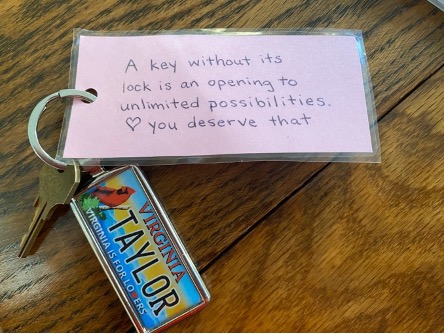
I listen to the Lectio 365 app for my daily devotionals. Sometimes, if something stands out to me, I will write it down in my planner. On Friday, Februrary 3rd, 2023 I jotted down, “Do not be afraid, I hold the keys” (Revelation 1).  The next day I received the key chain pictured above. God had my attention! 

First of all, the person who gave me the key chain was my daughter’s best friend’s boyfriend. Now, this young man barely knew me. We had been at the same group dinner a few times over the course of a year and a half and our conversations could best be characterized as casual chit chat.

But, I had sent a gift to him via his girlfriend—it was a pen I had found while clearing off my desk one day at church.  I thought of him because it had his name on it—Calvary. Shortly after that, Calvary went on a trip to Virginia and decided he would get something for me with my name on it—Virginia—to reciprocate. That alone would have been super thoughtful, but what he did with that key chain, adding a key and handwritten note, changed my life.

At the time, I was in my fourth year in a ministry position at my church and pretty happy. Hear me clearly: it was not perfect, but I loved the staff, I loved the families and children I worked with, and it was all very comfortable and easy. When I got the key chain, I told our ministry staff about it and asked them to pray for me.

Over the course of the next couple of weeks, I became more and more uncomfortable. Verses like, “Open the gates and I will go in” (Psalm 188:19) jumped out at me, or this prayer, “Holy Spirit, show me if I am too settled in this world. Shift me from my anchoring places of my own security” (Lection 365, 2/8/23). Then, on February 15th, in a commentary on the passage of Jesus calling the disciples, I heard, 

“Christ remains the Great Disrupter, challenging me to trade what I know for the great unknown, and all that I own for a greater cause…There is a wildness about the life of the pilgrim who leaves what is nailed down, obvious, and secure, and walks into the unknown without any rational explanation to justify the decision or guarantee the future. Why? Because God signaled the movement and offered it his presence and his promise” (Lectio 365, 2/15/23).

Before my husband left for work that morning, I said to him, “I feel like I need to resign from my job today or else God may cause our house to catch fire (and hopefully not be consumed) in order to get through to me.”

And that’s exactly what I did. It’s hard sometimes for people to understand that you would walk away from a perfectly good job to go to “nothing.” They like it better if you are going to something bigger and better.

I had a bit of a cushion that made it easier for the people in our congregation to accept, because by the time the church heard I was leaving, we had found out that our daughter and her husband and our first grandchild were moving from Chapel Hill to Ohio. So, in most people’s minds, I was leaving so that I could spend more time with my family.  While there was a kernel of truth in that, the real truth was that God had moved me to “leave what was nailed down, obvious, and secure, and walk into the unknown.”

I spent the next three months traveling back and forth from Chapel Hill to Ohio. I was enjoying the freedom of being able to come and go as I pleased, but in the back of my mind I was thinking about what I might do next vocationally. I have worked, sometimes more than one job at a time, since I was 15 years old, and while I am in my 60’s and close enough to retirement age, I had a sense that God wasn’t finished with me yet. I wasn’t uncomfortable; I would describe it more as curious.

And then everything became clear.

Ka’thy Gore Chappell, Executive Director of Baptist Women in Ministry of North Carolina called to tell me that BWIM NC had just received word that they had gotten a grant from the Lilly Endowment. I was aware that BWIM NC had applied for a grant and that it had something to do with preaching, but that was as much as I knew. Imagine my surprise when Ka’thy said that the grant included a part-time position for a grant director and that they would like for me to fill that role.

Surprised, but not really.

In that moment I could see clearly that God had led me to trade in what I knew for a greater cause.  And what a cause it is—to use the generous resources of the Lilly Endowment to give Baptist women in our state opportunities to become better preachers and ministers. 

“There is a wildness about the life of the pilgrim who leaves what is nailed down, obvious, and secure, and walks into the unknown without any rational explanation to justify the decision or guarantee the future. Why? Because God signaled the movement and offered it his presence and his promise” (Lectio 365, 2/15/23).

My prayer is that if you are reading this, you too will live into the unlimited possibilities of God’s presence and promise. 

💙 You deserve that!

Rev. Dr. Virginia Taylor has served in a variety of ministry positions, from senior pastor to college minister to children’s minister and more. She’s mom to an adult daughter and now grandmother to a beautiful granddaughter! She and her husband Ralph live in Chapel Hill.

Aileen Lawrimore: “Read It Again”

“Hey Mommy, we need to talk,” my daughter, Trellace, a freshman at Georgetown University was in her first college level religion class and she was not happy. 

“Mom! The book of Judges is awful! I never knew all this was in the Bible!”  

Trellace, born in 1994 after the Cooperative Baptist Fellowship (CBF) split from the Southern Baptist Convention (SBC), was as much a church kid as I had been. But she came along when CBF churches like ours were still trying to figure themselves out; we had not yet created reliable literature to help our volunteers teach kids biblical truths.

Determined not to be fundamentalists, some of us failed to teach fundamentals at all. As a result, there’s a whole generation of faithful little Baptists who missed out on the kind of focused Bible teaching I had received in my formative years. 

I was a child in the seventies. I went to GA’s and Acteens on Wednesdays and Training Union every Sunday night. I competed in “sword drills” so much that I could turn to a text in Haggai as fast as I could one in Genesis or Revelation. In the churches of my childhood, “read-the-Bible-through” efforts restarted every January. “Read the Bible Daily” was a tick box on our offering envelopes which we turned in weekly, containing at least 10% of our allowances.

Say what you will about old-timey SBC churches; but they taught us how to be disciplined and intentional students of Holy Scripture. 

Trellace also went to church every Wednesday and Sunday. But our church focused on God’s love, forgiveness, and grace and glossed over some of the nastier bits of the biblical narrative. Trellace had hardly even heard of Satan, let alone realized that God takes a lot of heat for ungodly behavior. Judges caught her off guard. 

“Levite’s concubine?” I asked her.  

“What? No. . . who is that?” 

“Never mind.” She’d find out soon enough.  

“Okay so anyway, Judges,” Trellace continued. “So much war and devastation. How could God call for all that evil?” 

Aha. She’d just begun the book then. She had not even met Jephthah’s daughter yet, bless her heart. “How many times have you read the passages that bother you?” I asked her. 

“Um once, why?” 

“You need to read them again.” 

She wasn’t having it. 

“Here’s the thing,” I said. “There are not many things we know with absolute certainty about God. But there are two truths I keep in mind when I’m reading the Bible. First, we know that God loves us more than we can imagine, and mere humans cannot change that, no matter what. Second, we know God is a God of grace and mercy. God is always ready to forgive us, ready to offer us a second—or 102nd chance.”  

“So then why did God ordain all this fighting, killing, and just meanness?” Trellace asked, teetering between skepticism and relief. 

“Well, that’s why you need to read it again. Maybe you misunderstood.”  

“Yeah Mom, I don’t think so.” 

“Here’s the thing: God is NOT a Big Bad Meany. We know that. We know that we know that. This is an absolute. There may be infinite additional truths about God, but this is one we know for certain. So, when it looks like God is being a Big Bad Meany, we know that there is more to the story,” I explained. “So, we need to read it again.” 

This has been a failsafe method of Bible study for me for decades.

Sometimes there’s a nuance in the text that I overlook. For example, Psalm 109. In this text, the Psalmist is nothing if not a Big Bad Meany. But a close look will remind readers that it is not God pronouncing these evils; this is a psalmist’s honest prayer that his own wicked desires be sanctified. It’s a beautiful example of how to be authentic before God, regardless of how ugly we look in the moment. 

Other hard texts might depict antiquity seeking explanations for life’s successes or failures. It’s not like they could check satellite images, order MRI’s, or run blood tests. They made sense of things the best they could. And often that meant throwing God under the (not yet invented) bus.

I remember getting downright furious with God for killing off Uzzah. You’ll find the story in 2 Samuel 6. David and the boys are celebrating the return of the Ark of the Covenant when the ox leading the cart that holds the Ark stumbles. Uzzah reacts reflexively and catches the ark before it falls. Then, according to the text, God strikes Uzzah dead for touching the Ark.  

That’s some serious Big Bad Meany behavior, right? I tagged the text for future discussion with my father, a pastor. In those pre-cellphone days, we had to wait for face-to-face visits for conversation, or at least until after 10 when the long-distance rates went down. 

A few weeks later, sitting in his living room, I recalled the Uzzah story. “Daddy!” I said, “God’s just being petty here. Uzzah was only trying to help. Would God prefer that the Ark fall into the road?”  

“Hmm,” Daddy said, hardly looking up from the solitaire game he had laid out on his lap desk. “I always figured Uzzah had a heart attack when he realized what he had done, and the people gave God the credit because they didn’t understand science.”  

For parents who are also biblical scholars, we give you thanks, oh Lord. 

Of course, there are also times when the texts won’t become clear upon subsequent readings. Faithful students learn to live with this because contrary to Descartes’ declaration of cognito ergo sum, we cannot always think our way into understanding. Often, we need to sit with our questions, live in the mystery of faith. As difficult as that can be, it’s a lot easier if we remember that God is NOT a Big Bad Meany. 

“Oh,” Trellace said. “I get it. Okay. Thanks. Headed to class. Love you Mommy!” 

“Love you too Trellace,” I signed off. 

Help her to keep reading, I prayed. Help her to keep asking questions. And help her always to find shelter in the truth that you love her more than she can imagine, and that you are not now, never have been, and never will be a Big Bad Meany. 

Rev. Dr. Aileen Lawrimore is a minister, writer, and parent of three adult children who currently pastors Ecclesia Church in Asheville, NC.

Photo from pickpik.com.

Melanie Storie: When It Stops

Today on the mountain, I watched it raining in my backyard while there was no rain at all in my front yard. The sun was shining through the fog. The cows were grazing in the front pasture. If I moved, maybe it would have all stopped. So, I stayed still. It rained like this for minutes in the back. The sun gazed bright on the cows. The rain stopped. The sun bathed everything. 

A few weeks ago, I was an elementary school teacher. I had served as a Children’s minister and then a missionary where my work often overlapped with local schools. I was called to work in public schools. I became a substitute, then a tutor, then I earned my teaching degree through a lateral entry program. I taught kids who needed a good teacher. They depended on me for far more than academics. A student whose dad went to jail in the night needed my black cozy chair for a nap the next day. I poured out my heart for the children I taught. Teaching was my new ministry.

I taught through deaths in my family, through COVID, through surgery, through a lockdown due to an actual shooting within our school zone (the Sheriff Deputies examined my classroom door for bullet fragments), and through the Big Ugly that put both of my children in the hospital.

Teaching is a ministry of stamina and dedication. In the profession, there is a phrase often echoed, “Find your WHY.” I knew my “WHY?” I was called by God to help children and families. In this new phase of my life, this calling kept me going on hard days, on scary days, on days when I didn’t think I could keep going. I loved my job and I kept going well in a hard profession.

Until I couldn’t. 

We moved to the mountains. It had always been our dream. Our boys have flown the nest, we found jobs. We moved. I started the school year.

Everything felt off. The supports I had in place in my old district were gone. More depended on me. Truthfully, more has been piling on for teachers every year. My husband, who works as a chaplain, was making more money than me, but I left for work before him and was home after him. I always had work with me at home. It was getting worse with the move. I was having a hard time getting everything done. My anxiety was through the roof. 

My nineteen year old son, Owen, asked me if I had seen the hummingbird at our house. I hadn’t. I hadn’t had time to see anything but work. 

After a weekend of tears and panic attacks, I quit my teaching job. All those traumatic times I had taught through caught up with me. There was no way to find “balance” or “self-care” without walking away. 

I don’t know what’s next. I do have faith that there is something good. I had time to  sit outside and meet my hummingbird. I can see miracles like rain in the backyard and sun in the front.

Sometimes, we need everything to stop so we can see and hear all of those things we have been missing. I cared for other people’s children so very much. I’m grieving that loss. I almost lost myself. I’m a precious child too. I thank God for reminding me.

“After the earthquake came a fire, but the LORD was not in the fire. And after the fire came a gentle whisper.” ~1 Kings 19:12

Melanie Storie is a writer, minister, and educator who lives in the NC mountains.

Wonder Women and Their Socks

Last week I wrote about the inspiration of a week full of Wonder Women. From a Zoom meeting of women lead pastors to the re-start of a women’s Bible study at the church I now serve to Baptist Women in Ministry of North Carolina’s 40th Anniversary Symposium (I am still thinking about that phenomenal cake!!), I was filled to the brim in the presence of such Wonder Women.

A more seasoned ministry friend, whom I deeply admire and love serving with whenever possible, noted that the artwork I shared by the immensely talented twins, Sarah and Catherine Satrun did not include her more “full of years” (Gen. 25:8) group.

“None of these Wonder Women look like women of my ilk— you know, decrepit, wrinkled, spry, with compression socks. Jus’ sayin’. In our caricature, though, please do keep the twinkle in the eye!”

This led to a conversation about my love for Wonder Women of a certain age (my years as an eldercare chaplain were some of my favorites!), which led to a chat about WW themed compression socks, which she swiftly located. Always resourceful!

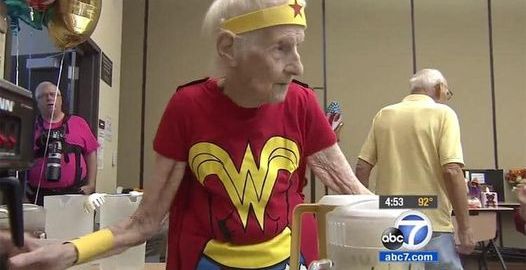
She also found a photo that I immediately saved on my desktop.

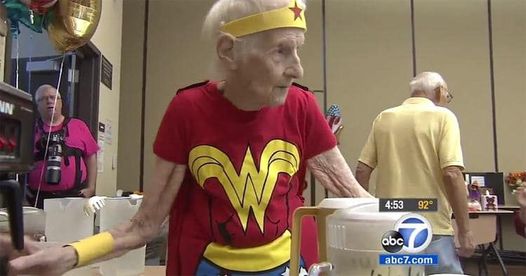
YES to every pixel of this. YESYESYES!! Friends, this Wonder Woman was 103 when this was taken! Read more about her here.

YES to those who have gone before and lived with courage and whole-hearted love and perseverance and compassion for themselves and others and who still, as they adapt to the last season of this life, open their hearts to what is now.

That’s my favorite aspect of the Wonder Women of a certain age in my life: the ability to honor what has been—what worked for them, what didn’t work for them, the truth of their experiences without rose-colored or doom-colored glasses—AND to be present to the now, to value that the world is always changing, and to not hold the women or the world of now to the shape and substance of the past.

When I am in the presence of a woman who can hold her story with respect and grace and love and also make room for others’ unique-yet-connected story…I know I am with a true Wonder Woman. That space is holy. That space is filled with the love that makes all things possible.

We can do both. We can honor what has been and what worked in the past and how hard certain things were that aren’t that kind of hard anymore. And, at the same time, we can honor what is happening now and how what used to work isn’t working anymore and lean into the desire for transformation and adaptation. Living with that kind of versatility is wisdom in motion: willingness to be malleable, responsive to the Spirit, leaning into reflective learning.

Years ago, I served a community with two prominent women leaders, whom we’ll call Polly and Alice. Both had a deep passion for loving God and loving others. Each had her own gifts to bring to the table and contributed greatly to the ministries around them.

They could not have been more different.

Polly wore vibrant clothes, laughed often and loudly, and taught her Sunday School class even after macular degeneration limited her vision. She procured a special machine that enlarged the writing in her quarterly until she could read it and kept right on leading the friends with whom she had walked most of her life.

She once told me she planned to teach until she couldn’t see anymore–and then she might learn braille! I’m pretty sure she was joking about the braille. But with Polly, you never knew—she just might do it.

Alice found her niche in missions. She’d led women gathered in someone’s fancy, seldom used parlor to learn about missionaries serving in places they struggled to locate in a map. They prayed for missionaries and raised funds in all sorts of creative ways, from collecting dimes in tiny cardboard church-shaped boxes (which fascinated me as a child!) to selling baked goods and cookbooks and crafts.

Alice struggled hard when women’s interest in missions began to shift from learning about “foreign” missionaries to doing hands-on missions in their own communities or traveling to participate in missions around the country—and even the globe. On Wednesday nights, more women opted for Bible study rather than the traditional missions study. Their call was to study scripture and live it out by doing missions themselves, making an impact right where they lived.

Alice became deeply frustrated when she could not influence younger women to do missions like their mothers or grandmothers did. She worried that “no one cares about missions anymore!” As we humans often do, she couldn’t quite make the shift to what had already shifted and was never going to shift back. Her grief for what she viewed as “lost”–the old, familiar, defining ways–was so powerful and so painful, that she couldn’t quite see the good that was happening in new, different ways of living missions.

I know now that in a way I didn’t know then that sometimes grief comes out with protective fronts like frustration or judgment, which make the grief hard to hear. Looking back, I realize that sometimes, in both ministry and my own spiritual journey, I have missed the deeper grief as I tried to deal with (or duck) the sharper, protective emotions coming my way. I want to keep becoming more attuned to the grief underneath, to listen for its tones in those protective emotions and know that what I am hearing is pain, fear, loss–grief.

During that season of ministry, I told my husband, “I want to grow up and be Polly.” I still do. Imperfect, colorful, determined to use her gifts as long as she could, finding ways to adapt and giving room for new learning. Polly absolutely would have worn Wonder Woman compression socks.

I want to as well. I also want to keep learning how to lovingly tend to my own grief, listening for my own protective measures– criticism or anger or judgment–and recognizing that they connect to something that hurts. And the first step to healing that hurt is realizing that it exists.

As I keep getting fuller in years, I want more twinkle in my eye, more compassion for myself and others. I want to give more room for others to be, to create space for those who come after to make their own ways of living out their faith—and know that, just like I did “back In the day,” they need support for the hard work of figuring it out in their own setting. When the things I hold dear shift, I pray for the grace to grieve what was so good for me for so long and trust that God is still, as always, doing a new thing, a new good thing.

Both Polly and Alice were Wonder Women in their own ways. They taught me so much. I think maybe Alice just forgot for awhile that her tiara could also be a boomerang—more than one thing can be true at once.

In fact, a whole lot of things can be true at once, including the rich variety of Wonder Women, of every age, size, style, spirit and socks.

Photo from https://myfavoritescrubsllc.com/collections/women-compression-socks

On Fouls and Freedom

Last week, I wrote about becoming the referee in our own lives.

The writing had more of a prophetic voice than the pastoral voice that comes naturally to me. Usually I lean toward reflective, careful, warm, pensive ways of sharing and being with people. Pastoral care (spiritual care) is at the center of ministry for me. 

But in that post, like ancient Israel’s prophets or John the Baptist, my tone was far more clear, direct, and definitive. Declarative. “No one gets to tell you, ‘no harm, no foul.’ You are the ref in your own life. You are the steward of your experience. No one else.” 

I squirmed a bit as I prepared to publish. I heard that clarity and sharpness—not sharp like a knife, but sharp like focusing a picture. The opposite of blurry. But, ummmm, different. 

Is it OK that this sounds different? What if people are confused or put off by the shift in tone?  Should I go back and soften it? 

After some pondering, praying, and processing, I sensed a settledness about publishing it with the original sharp focus. Here’s why: “Pent-up truth-telling tends to come out with some velocity on it.”[1]

Here’s my why:

I’ve worked so hard for so long to even get to a point where I had words about becoming the ref in my own life. So many things about me, from being a white woman raised in suburban Atlanta in the 70’s and 80’s to my particular family story to my birth order to my interior hardwiring to living as an Enneagram 2 to being taught that Jesus only wanted me for a sunbeam (a lesser sunbeam, of course, because girl) for so, so long, plus a dozen other realities, shaped me to be someone who had to work for years to tell the truth about what I experienced, what I felt, what I saw, what I knew to be real in my own personal journal

Journaling became essential for me in middle school. I discovered then that writing helped me figure out what I was thinking, feeling, or experiencing. A true extrovert, verbal processing is how I make sense of things. There were so many voices in my world, right at my ear, always speaking so loudly and with so much authority that I had trouble hearing myself. 

As a teen and young adult, much as I might argue my point of view or stomp off when I wasn’t heard or speak with sureness and even arrogance to say my piece, right under that veneer was a sea of self-doubt, and even more so, self-distrust. Not just, should I have said ?! Or Oh, wow, I didn’t handle that well! or Ugh, I’m so embarrassed. All of which are awkward and hard enough.

But something much deeper was at play. Other people’s points of view and perspectives and versions of the truth took up almost all the space in me and in my world. In a black-and-white/either-or/zero-sum system, there can only be one winner. Other voices dominated. My inner voice got smaller and smaller and smaller. It was only with intense velocity that the deeper truths could come out, which I usually regretted–or was made to regret–immediately. So that inner voice went down even deeper.

I often came across as confident and self-assured. I was neither.

So journaling became a refuge, a place to hear myself. Yet, even in my personal journal, I would often hedge my language, editing myself before the words even made it from pen to page. 

No one else was reading my journals (thank God!). But I didn’t need to experience anyone judging me or making fun of me or telling me that I was “crazy” or “too sensitive or “too angry.” I had internalized all that feedback, all the verbal and non-verbal corrections, all the nebulous codes of “how to be and be seen” to such an extent that I fed back, corrected, and coded myself automatically. 

I didn’t even realize I was doing it for the longest time. I’d just shut my journal with a strange sense of sadness, not realizing I was shutting out myself. It took decades of journaling and growth and hard things I could no longer shut out and a phenomenal support system and oceans and oceans of grace to figure out I had other options. 

First and foremost, I had the option of listening to God. Not the “sunbeams, only” version my fundamentalist upbringing had taught, but the God who loves and sees us all. Who understands us better than we understand ourselves. Who hears us before a word is on our lips or formed in our minds. Who designed us to thrive as we love our neighbor as we love ourselves. Who knows why we get stuck in the unhelpful and often tragic cycles that we do and how to help us get unstuck. Whose grace is always writing new hope in our lives. 

In listening to God, I started learning to listen to myself, to the truths I knew, but didn’t think I was allowed to hear or to say. The Spirit slowly, slowly helped me start to hear myself and tell my truth, even and especially if it was just for me.

Years ago, a mentor suggested I start reading the Psalms closely. There the voices of our ancestors gave me permission to lay it all out, spill the beans, pitch a fit, vomit up a torrent of feelings, dance with praise, sing with abandon, and let God work me through it. 

I write the truth in my journals now. Most of the time!

So the settledness around publishing the post as-is came when I realized I didn’t want to hedge anymore. I didn’t want to press “publish” and feel that same strange sense of sadness. The Spirit has guided, prodded, and dragged me too far toward freedom to start backtracking now.  

“I am the steward of my own experience. No one else.” Yep. And I want to be a faithful steward, valuing my own voice as I also value the voices of others. It’s not a black-and-white/either-or/zero-sum game after all. It never was. 

As it turns out, there are far more truths, more possibilities, more room to be than I had ever imagined. Thanks be to God.     


[1] Carolyn Hax, advice columnist. I’m thinking I need this tattooed in my soul. https://www.washingtonpost.com/advice/2023/09/04/carolyn-hax-dog-back-sister/?utm_campaign=wp_carolyn_hax&utm_medium=email&utm_source=newsletter&wpisrc=nl_hax

[2] Photo from https://thewritelife.com/journaling-writing-techniques/

[3] Carolyn Dube created this amazing journal. I’m really interested in leaning into her playful approach to art since I am a stick-figure-at-best artist, but love to create. https://acolorfuljourney.com/colorfully-scribbled-morning-pages-transform-into-butterflies/

Starting Again

Over the course of 2022, I had not one, not two, but three different physical challenges that sent me to physical therapy. Because each challenge involved a different part of my body, I worked with three different therapists during that time. The gifts and skills of all three therapists, as well as a perfect-for-me therapy assistant, helped me through the toughest year of my life so far.

Because I was there so often that painful year, when I signed in each visit, I had to pause and think hard before filling in who I was seeing that day. Too much change. Too many problems.

But something stayed the same every single visit: the collection of inspirational posters lining the walls of the big treatment area. No matter where I looked, there was some strong man in an outdoorsy photo coupled with a grit-centric saying. “Determination: never stop pushing for what you want” or “Commitment: stay the course no matter what.”

I can’t remember what they actually said because they said nothing to me. At least nothing that my ears could hear as encouragement or blessing. I understood that the intent was to push us toward our treatment goal. I wasn’t confused. I was just exhausted.

I had nothing left in me that could push or stay the course. I felt empty. Worse, I felt trapped.

A long string of loss and struggle and grief had needed my attention for years. But over an eight year period I found myself in a seemingly endless season of unfamiliar shifting circumstances. I couldn’t find my feet in this new terrain. What I thought was solid ground often gave way. Hidden stones jutted just under the surface. I lost count of the times my step landed wrong, jarring me down to my bones.

All of my pastoral skills, all my chaplaincy training, all my theological thinking, all my passion for scripture and prayer and compassion and grace, all the wisdom of a lifetime of mentors, spiritual friendships, study, openness to learning and commitment to working through my stuff…none of it helped me find my way out of that maze of broken ground.

Even so, those things helped me get up and keep walking, over and over again, like PT for the soul. God was at work. I kept going, picking my way over sharp edges, trying to avoid loose stones, concentrating on each footfall, treading diagonally on the steepest declines, growing painfully familiar with falling.

Each rising was harder than the last one. I kept hoping the trail would even out, grow smoother. I just had to keep trying, keep going.

But after too long traveling that way, I was grit-less.

PT helps us find ways to work with or work around some part of us that isn’t working like it should. Contrary to the messages on those posters, what that year of PT did for me was help me come to the end of my grit, courage, and determination to get back up and keep going. That was the only way things were going to change.

In the middle of my work with one PT specialist, I found that things were suddenly getting worse, not better. Troubled and anxious, I perched on the examination table and told her how the past week had gone. I remember her tilting her head, listening closely, and then saying, “You know, sometimes we can work so hard on strengthening that we forget how important it is to soften, to release. So let’s focus on that today.”

Wait, what?!? I had no idea that was available to me. I had no idea that was part of the process.

She took me through a slow series of stretching exercises. We focused on my breathing. We worked on me actively relaxing certain muscles. I’d been strung so tightly for so long, it took intense focus to let myself let go.

Something shifted in me that session. As I moved through the series of stretches, she asked me more about what I do as a pastor. What I told her was what I wanted to do, what I value, what I believe is vital for the body of Christ, what I long to see in us and for us.

“I didn’t go into ministry to give my life to an institution,” I surprised myself by saying out loud. A long, slow, once-trapped breath suddenly poured out of me. She heard me. I heard myself.

Over time, I learned I could stop trying to walk that rock-filled path. I realized it wasn’t the only path. I started to give myself permission over and over to put down my determination, grit, courage, boldness, and whatever else the poster preachers demanded. I really didn’t have much of a choice anyway. Everything in me was so tensed and tied up in trying to be resilient that I was practically paralyzed.

In time, a new path emerged in that wilderness. In time, I’m becoming healed and rested enough to start again. But God knows it’s been a starting again that looks very different from how I have ever done things before. And thank God for that.

So here we are, starting again. Ten years after the publication of our book, A Divine Duet: Ministry and Motherhood, this communal blog, Ministry and Motherhood, is ready to take some new steps after a hiatus. Join us.

Here’s the details:

What and When: 500-1000 word pieces are due on Thursdays. Single spaced, 12 point font. Photos welcome (with credit as needed). Pieces will be lightly edited and formatted for the space. Send to hello@ministryandmotherhood.com.
What to write: Share where you are, what you’re learning, what you’re up against, what you’re thinking about, what you want to say about ministry, motherhood, and anything else the Spirit is stirring in you. This is a space for saying what you want and need to hear yourself say.
Support: Need help zeroing in on a topic or exploring what you want to say? Want to write but feel overwhelmed or a little reluctant? I’ll be delighted to schedule a conversation for support and processing space.
Why write?: Women called to ministry have things to say that our church and our world need to hear. Women have always been part of the story. If we don’t tell our own stories and frame our own reflections and insights, they tend to get lost in all that’s overflowing off our already full plates. • Purpose: To mutually create a space where we can tell the truths we see, the ones we feel burning in our bones like Jeremiah (20:9).

Contact hello@ministryandmotherhood.com to learn more and sign up for a week that best fits your life and schedule.

In the meantime, blessings for all who are starting again in big and small ways. May we know in heart, mind, and body that God is with us…as God always is.